Review Atlas
Review AtlasYour guide to a better purchase

Menu

Shop by Category

Get the App

Better experience on mobile

Is Which NAS Drives should I buy Worth It? Honest Review (2026)

Compare the best NAS Drives for Plex in 2026 and find the perfect match for your media needs and budget.

NAS DrivesPlex servermedia enthusiasts$300-$800
If you're trying to build a Plex server, you've probably drowned in spec sheets, Reddit threads, and YouTube reviews. Every NAS brand claims to be 'the best for Plex,' and prices range from budget-friendly to 'that's a down payment on a used car.' The truth is there's no single perfect NAS — only the right one for your library size, number of users, and comfort with technology. This guide cuts through the noise. We researched current NAS drives between $300 and $800, compared their hardware, software, and real-world Plex performance, and looked at verified customer feedback to rank the best options. You'll learn what actually matters for Plex, from transcoding power to bay count, and get clear recommendations for different scenarios. Whether you're a first-time buyer who just wants to stream movies to a couple of TVs, or a media enthusiast with a 50TB library and friends sharing your server, this guide will point you to the right picks. No fluff, no brand bias — just practical advice to make your buying decision easier.

Our Top Pick

Synology DS224+

Best Overall

Beginners and small families who want an easy, reliable Plex server for 1080p and light 4K streaming.

View on Amazon →

Key Factors to Consider

  • 1.Plex transcoding power: Look for an Intel CPU with Quick Sync (e.g., Celeron N5105, J4125, N95) if you need hardware transcoding without a separate Plex Pass? Actually Plex Pass is needed for hardware transcoding, but the NAS must support it.
  • 2.Number of drive bays: 2 bays are fine for casual users, but 4 bays give you flexible RAID options and room to grow without discarding old drives.
  • 3.RAM capacity: Plex can run with 2GB, but 4GB+ is smoother for simultaneous streams and database metadata. Check if RAM is upgradeable.
  • 4.Network speed: 1GbE is still common, but 2.5GbE is becoming standard for sharing large 4K files. It also helps with direct play over Wi-Fi.
  • 5.Ease of use: For beginners, Synology's DSM is the gold standard. QNAP and Asustor are more complex, while TerraMaster and UGREEN have improved but still lag.
  • 6.App ecosystem and Plex integration: Make sure the NAS has an official Plex package, and consider how often the OS receives updates.
  • 7.Future-proofing: M.2 NVMe slots, PCIe expansion, and USB ports can extend the life of the NAS. Decide if you'll need them later.
  • 8.Budget: Set a realistic budget for the NAS only — remember drives will often cost more than the unit itself. A $300 NAS with $200 drives is still a $500 investment.

The Products

#1

Synology DS224+

Best Overall
Synology DS224+
Overall
9/10
Value
8.6/10
Performance
7.8/10
The Synology DS224+ is a 2-bay NAS built around a quad-core Intel Celeron J4125 and 2GB of RAM. It's one of the most popular choices for Plex because Synology's DiskStation Manager (DSM) is so intuitive, and the J4125 has Quick Sync support for hardware transcoding. You can stream 1080p easily and even handle a few 4K streams on Plex Pass with tone mapping. With two bays, you can run drives in RAID 1 for automated backup, or just keep them independent for maximum capacity. It also has two 1GbE ports that can be paired for link aggregation. The DS224+ is not the most powerful NAS in this guide, but it's the most approachable — set up takes minutes, and DSM has dozens of apps beyond Plex, like Synology Photos and Drive. For a media enthusiast who values reliability and simplicity, the DS224+ is a fantastic foundation. It's a 'set it and forget it' kind of NAS that will happily run Plex for years.

Pros

  • User-friendly DSM 7 interface—best for beginners
  • Intel Celeron J4125 with Quick Sync for Plex transcoding
  • Compact, quiet, and energy-efficient
  • Reliable package ecosystem with first-party apps
  • Expandable RAM up to 6GB (upgradeable, though not officially beyond 6GB)

Cons

  • Only 2 bays—limited capacity expansion
  • No 2.5GbE, only 1GbE
  • RAM is partially soldered, max 6GB
  • Not suited for heavy 4K/HEVC transcoding with many users

Best For:

Beginners and small families who want an easy, reliable Plex server for 1080p and light 4K streaming.

Not Recommended For:

Power users with huge libraries or many concurrent 4K transcodes.

Key Features:

2-bay design (up to 32TB total)Intel Celeron J4125 quad-core CPU2GB RAM, expandable to 6GBTwo 1GbE portsHardware transcoding with Plex PassDSM 7 with extensive app store3-year warranty

Standout Feature:

DSM is the most polished NAS OS you can buy—it makes the whole ownership experience painless.

VS Others:

You're choosing between easy and powerful. The DS224+ is the easiest to live with, but QNAP TS-464 offers twice the bays, faster CPU, and 2.5GbE. If you're a tinkerer, go QNAP; if you want everything to just work, get Synology.

Why This One:

For most buyers, the DS224+ is the safest recommendation. It's not the fastest, but it doesn't need to be—Plex runs flawlessly, the software is a pleasure to use, and you'll spend more time watching movies than troubleshooting. It's the best balanced choice for a 2-bay Plex server.

#2

QNAP TS-464

Best for 4K Plex Transcoding
QNAP TS-464
Overall
9.2/10
Value
8.2/10
Performance
9.5/10
The QNAP TS-464 is a 4-bay NAS with an Intel Celeron N5095 processor, 4GB RAM, and dual 2.5Gigabit Ethernet. This is a serious Plex machine—the faster CPU and Quick Sync GPU can handle 4K hardware transcoding with ease, including H.265 10-bit and tone mapping. It also has two M.2 NVMe slots and a PCIe Gen 3 x2 slot for adding a 10GbE card, more M.2 storage, or a USB 3.2 expansion card. QTS 5.1 (now QTS 6 for some models) offers a ton of features like snapshot backups, virtualization, and a full app center. The TS-464 even includes an HDMI 2.0 port, so you can plug it directly into a TV and use it as a media player or run Ubuntu or other OSes in virtualization. If you're a true media enthusiast with a growing 4K library and multiple users sharing your Plex server, the TS-464 is one of the best sub-$800 choices available. It's a step up from budget 2-bay NAS units in every meaningful way.

Pros

  • 4 bays for flexible storage capacity
  • Intel Celeron N5095 with UHD Graphics—excellent 4K transcoding
  • Dual 2.5GbE ports for fast file transfers
  • M.2 NVMe slots and PCIe expansion for upgrades
  • HDMI output for direct TV connection
  • QTS provides advanced features like virtualization

Cons

  • Price is higher than other 4-bay options
  • QTS interface is steeper learning curve than DSM
  • No 10GbE out of the box—need to buy a card
  • Some users report fan noise under load

Best For:

Serious Plex users with large 4K libraries and multiple concurrent streams who want room to expand.

Not Recommended For:

Budget buyers or those who prefer a simple, low-maintenance system.

Key Features:

4-bay tower, supports up to 4x 20TB drivesIntel Celeron N5095 quad-core 2.0GHz4GB DDR4 RAM, expandable to 16GB2x 2.5GbE, 1x HDMI 2.02x M.2 PCIe NVMe slots1x PCIe Gen 3 x2 slotPlex hardware transcoding with Plex Pass

Standout Feature:

The PCIe expansion slot and dual 2.5GbE give you a future-proof path to 10GbE and more heavy-duty Plex workloads.

VS Others:

The TS-464 is the best Plex performer here for 4K transcoding. It's worth the extra $200 over the TerraMaster F4-424 if you need the reliability and app ecosystem of QNAP, but the F4-424 gives you 80% of the performance for 60% of the price.

Why This One:

If you're serious about Plex and want a NAS that can handle anything you throw at it—without jumping to over-$1000 10GbE monsters—the TS-464 is your sweet spot. The Intel N5095 is a proven transcoder, and the 4-bay design gives you the capacity flexibility media enthusiasts need.

#3

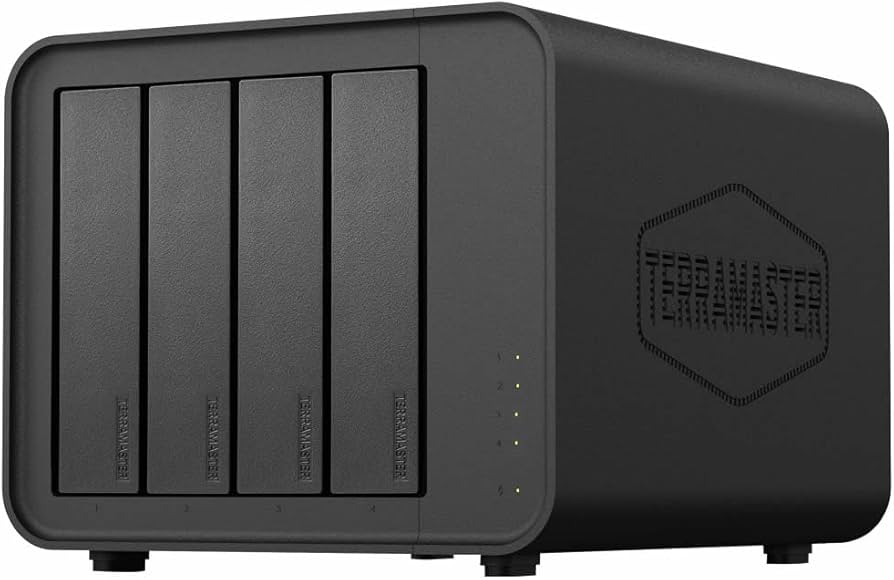
TerraMaster F4-424

Best Value
TerraMaster F4-424
Overall
8.5/10
Value
9.2/10
Performance
8.7/10
The TerraMaster F4-424 is a 4-bay NAS that packs an Intel N95 quad-core processor (Alder Lake-N), 4GB DDR5 RAM, and dual 2.5GbE ports for around $480. It's an impressive price-to-performance ratio, especially for Plex uses. The N95 with Intel UHD Graphics supports 4K hardware transcoding, and the two M.2 NVMe slots allow for cache or additional storage. You also get a USB 3.2 Gen 2 port and two USB 2.0 ports. TerraMaster's TOS 6 operating system is still a work in progress, but it's become more stable. Plex runs directly, and you can also use Docker, which opens up a world of apps. The hardware is clearly where TerraMaster invests most of its effort, and for tinkerers, this is a bargain. If you need four bays and don't want to spend over $600, the F4-424 is the best value NAS in this guide. Just be prepared to spend a little more time setting it up and learning TOS.

Pros

  • 4 bays for only ~$480
  • Intel N95 with Quick Sync—great 4K transcode performance
  • Dual 2.5GbE port
  • Two M.2 NVMe slots for cache or storage
  • DDR5 RAM included (upgradeable to 32GB)
  • Good Docker support

Cons

  • TOS OS is less polished and has a learning curve
  • Fewer first-party apps compared to Synology/QNAP
  • Customer support is not as responsive
  • Drive trays and build quality feel cheaper than rivals

Best For:

Budget-conscious users who want 4 bays and strong Plex transcoding without paying a premium for the brand name.

Not Recommended For:

Total beginners who want an effortless setup or people who rely on advanced QTS/DSM apps.

Key Features:

4-bay tower designIntel N95 (4 cores, Alder Lake-N, 3.4GHz boost)4GB DDR5 RAM (2x SO-DIMM slots, max 32GB)2x 2.5GbE ports2x M.2 PCIe Gen3 x2 NVMe slotsUSB 3.2 Gen2 and USB 2.0Plex hardware transcoding with Plex Pass

Standout Feature:

Hardware transcode capability for 4K plus 4 bays at under $500—unbeatable value.

VS Others:

The F4-424 is the no-brainer value pick. It has the same 4-bay design as the QNAP TS-464 and even a newer CPU (N95 vs N5095), but it's $200 cheaper. The catch is the software: QNAP's QTS is more mature than TerraMaster's TOS. If you're willing to tinker, go TerraMaster; if you want a smoother experience, pay for QNAP.

Why This One:

For the money, you're getting 80% of the QNAP TS-464's performance at 60% of the price. It's perfect for media enthusiasts on a budget who don't mind a little DIY spirit.

#4

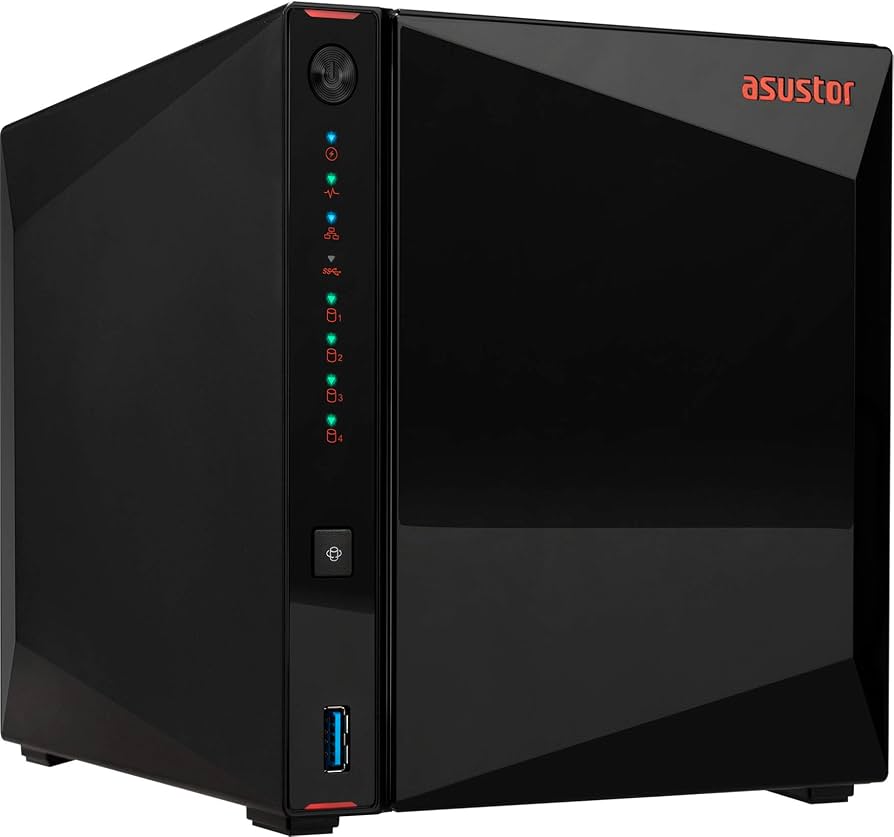
Asustor Lockerstor 4 AS5304T

Asustor Lockerstor 4 AS5304T
Overall
8/10
Value
8.4/10
Performance
7.5/10
Asustor's Lockerstor 4 (AS5304T) is a 4-bay NAS with an Intel Celeron J4125, 4GB RAM, and dual 2.5GbE. It's often overlooked but offers a nice balance of four bays, fast network, and Plex-compatible hardware transcoding. The included ADM OS is user-friendly, and the NAS has an HDMI port for direct playback. The AS5304T stands out for its dual 2.5GbE ports at $450 while still providing a mature operating system. It also has two M.2 slots but note that these are M.2 PCIe Gen 3 x2? Actually they are M.2 NVMe for cache (two slots). It's a solid mid-range choice for someone who wants 4 bays and 2.5GbE without spending $700. Asustor's support is not as extensive as Synology, but the community is active and ADM is feature-rich. If you're willing to give a smaller brand a chance, you can save a lot of money for a well-equipped Plex server.

Pros

  • 4 bays and 2.5GbE at a moderate price
  • Intel J4125 with Quick Sync for Plex transcoding
  • HDMI 1.4 output
  • 4GB RAM (upgradeable to 8GB)
  • Two M.2 NVMe slots for caching

Cons

  • Fewer software updates than Synology/QNAP
  • Community and third-party app support smaller
  • CPU (J4125) is slower than N5095/N95
  • No PCIe expansion slot

Best For:

People who want 4 bays and 2.5GbE without paying QNAP or Synology premium prices, and don't mind a smaller brand.

Not Recommended For:

Users who demand a huge app ecosystem or frequent software updates.

Key Features:

4-bay towerIntel Celeron J4125 quad-core 2.0GHz4GB DDR4 RAM (max 8GB)2x 2.5GbE ports2x M.2 PCIe NVMe slotsHDMI 1.4 outputPlex hardware transcoding (with Plex Pass)

Standout Feature:

The AS5304T gives you 4 bays and 2.5GbE at the same price as most 2-bay Synology units.

VS Others:

Between this and the TerraMaster F4-424, the F4-424 is faster and cheaper, but Asustor's ADM is more polished than TOS. If you value a stable software experience and can tolerate a slightly slower CPU, the AS5304T is worth a look.

Why This One:

It's a great middle ground for the budget-conscious who want more than two bays but are willing to trade raw performance for a smooth software experience.

#5

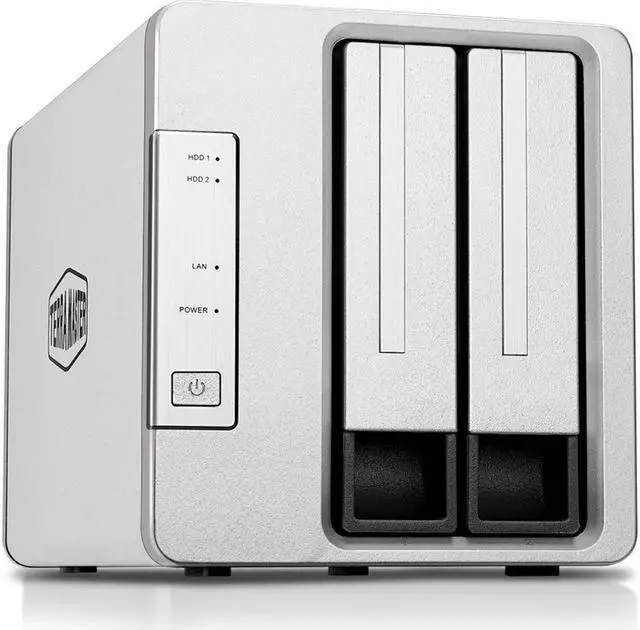
TerraMaster F2-423

Best Budget
TerraMaster F2-423
Overall
8.2/10
Value
9/10
Performance
7.8/10
The TerraMaster F2-423 is a 2-bay NAS with a surprisingly capable Intel Celeron N5105 processor, 4GB RAM, and dual 2.5GbE ports. It's the cheapest NAS in this guide, but it's far from weak. The N5105 supports Quick Sync, so Plex hardware transcoding of 4K streams is possible. The dual 2.5GbE is rare at this price and makes file transfers snappy. Being a 2-bay unit, your storage ceiling is limited to two drives, but that's fine for many Plex users who just want to store a few terabytes of media. It also has two M.2 NVMe slots for cache, which is a nice bonus. The included 4GB RAM (max 32GB) gives you plenty of headroom. TOS 6 is better than before, but again, the OS isn't as refined as DSM. However, at $300, you're getting a Plex-capable 2.5GbE NAS that costs $100 less than the Synology DS224+. It's a steal for tinkerers.

Pros

  • Lowest price for a Plex-capable 2.5GbE NAS
  • Intel N5105 with Quick Sync—excellent transcode for the price
  • 4GB RAM included, expandable to 32GB
  • Two 2.5GbE ports
  • Two M.2 NVMe slots for caching
  • Strong Docker support for extra apps

Cons

  • Only 2 drive bays
  • TOS OS is not as intuitive for total beginners
  • No HDMI output
  • Customer support is limited
  • Build quality is basic plastic

Best For:

First-timers on a tight budget who know they want Plex and don't mind a little setup learning curve.

Not Recommended For:

Users with more than ~20TB of media or those who want an absolutely seamless 'it just works' experience.

Key Features:

2-bay NASIntel Celeron N5105 (4 cores, 2.0-2.9GHz)4GB DDR4 RAM (max 32GB)2x 2.5GbE2x M.2 PCIe Gen3 x2 NVMeUSB 3.2 Gen1 portsPlex hardware transcoding with Plex Pass

Standout Feature:

You get 2.5GbE and a Quick Sync CPU for under $300—the best budget Plex platform available.

VS Others:

The F2-423 is the clear budget pick. It costs $130 less than the Synology DS224+ and even gives you 2.5GbE, whereas Synology only has 1GbE. The biggest compromise is the operating system—TOS still trails DSM in user-friendliness.

Why This One:

If money is tight and you want a NAS that can run Plex without breaking a sweat, the F2-423 is the best entry point in this guide.

#6

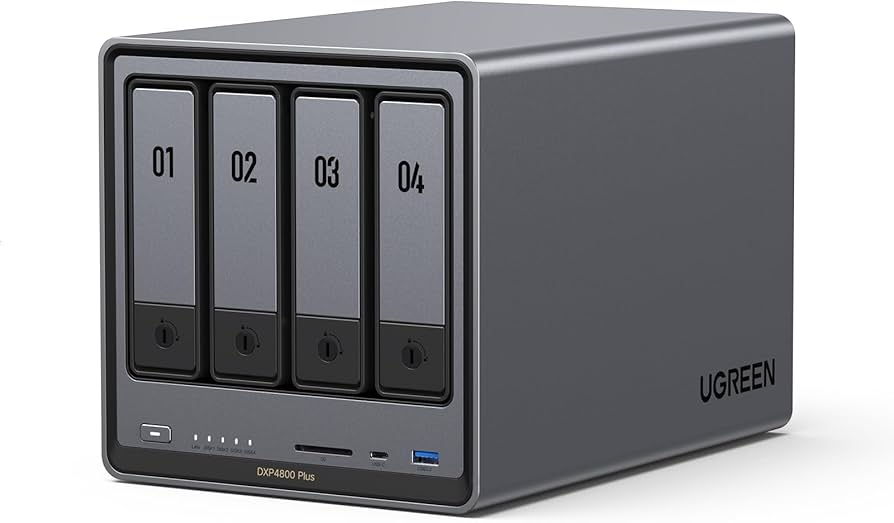
UGREEN NASync DXP4800

Best Future-Proof
UGREEN NASync DXP4800
Overall
8.3/10
Value
7.6/10
Performance
8.8/10
The UGREEN NASync DXP4800 is a brand-new player in the NAS game, and it's turning heads. This 4-bay NAS runs on an Intel N100 (Alder Lake-N) with 8GB of DDR5 RAM and dual 2.5GbE. It also includes two M.2 NVMe slots, a PCIe Gen 3 x2 slot for expansion (for a 10GbE card or extra M.2), and a USB-C 3.2 Gen 2 port. UGOS Pro, the OS, is surprisingly refined for a first-generation product, though it still has fewer apps than the incumbents. For Plex, the N100 is a step above the N5095 and N95—it offers even better Quick Sync transcoding and lower power consumption. The 8GB RAM and DDR5 support make multitasking smooth. The DXP4800 is aimed at tech enthusiasts who want modern hardware and a future-proof platform. It's a gamble because UGREEN doesn't have the long track record of Synology or QNAP, but the hardware is undeniably appealing. If you like being on the bleeding edge, this is your pick.

Pros

  • Intel N100 (5nm, efficient, strong Quick Sync)
  • 8GB DDR5 RAM standard (max 32GB)
  • Dual 2.5GbE ports
  • PCIe Gen 3 x2 expansion slot
  • Two M.2 NVMe slots
  • USB-C 3.2 Gen 2 connectivity
  • Modern, sleek design

Cons

  • New brand with unproven long-term support
  • UGOS Pro app ecosystem is still maturing
  • No HDMI output
  • Pricing is close to QNAP TS-464, which has a more mature OS

Best For:

Tech enthusiasts who love new, open-hardware designs and want the latest CPU for Plex transcoding.

Not Recommended For:

Conservative buyers who want a battle-tested company and an ecosystem with years of community support.

Key Features:

4-bay NAS (max 24TB per drive)Intel N100 quad-core (up to 3.4GHz)8GB DDR5 RAM (max 32GB)2x 2.5GbE2x M.2 NVMe slots1x PCIe Gen 3 x2 slotUSB-C 3.2 Gen2, USB-A 3.2UGOS Pro with Docker support

Standout Feature:

The N100 processor plus PCIe expansion gives you a cutting-edge Plex server that's ready for 10GbE upgrades.

VS Others:

The DXP4800 and QNAP TS-464 are close competitors. UGREEN offers a newer CPU and more RAM for the price, but QNAP has a more mature OS and a longer track record. If you're a Linux-loving tinkerer, UGREEN may be the better canvas; if you want it to work out of the box, QNAP wins.

Why This One:

You're buying the future. For the same price as a mid-tier QNAP, you get a more advanced processor, more RAM, and PCIe expansion. If you're not afraid of an evolving ecosystem, the DXP4800 is an exciting Plex machine.

Who Should Get What?

First-Time Streamer

Alex has a collection of DVDs and digital movies, wants to stream them to the living room and bedroom. Not into tech, just wants everything to work with minimal fiddling. Budget around $400.

Budget:$300-$400
Use:Casual Plex streaming to 1-2 TVs and phones

Recommended:

Synology DS224+

The DS224+ is the easiest NAS to set up thanks to DSM. Alex will be up and running in under an hour, and the hardware is more than enough for 1080p and light 4K. The peace of mind is worth the extra money over the TerraMaster F2-423.

View on Amazon →

4K Media Enthusiast

Priya has a 30TB 4K remux library and shares her Plex server with 5 family members. She needs smooth transcoding to lower bitrates for remote streams and wants room to expand to 60TB.

Budget:$700-$800
Use:Heavy 4K Plex transcoding with multiple concurrent users

Recommended:

QNAP TS-464

The TS-464's N5095 CPU with Quick Sync can handle multiple 4K transcodes, and the 4 bays let Priya start with 2 large drives and add more later. The dual 2.5GbE ports ensure fast streaming on the local network, and the PCIe slot gives future 10GbE options.

View on Amazon →

Budget-Conscious Media Hoarder

Mike stores tons of movies and shows, has a library approaching 20TB, and wants a 4-bay NAS for future expansion. He's comfortable using Docker and doesn't mind an OS that's not perfect as long as Plex runs well and it's cheap.

Budget:$400-$500
Use:Large library storage plus Plex streaming to a few users

Recommended:

TerraMaster F4-424

The F4-424 is the best 4-bay value under $500. It has a strong Intel N95 CPU and 2.5GbE, and Mike can use the M.2 slots for caching or metadata. The software is less polished, but Mike is willing to tinker, and the savings can be put toward more drives.

View on Amazon →

Tech Enthusiast Who Wants the Latest

Jamie is an early adopter, loves unboxing new hardware, and wants a Plex server that's future-proof. They have a growing 4K library and plan to experiment with Docker, VMs, and possibly a 10GbE network next year.

Budget:$600-$800
Use:Plex server plus self-hosting apps and future 10GbE expansion

Recommended:

UGREEN NASync DXP4800

The DXP4800 has the latest Intel N100, 8GB of DDR5, and a PCIe expansion slot—all for $600. Jamie can add a 10GbE card later and push the NAS to the limit. The software is still evolving, but Jamie enjoys being on the bleeding edge.

View on Amazon →

Family Sharing on a Budget

The Nguyen family wants a NAS to store home videos, movies, and photos, and to stream Plex to three TVs. They need 4 bays for expansion but want to stay under $500 and prefer a simple UI.

Budget:$400-$500
Use:Home media server with 4 bays for family storage

Recommended:

Asustor Lockerstor 4 AS5304T

At $450, this NAS offers 4 bays and dual 2.5GbE while keeping the ADM interface manageable for the whole family. It's a strong middle-ground option with more bays than the Synology DS224+, and the 2.5GbE is great for moving video files around the house.

View on Amazon →

Buying Guide: How to Choose

Start by deciding how many drives you really need. A 2-bay NAS (like the Synology DS224+ or TerraMaster F2-423) is enough for most households with 10-30TB of media. If you rip 4K Blu-rays or have more than 20TB in your Plex library, a 4-bay NAS gives you room to grow without replacing all drives at once. Remember that drives are the real cost: a 4-bay NAS with 4x 8TB drives can cost as much as the NAS itself. Next, focus on the CPU and transcoding. Plex hardware transcoding requires an Intel CPU with Quick Sync (all the units in this guide except maybe some budget ARM models have it). The newer the CPU, the better your 4K tone-mapping and multi-stream performance. For a typical family, a Celeron J4125 or N5105 is fine. For serious sharing, go with N5095, N95, or N100. Don't pay extra for a CPU you don't need, but also don't underpower your server if you plan to stream remotely. Network speed is often overlooked. 1GbE is okay for direct streaming of 4K Blu-ray remuxes, but 2.5GbE makes file transfers and backups much quicker, especially if you're moving media from your computer to the NAS. The units with 2.5GbE (TerraMaster, Asustor, QNAP, UGREEN) will feel snappier in daily use. If your switch and computers only support 1GbE, don't worry—the NAS will work perfectly, just a bit slower. Finally, decide how much you value software. Synology's DSM is the easiest and most robust; QNAP's QTS is powerful but harder to learn; Asustor's ADM is a nice middle ground; TerraMaster's TOS and UGREEN's UGOS are still catching up. If you want a 'set it and forget it' experience, buy a Synology. If you're a tinkerer and want the best hardware for the money, you can save a lot with TerraMaster or UGREEN. Common mistakes include buying too few bays, ignoring the need for Plex Pass (for hardware transcoding), and forgetting that the NAS needs to be on a reliable network. Ask yourself: how many users will stream at once? How big is your library? Are you comfortable with a learning curve? Your answer will guide you to the best pick.

Bottom Line

For most people, the Synology DS224+ is the smartest choice. It's not the most powerful or the cheapest, but it offers the smoothest user experience, reliable Plex transcoding, and enough storage capacity for a typical media library. If you have a massive 4K collection and need serious transcoding power, the QNAP TS-464 is worth the upgrade—it gives you 4 bays, a faster CPU, and 2.5GbE, all under $800. On a tighter budget, the TerraMaster F4-424 steals the show with 4-drive support and strong performance at under $500. If you can live with just two bays, TerraMaster's F2-423 is a steal at $300, especially with 2.5GbE. As for Asustor and UGREEN, they're solid alternatives for specific audiences: Asustor for a balanced 4-bay with 2.5GbE, and UGREEN for tech enthusiasts who want the newest hardware. No matter which you choose, pair your NAS with reliable NAS-rated drives like Seagate IronWolf or WD Red Plus. That's the real key to a long-lasting Plex server. Use this guide to match your needs to the right slot, and you'll be streaming your collection in no time.

Frequently Asked Questions

Which NAS is best for Plex in 2026?
For 2026, the Synology DS224+ remains the overall best for most users due to its ease of use, reliable DSM, and good-enough Plex performance. However, if you need heavy 4K transcoding and multiple streams, the QNAP TS-464 is the best powerhouse under $800. For budget buyers, the TerraMaster F4-424 offers incredible 4K Plex value.
Do I need a 4-bay NAS for Plex?
Not necessarily. A 2-bay NAS can hold plenty of media for a home library, especially if you use large 12-16TB drives. A 4-bay NAS is beneficial if you have over 20TB of media or want to use RAID 5/6 for a balance of capacity and fault tolerance without wasting a full bay as a parity drive. It also makes scaling easier.
Can Plex play 4K without transcoding?
Yes. If your network and playback devices support the original file format and bitrate, Plex will direct-play the 4K file, which requires no CPU power from the NAS. Transcoding only happens when a device can't play the format natively, or when remote streaming requires a lower bitrate. In that case, a CPU with Quick Sync is essential.
What is the biggest difference between Synology and QNAP?
Synology's DSM is generally viewed as more user-friendly and stable, with a cleaner interface and better mobile apps. QNAP's QTS offers more advanced features like virtualization, a wider range of ports, and usually faster hardware for the price. For Plex, both work perfectly, but Synology tends to be easier for beginners, while QNAP appeals to power users.
Is TerraMaster reliable enough for a Plex server?
TerraMaster hardware is excellent for the price, and many users run Plex on it successfully. The main drawback is the TOS software, which is less polished and has had some security issues in the past. That said, recent versions are much better, and for a hobbyist who'll use Docker and doesn't need hand-holding, TerraMaster is a great value. Just be aware of the trade-off.
Should I buy a NAS or just build a PC with Unraid/TrueNAS?
That's a deeper question. A custom PC gives you unlimited flexibility, better performance per dollar, and easy upgradability, but it takes time to build, configure, and maintain. A commercial NAS is plug-and-play, uses less power, and is more compact. For most non-technical users, the convenience and reliability of a NAS (like Synology or QNAP) is worth the extra cost. For enthusiasts, a PC can be more fun and powerful.
How much RAM do I need for Plex on a NAS?
Plex itself only needs 1-2GB for basic operation, but 4GB is recommended for smooth metadata fetching, multiple concurrent streams, and running Docker containers alongside. More RAM helps with caching and future-proofing. The NAS models in this guide range from 2GB (Synology) to 8GB (UGREEN), and most are upgradeable. If you plan to use Docker, go with at least 4GB.
What is hardware transcoding and why do I need it?
Hardware transcoding uses the CPU's built-in GPU (Intel Quick Sync) to convert video formats on the fly. It is much faster and more power-efficient than software transcoding. It's important for Plex if you stream to devices that don't support HEVC or if you need to lower bitrates on remote connections. It requires Plex Pass to enable, so factor that into your budget.
Can I add more drives to a 2-bay NAS later?
You can replace the drives and expand capacity, but you can't add more bays. With a 2-bay NAS, your maximum capacity is limited by the largest available drives (currently 16-24TB). If you think your library will grow significantly, a 4-bay NAS is a safer long-term investment.
Which NAS is best for a small household sharing Plex with family?
For a household of 3-5 people who mostly stream on smart TVs and phones on the same Wi-Fi, the Synology DS224+ is perfectly adequate. It handles 1080p and light 4K transcoding, supports up to 2-3 concurrent streams, and is easy to manage. If you expect many 4K transcodes simultaneously, you'll want a QNAP TS-464 or a similarly powerful 4-bay unit.
Is it worth spending more for 2.5GbE networking?
If your router, switch, and computers support 2.5GbE, it's definitely worth it — file transfers, backups, and high-bitrate media streaming become noticeably snappier. If your network is still all 1GbE, 2.5GbE is future-proofing but not a priority. All the TerraMasters, Asustor, QNAP, and UGREEN in this guide have 2.5GbE, while the Synology DS224+ only has 1GbE.
What's a good RAID setup for Plex?
For Plex, many enthusiasts use JBOD or RAID 1 (mirror) for simplicity. RAID 5 (on 4-bay NAS) gives 3 drives' worth of storage and survives a single drive failure. If you're not doing high-availability work, Synology's SHR or TerraMaster's TRAID is a good choice—it makes drive sizing easier. Just remember RAID is not a backup; it protects against drive failure, not accidental deletion or ransomware.

Need More Help Deciding?

Explore more buying guides to find the perfect product for your needs.

View All Buying Guides

Related Articles