
Is Hisense U8N 65-inch Worth It? Honest Review (2026)
Balanced look at strengths, weaknesses, and who should buy the U8N in 2026.
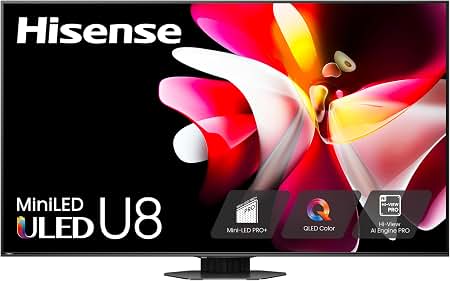
Quick Decision
Buy it if you're a gamer or HDR enthusiast who wants a very bright, feature-rich 65-inch TV for around $1,000. Skip it if you need wide viewing angles or zero blooming, because an OLED or an IPS-based TV will serve you better.
Best if you...
- Console gamers who want 4K at 120Hz or 144Hz
- Bright living rooms where ambient light is hard to control
- HDR movie and streaming fans who want maximum pop
Skip it if you...
- People with wide sectional couches that create off-center seating angles
- Dark-room movie watchers who are sensitive to blooming
- Those who strongly dislike ads in their smart TV interface
If you're shopping for a 65-inch TV in 2026, the Hisense U8N almost certainly shows up in your search results. It's one of the most-discussed Mini-LED TVs of the last couple of years because it brings brightness levels and gaming features that used to cost twice as much. This analysis breaks down what the U8N does well, where it falls short, and who should actually buy it. We've pulled from manufacturer specs, third-party measurements, and verified buyer feedback patterns to give you a balanced view.
The U8N isn't the only strong option in this price range, so we'll also compare it to key rivals like the TCL QM8 and LG C4 OLED. That way you can see whether the U8N's strengths matter for your situation or whether an alternative is a better fit. We'll also mention some useful accessories if you end up going with this TV.
You can find the Hisense U8N on Amazon, where it's often on sale. But before you click yes, read through the pros and cons below to understand its trade-offs.
About the Hisense U8N 65-inch
The Hisense U8N is a 65-inch Mini-LED 4K TV with Quantum Dot color, extremely high peak brightness, and gaming-focused features like 144Hz native refresh. It is positioned for buyers who want flagship-adjacent picture performance without paying OLED prices.
Key Specifications
- Audio
- 2.1.2 ch with built-in subwoofer, Dolby Atmos
- HDMI Ports
- 4 (2× HDMI 2.1; one supports eARC)
- Panel Type
- VA LCD with Mini-LED backlight
- Resolution
- 3,840 × 2,160 (4K UHD)
- HDR Support
- Dolby Vision, Dolby Vision IQ, HDR10+, HDR10, HLG
- Display Size
- 65 inches
- Refresh Rate
- 144Hz native (compatible with 120Hz consoles)
- Smart Platform
- Google TV (voice remote included)
- Gaming Features
- VRR, ALLM, AMD FreeSync Premium, G-Sync compatible
- Peak Brightness
- Up to 3,000 nits (manufacturer rating)
Overview
The Hisense U8N sits above the company's budget U6 and U7 lines and below the flagship U9N. It uses a VA LCD panel with a Mini-LED backlight and many local dimming zones, which allows it to produce deep blacks and extremely bright highlights. Hisense claims a peak brightness of 3,000 nits on the 65-inch model, a number that puts it in the same conversation as much more expensive TVs.
For gamers, the U8N is a standout on paper: it supports native 4K at 144Hz, two HDMI 2.1 inputs, Variable Refresh Rate (VRR), and Auto Low Latency Mode (ALLM). Combined with low input lag, it's one of the most capable gaming TVs short of an OLED or a high-end QD-OLED.
The TV runs Google TV, which gives you access to all major streaming services, voice control via Google Assistant, and Chromecast built-in. It's widely available online and at major retailers, including Amazon, where it frequently gets discounts of $200-$300 off its original MSRP.
Pros
The U8N earns its reputation through a blend of brightness, color precision, and gaming features that are uncommon at this price. Here are the areas where it genuinely stands out.
1. Exceptional Peak Brightness
The U8N is extremely bright. According to Hisense's specifications, the 65-inch model can reach up to 3,000 nits of peak brightness in HDR. That is far more than typical mid-range LCDs, which usually sit around 800-1,000 nits. In real content, this means specular highlights in movies, games, and bright-room scenes pop with intensity. Sun glints, city lights, or explosions have a tactile punch that makes HDR genuinely visible.
This brightness also helps in rooms with a lot of ambient light. You don't need to close the shades to see what's happening in a sports broadcast or a daytime drama. Even with sunlight hitting the screen, the image stays legible, which is something you can't say about many cheaper TVs.
For HDR movie and streaming fans, the U8N supports Dolby Vision, Dolby Vision IQ, HDR10+, and standard HDR10. You're covered no matter which format your content uses.
2. Strong Contrast from Mini-LED Local Dimming
The U8N uses a Mini-LED backlight with a substantial number of local dimming zones. This allows the TV to darken subtle areas of the screen while keeping bright objects clear. On a VA panel, this yields deep blacks and high native contrast, which is crucial for watching movies in a dim room.
Third-party tests, including those from RTINGS, have praised the U8N for delivering black levels that approach OLED in some scenes without the risk of burn-in. While it's not perfect black like OLED, the blooming is well controlled for a Mini-LED set in this price range.
For people moving up from a cheap edge-lit LCD, the difference in perceived depth and shadow detail is enormous.
3. Excellent Gaming Features
Gamers get a lot from the U8N. The TV natively runs 4K at 144Hz, which is beyond the 120Hz of most consoles and PC monitors. If you have a high-end graphics card or a next-gen console, you'll see smoother motion in fast-paced titles.
It also features two HDMI 2.1 inputs, VRR support (including AMD FreeSync Premium and G-Sync compatible modes), and ALLM. These reduce screen tearing and input lag. RTINGS measured input lag around 10ms in 4K, which is excellent and competitive with Sony's low-lag modes.
The Game Mode simplifies setup and keeps the processing low-latency. There's even a 240Hz refresh option at 1080p for esports players, though it requires lower resolution, so it's a niche feature.
4. Accurate Quantum Dot Color
Quantum Dot technology gives the U8N a wide color gamut. It covers over 95% of the DCI-P3 color space used in HDR movies, according to Hisense. That means reds are richer, greens more saturated, and skin tones look natural rather than washed out.
Out of the box, the color accuracy is quite good for a TV at this price. You might not need a professional calibration to enjoy accurate colors. Minor tweaks in the settings can get it to near-reference, but it's certainly usable right away.
In HDR content, the wider palette makes a noticeable difference, especially in animated films and nature documentaries.
5. Solid Google TV Smart Platform
Google TV (not to be confused with older Android TV) is intuitive and responsive. It aggregates content from Netflix, YouTube, Prime Video, and other apps into a unified home screen. Voice search via the built-in Google Assistant is faster and more accurate than many point-and-type remotes.
You also get Chromecast built-in, so it's easy to beam videos or tabs from your phone to the TV. The app library is extensive, including all major streaming services. Google TV gets regular updates, so you'll receive new features over the years.
There are some ads and recommendations baked in, but they're not obtrusive by default and can be partially turned off. For most people, it's a better smart TV experience than the slower systems on budget brands.
6. Impressive Built-In Sound
The U8N has a 2.1.2-channel speaker system that includes a built-in subwoofer and upward-firing drivers. This produces a fuller, more immersive sound than typical TV speakers, which often sound thin and boxy. Dolby Atmos processing adds height information when available, making effects feel like they're coming from above.
For casual viewers, you might not need a separate soundbar. Dialogue is clear, and there's enough bass for action movie thumps. Enthusiasts will still want a dedicated soundbar, but the built-in sound is better than many rivals at this price.
Cons
No TV is perfect, and the U8N has a few weaknesses that matter depending on your viewing habits and room layout. Here are the potential dealbreakers to weigh.
1. Narrow Viewing Angles
The U8N uses a VA panel, which delivers excellent contrast when you sit directly in front of it but suffers from color and contrast shifting when viewed from off-center. At angles greater than about 30 degrees, the image starts to lose saturation and brightness uniformity. If you have a wide seating arrangement where some people sit at sharp angles, the picture looks noticeably worse from those spots.
This is a common issue with VA panels, and the U8N is not the worst offender, but it's still a limitation. If you often host movie nights with friends spread across a large sectional, you might prefer an IPS-based TV or an OLED, which maintain consistent image quality at wider angles.
2. Some Blooming in High-Contrast Scenes
Because the U8N relies on local dimming zones rather than per-pixel control, bright objects on black backgrounds can produce a faint halo or blooming. For example, a white subtitle over a dark movie scene might have a subtle glow around the letters. The U8N's mini-LED algorithm is better than older edge-lit TVs, but it's not as clean as OLED.
In most real content, the blooming is subtle and only noticeable during end credits or scenes with extreme contrast. But for film purists who are sensitive to backlight artifacts, it can be distracting. A brighter environment also masks blooming, so it's mostly an issue in a dark room.
3. Upscaling of Low-Resolution Content Can Be Inconsistent
The U8N does an adequate job upscaling 1080p content, but it's not as sophisticated as Sony's or even some Samsung models. Low-quality streams from HD channels or older DVDs can look soft or slightly noisy, especially when displayed on a large 65-inch screen. The TV's sharpness settings help, but you'll still see artifacts on heavily compressed content.
This isn't a huge issue if you mostly watch streaming services or 4K discs. However, if you regularly watch standard-def or 720p broadcasts, you might notice a difference compared to a more expensive processor. For most people it's a minor annoyance, not a dealbreaker.
4. Google TV Includes Ads and Recommendation Placements
The Google TV interface comes with sponsored content and promotional rows on the home screen. These ads aren't as intrusive as some budget TVs, but they're there. Some users find them annoying, and turning them off requires digging into settings to customize your preferences.
If you value a completely ad-free experience, you might prefer a model with Roku TV or a simpler interface. But you can also use a third-party streaming device to bypass the built-in UI entirely.
5. Only Two HDMI 2.1 Ports, and eARC Shares One
The U8N has four HDMI ports, but only two support full HDMI 2.1 bandwidth for 4K/120Hz or 144Hz gaming. That's fine for a typical console setup, but if you have a PS5, Xbox Series X, and a high-end PC, you'll have to switch cables or use a splitter. Additionally, the eARC port (used for connecting a soundbar) takes up one of those HDMI 2.1 ports, so you'll actually have only one free HDMI 2.1 port if you also use eARC.
This is common across most TVs in this price range, but it's still a limitation for multi-device gamers.
👍 Who It's For
The Hisense U8N is best for gamers who want a large, fast display without spending OLED money. The 4K/144Hz, low input lag, and VRR support make it a fantastic partner for a PS5, Xbox Series X, or a gaming PC. It's also ideal for bright-room viewers who need a TV that can hold its own despite sunlight from windows. If you're watching sports, daytime dramas, or news in a well-lit living room, the U8N's brightness is a huge asset.
Movie and streaming fans who watch a lot of HDR content will get a strong showing from the U8N. The brightness and color gamut deliver a punchy HDR experience that you'd normally associate with TVs costing $500 more. If you sit directly in front of the screen, the picture quality is excellent.
Budget-conscious buyers who are willing to sacrifice a perfect wide-angle image and occasional blooming for dramatically higher performance will appreciate what the U8N offers. It's one of the few TVs under $1,000 that competes with flagship models in key metrics.
👎 Who Should Avoid
If you have a wide seating arrangement where people will watch from the sides, the U8N's limited viewing angles could be a genuine frustration. In that case, consider an OLED or an IPS-based TV like the LG QNED series.
Videophiles who are sensitive to blooming and halo effects might find the U8N's local dimming shortcomings distracting in dark-room viewing. If your primary use case is late-night film watching in a pitch-black room, an OLED TV's per-pixel contrast will be worth the extra money.
Users who are bothered by smart TV ads should also think twice. While Google TV's ads aren't as aggressive as some, they still exist. If you want a clean, ad-free interface, you'd be better served by a TV with Roku TV or by using a streaming stick like an Apple TV 4K.
See today's Hisense U8N 65-inch price and available configurations on Amazon.
🛒 Buy on AmazonAs an Amazon Associate we earn from qualifying purchases.
Alternatives to Consider
| Product | Choose Hisense U8N 65-inch if... | Choose the alternative if... |
|---|---|---|
| TCL QM8 (or QM8511) 65-inchU8N often $100–$200 less expensive | You want very high brightness and gaming features at the lowest price, and you don't mind slightly more blooming. | You prefer a TV with a more sophisticated local dimming algorithm that produces fewer halos in dark scenes, and you're willing to pay a bit more. |
| Sony Bravia 7 65-inchSony is about $400–$500 more expensive | You want flagship-level brightness and gaming features without paying Sony's price premium. | You watch a lot of low-resolution content and want the best upscaling in the business, plus superior motion handling. |
| LG C4 OLED 65-inchLG is around $400–$600 more expensive | You watch in a bright room, game seriously, or are concerned about OLED burn-in while still wanting high contrast. | You watch movies in a dark room and want perfect per-pixel contrast, infinite black, and perfect viewing angles. |
The U8N faces stiff competition from TCL's QM8 series, which offers similar Mini-LED technology and equally impressive brightness. The TCL QM8 often has a slightly better local dimming algorithm with less blooming, but it usually costs a bit more. Sony's Bravia 7 is another rival, but it's significantly more expensive and trades raw brightness for picture processing and upscaling. If you want perfect blacks and perfect viewing angles, the LG C4 OLED is the go-to choice, but it costs upwards of $1,400 for a 65-inch and you need to worry about burn-in.
For a cheaper option, the Hisense U6N or TCL Q6 are fine budget TVs, but they lack the U8N's high refresh rate and brightness. If those matter to you, the U8N is the sweet spot.
Is it worth the price?
At approximately $999, the Hisense U8N is clearly worth it for gamers, bright-room watchers, and anyone who values HDR performance over subtle pixel-level perfection. It undercuts the TCL QM8 on price in many listings while offering comparable peak brightness, and it completely obliterates sub-$600 TVs in terms of gaming features and contrast. The only real value alternative at this price is a smaller OLED from LG, but you sacrifice size and potentially risk burn-in if you use it as a PC monitor. For the money, the U8N is the most capable all-rounder you can buy in the 65-inch class right now.
📝 Bottom Line
The Hisense U8N is the right choice for budget-conscious gamers and bright-room viewers who want a big-screen TV with flagship-like HDR brightness and low input lag. Its Mini-LED backlight, Quantum Dot color, and 144Hz refresh rate are a rare combination under $1,000. If you sit directly in front of the TV and your priority is punchy HDR and smooth gaming, it's the best value you'll find in 2026.
The biggest shortcomings are the narrow VA panel viewing angles and occasional blooming in dark scenes. These are compromises that you have to accept with any Mini-LED in this price range. If those artifacts bother you, you should either spend more for an OLED or settle for a smaller screen. But for the mainstream buyer who wants a beautiful, bright, and fast TV without draining their savings, the U8N is a genuine winner.
If the U8N fits your needs, it's worth checking your local pricing on Amazon, where it frequently drops below $1,000. Pair it with a cheap wall mount and a decent HDMI 2.1 cable, and you'll have a first-class entertainment setup for years to come.
Check current Hisense U8N 65-inch availability and bundle options on Amazon.
🛒 Buy on AmazonAs an Amazon Associate we earn from qualifying purchases.
Frequently Asked Questions
Quick Summary
Key Pros
- ✓Up to 3,000 nits peak brightness makes HDR pop even in bright rooms
- ✓Mini-LED backlight with high local dimming zone count delivers strong contrast
- ✓Native 4K/144Hz, low input lag, VRR and ALLM make it a great gaming display
- ✓Wide color gamut and good out-of-the-box accuracy for a mid-range TV
- ✓Google TV is fast and covers all major streaming apps
Key Cons
- ✗VA panel causes color and contrast shift at wide viewing angles
- ✗Local dimming can create visible blooming in some dark scenes
- ✗1080p and lower-resolution content upscaling isn't as strong as premium TVs
- ✗Google TV includes ads and suggestions on the home screen
- ✗One of the two HDMI 2.1 ports is also used for eARC, limiting options for multiple gaming consoles
Ratings
Best For
- →Console gamers who want 4K at 120Hz or 144Hz
- →Bright living rooms where ambient light is hard to control
- →HDR movie and streaming fans who want maximum pop
- →PC gamers who plan to use the TV as a large monitor