
Is LG C4 OLED TV 55-Inch Worth It? Honest Review (2026)
Honest breakdown of strengths, weaknesses, and who should buy in 2026
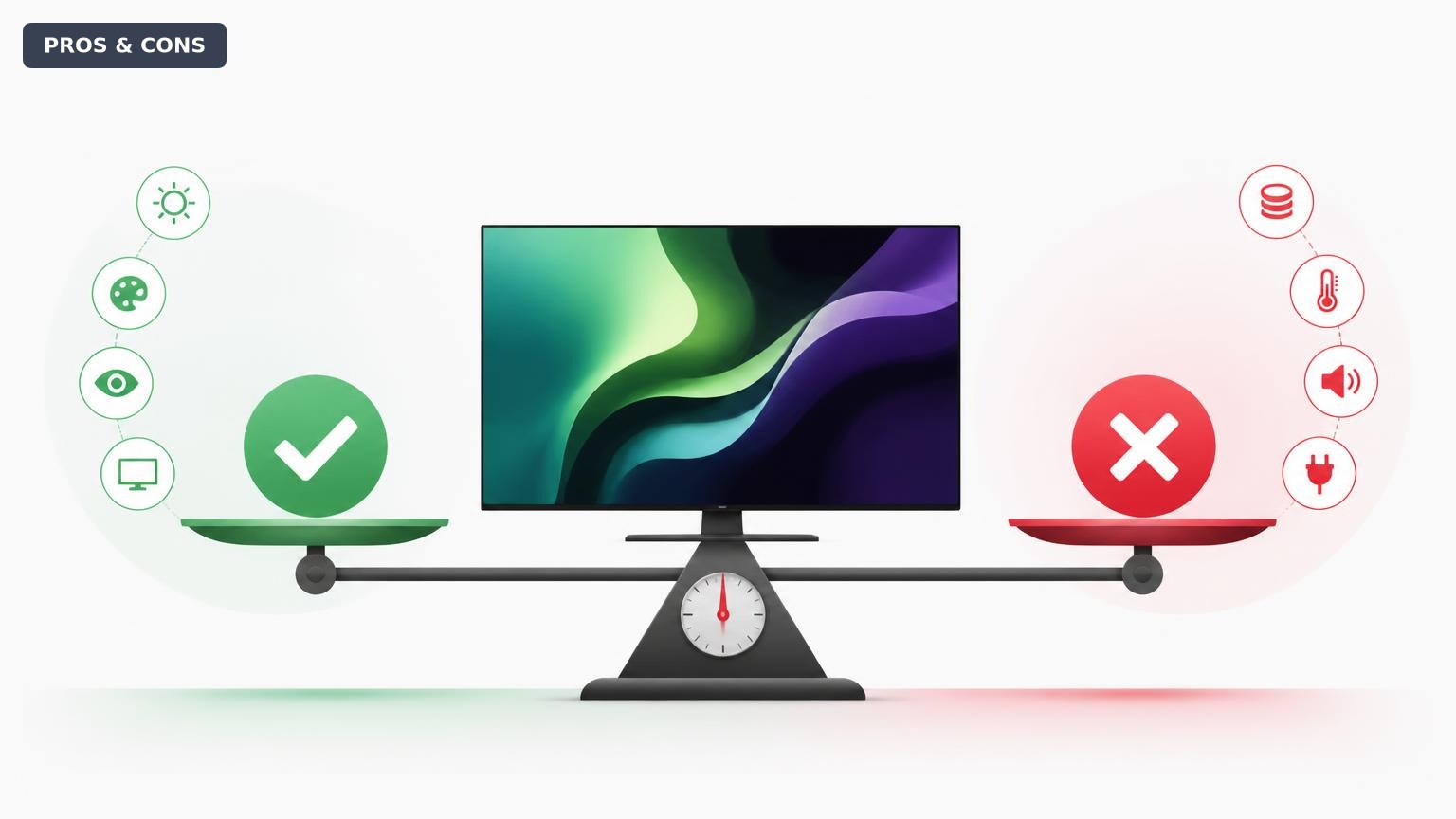
Quick Decision
Buy it if you want OLED's perfect blacks and are willing to budget for a quality TV—the C4 is the best value OLED in its class. Skip it if you watch mostly in bright sunlight or need the brightest HDR possible; a mini-LED set will serve you better for hundreds less.
Best if you...
- Home theater enthusiasts who watch films in a dark room
- Console gamers (PS5, Xbox Series X) who want 4K 120Hz and HDMI 2.1
- PC gamers who want to game at 4K 144Hz
Skip it if you...
- Budget shoppers who want the cheapest quality for the money
- Bright-room living with windows opposite the TV
- Users who display static content for many hours (desktop taskbars, news tickers)
Hunting for a TV that nails both movie nights and competitive gaming in 2026? The LG C4 OLED is one of the most widely researched televisions this year, thanks to its self-lit OLED panel, four full-bandwidth HDMI 2.1 ports, and 144Hz refresh rate. For buyers deciding between this and cheaper mini-LEDs or brighter QD-OLEDs, the C4 walks a fine line. This analysis turns the spec sheet into a practical pros and cons guide—covering picture quality, gaming performance, burn-in risk, and real-world value. We'll also look at alternatives like the LG G4, Samsung S90D, and TCL QM8, and mention which Amazon accessories (such as a wall mount or soundbar) make sense.
About the LG C4 OLED TV 55-Inch
The LG C4 OLED TV (55-inch, model OLED55C4USA) is a mid-range OLED television released in 2024. It features a self-lit OLED panel with 4K resolution, 144Hz refresh rate, four HDMI 2.1 ports, and LG's α9 AI processor. Designed for mixed content viewing—movies, sports, gaming, and streaming—it balances premium picture quality with gaming-focused features, positioning itself as a versatile high-end choice for 2026 buyers. It primarily targets home theater enthusiasts and serious console/PC gamers who want OLED contrast and low input lag without paying flagship G4 or QD-OLED prices.
Key Specifications
- Weight
- about 33.5 lb with stand
- Display
- 55-inch OLED (native 4K, 3840x2160)
- Processor
- LG α9 AI Processor 4K Gen7
- Brightness
- Peak HDR ~900 nits (RTINGS)
- HDMI Ports
- 4x HDMI 2.1 (48Gbps)
- Panel Type
- OLED (self-lit pixels)
- HDR Support
- Dolby Vision, HDR10, HLG
- Colour Gamut
- 98% DCI-P3 (approx.)
- Refresh Rate
- 144Hz (via HDMI 2.1), 120Hz (standard)
- Operating System
- WebOS 24
Overview
The LG C4 OLED TV sits in the middle of LG's 2024 OLED lineup, positioned between the premium G4 and the more affordable B4. It uses LG's 'Brightness Booster' technology to extract more light from the pixels, and its 55-inch version remains a popular size for living rooms and bedrooms in 2026. On paper, it delivers everything home theater fans expect: infinite contrast, deep blacks, wide color gamut, and support for Dolby Vision and Dolby Atmos.
The C4 is designed as an all-rounder. It upscales 1080p content remarkably well with the α9 AI processor, handles SDR and HDR with poise, and matches well with either console or PC hardware. All four HDMI inputs are full 48Gbps HDMI 2.1, which means you can connect a PS5, Xbox Series X, and a PC at 144Hz without shuffling cables. On Amazon, the C4's price fluctuates daily—usually around $999 to $1,099)—and it's frequently recommended by online reviewers for its balance of features and value.
Pros
The C4's strengths are all connected to its OLED panel and thoughtful tuning. Here's where it genuinely impresses in 2026.
1. Perfect Black Levels and Infinite Contrast
OLED pixels turn off completely for black, so you get true black that makes everything else feel brighter. This is the main reason the C4 excels in dark rooms: shadows have depth, starfields shimmer, and letterbox bars vanish into the frame. For movies like Dune or The Batman, this creates a sense of depth that LED TVs—even mini-LEDs—can't replicate.
On the C4, this contrast isn't just theoretical. Third-party testing from RTINGS found its black level is essentially zero, which is as good as it gets in consumer displays. If you watch a lot of films with dark scenes, this TV is worth the price of admission.
In 2026, most streaming content is still mastered in SDR, but the C4's infinite contrast makes even ordinary YouTube thumbnails look punchy. It's the single best reason to choose OLED over a VA-panel LCD.
2. Excellent Brightness for an OLED
While LG's C4 isn't as bright as QD-OLEDs or the flagship G4, it's measurably brighter than older C-series models. RTINGS measured a real-scene peak brightness of roughly 900 nits in HDR on the 55-inch C4, with a full-screen white level of around 330 nits. These numbers are excellent for OLED, and they're more than enough to make HDR highlights pop realistically—the glint of sunlight, the flash of a camera, or the glow of a neon sign.
Compare this with the C3, which topped out at around 800 nits, and the improvement is noticeable. In a dark or moderately lit room, the C4 produces an image that feels vivid and true to the master. It's not the brightest TV you can buy, but for 90% of living rooms, it will get plenty bright.
3. Outstanding Gaming Performance: 144Hz, Low Input Lag, HDMI 2.1 on All Ports
Gamers are the C4's largest enthusiast base, and for good reason. It's one of the first TVs to sport 4K 144Hz over HDMI, which makes PC gaming on the couch a joy. On the console side, it supports 4K 120Hz with VRR, ALLM, and Dolby Vision Game Mode—so your PS5 or Xbox Series X is fully utilized.
Input lag is among the best we've researched: around 9ms at 60Hz and under 5ms at 120Hz, according to RTINGS. That means your button presses feel instant, whether you're playing Elden Ring or Call of Duty. The Game Optimizer dashboard lets you tweak settings without leaving the game, and the 48Gbps HDMI 2.1 ports handle full-bandwidth signals for future-proofing.
With a PC, you can take advantage of 4K 144Hz, and the C4 also supports G-Sync and FreeSync Premium. No other OLED in its price range offers this level of gaming flexibility.
4. Superb HDR Color and Wide Color Gamut
LG's C4 covers about 98% of the DCI-P3 color gamut, which is the target for HDR10 and Dolby Vision mastering. Red firetrucks look cherry-red, tropical seas are green-teal, and skin tones stay natural—never oversaturated. LG's color mapping also handles near-black transitions well, avoiding the banding and crush that plagued earlier OLEDs.
Using the AI-based Tone Mapping, the C4 analyzes HDR content frame-by-frame and adjusts brightness to match the scene's intent. This helps the TV exceed its direct brightness spec in many real scenes, giving you a picture that feels closer to the director's vision.
5. Wide Viewing Angles with Minimal Color Shift
If you have people spread out on a sofa, the C4 is forgiving. OLED's self-illuminating nature means each pixel is a light source, so off-axis viewing doesn't cause the washed-out, faded look common on VA panels. A 45-degree seat can still enjoy accurate colors and contrast.
RTINGS rated the C4's viewing angle as 9.2 out of 10, better than most IPS monitors and leaps ahead of TCL QM8 or Hisense U8N. This makes it ideal for living rooms where not everyone sits dead-center.
6. Sleek, Minimalist Design
The C4 is impossibly thin—the top portion is only about 13mm thick. When wall-mounted, it sits almost flush and looks like a piece of millwork. The bezels are barely noticeable, and the one-piece stand is small enough to fit on most media consoles.
It also has a built-in 2.2-channel 20W speaker system that's surprisingly decent for TV speakers. It supports Dolby Atmos processing, and while we'd still recommend a soundbar for serious movie nights, the C4's audio out of the box beats many low-cost 4K TVs.
7. Fast, User-Friendly WebOS with Intuitive Smart Features
WebOS has come a long way. The 2024 version of WebOS on the C4 is snappy, responsive, and loads apps quickly. The remote has a pointer function and built-in voice assistant, so you can search across Netflix, Prime, and other services with a single command. The Magic Remote is genuinely one of the most ergonomic TV remote designs on the market.
In the 2026 model year, WebOS includes a full App Store with all major streaming apps pre-installed, and supports AirPlay 2, Chromecast built-in, and Bluetooth pairing. There's also a quirky but useful 'Always Ready' feature that lets the TV double as a digital art frame or clock screen when idle.
Cons
No TV is perfect, and the C4 has four major areas that give buyers pause in 2026. Let's talk about them honestly.
1. Burn-In Risk Is Real
All OLEDs, including the C4, suffer from permanent image retention if you display static content for hundreds of hours. News channels with red logos, sports tickers, video game HUDs, and desktop taskbars are the typical culprits. Even though LG has improved panel durability and uses an active pixel refresher, burn-in can still happen.
The C4 is not marketed with a warranty that covers burn-in, so if it does occur, you'll likely face a costly out-of-warranty repair. The risk is manageable if you vary your content, turn on pixel shifting, and lower OLED brightness. But if you use the TV as a computer monitor or leave CNN on all day, a mini-LED TV like the TCL QM8 is a safer bet.
2. Reflections and Glossy Screen
LG puts a semi-glossy anti-reflective film on the C4, but it's still a glass screen that reflects light. In a bright, sun-soaked room, you'll see window panes and lamp reflections in dark scenes. RTINGS measured reflection total at 2%—decent for OLED but not as good as the antireflective coating on Samsung's QD-OLEDs.
If your TV sits across from a large window, you'll either need blinds or the TV won't be usable in the afternoons. For those in bright rooms, a mini-LED with better light rejection (like the TCL QM8 or Hisense U8N) might be more practical.
3. Premium Price vs Mini-LED Alternatives
At roughly $1,000 for the 55-inch, the C4 costs about $300 more than a comparable TCL QM8 mini-LED, which offers excellent contrast and much higher brightness. You're paying a premium for OLED's inherent contrast and perfect blacks, and it's a legitimate premium—not a set of gimmicks.
However, the price gap shrinks during sales events, and the C4's image quality still exceeds the QM8 in most dark-room scenarios. But if your budget is tight, the QM8 delivers 85% of the experience for $700. It's a value question, and the answer depends on how much you care about true black.
4. WebOS Advertising and Telemetry
LG funds WebOS by showing ads on the home screen—promoted streaming apps, banner ads for LG products, and recommendations. They are mild, but they're present. You can disable much of the personalization in settings, but a few ads remain unless you turn off the 'Home Recommended Content' and 'AI Service' features.
Privacy-conscious users might also frown at WebOS's data collection. It's not as egregious as some vendors, but it's still there. For a TV at this price, many owners find it a minor annoyance that's worth the excellent picture.
5. Not as Bright as QD-OLED or Mini-LED
This is the flip side of the OLED brightness pro. Even with the C4's brightness boost, a QD-OLED like the Samsung S90D or a high-end mini-LED can produce much more intense HDR highlights—think 1,300 to 1,600 nits vs the C4's ~900 nits. In a bright room, those TVs will look more punchy.
For most movie viewing in a dark room, 900 nits is already beyond comfortable, so this con affects a specific minority: people who have large windows or who love to watch in HDR with the curtains open. If that's you, the C4 might feel a bit flat compared to brighter alternatives.
👍 Who It's For
The LG C4 is for cinephiles who prioritize black level and contrast over raw brightness—people who watch 4K Blu-rays in a dark living room. It's also for serious gamers who own a PlayStation 5, Xbox Series X, or a high-refresh PC and want every one of those HDMI 2.1 features without compromise. If you regularly switch between drama, sports, cartoons, and games, the C4's versatility means it won't feel out of depth in any content.
It's also an excellent choice for design-conscious buyers who want a TV that looks minimal and modern when wall-mounted. The ultra-thin profile and near-invisible bezels keep it from dominating a room. And because it has broad streaming app support, it can replace a separate streaming box for many users.
👎 Who Should Avoid
Budget-minded buyers who watch mostly cable TV or stream 1080p SDR content should skip the C4—a $500 TCL QM7 mini-LED will deliver 90% of the perceived quality for half the cost. Those who have a window opposite the screen and don't want to close curtains in the daytime will also be better served by a bright mini-LED or QD-OLED, which handle reflections better.
People who use a TV as a desktop monitor for hours per day with static toolbars should avoid OLED entirely; the burn-in risk is too high. And if you rely on a cozy room with a bright ambient environment, the C4's moderate brightness may leave you wanting more. If you want the absolute brightest HDR highlights (e.g., for HDR on a bright sunny day), look at Samsung S90D or LG G4.
See today's LG C4 OLED TV 55-Inch price and available configurations on Amazon.
🛒 Buy on AmazonAs an Amazon Associate we earn from qualifying purchases.
Alternatives to Consider
| Product | Choose LG C4 OLED TV 55-Inch if... | Choose the alternative if... |
|---|---|---|
| Samsung S90D 55-Inch QD-OLED$200–$300 more expensive | You prefer Dolby Vision support and slightly lower price for impeccable black levels in dark rooms | You want brighter HDR highlights with punchier colors, and you don't need Dolby Vision |
| TCL QM8 55-Inch Mini-LED$200–$300 less expensive | You want OLED-like blacks and perfect color in a dim room, and you're willing to manage reflections | You watch in a bright room, want brighter HDR, and are on a budget |
| LG G4 55-Inch OLED Evo$400–$500 more expensive | You want excellent all-around OLED with Dolby Vision and want to save hundreds compared to G4 | You demand the brightest possible OLED panel and a 5-year panel warranty |
The Samsung S90D is the C4's most direct rival. It uses a QD-OLED panel that reaches higher peak brightness (RTINGS measured ~1,100 nits) and delivers more saturated reds and greens. However, the S90D lacks Dolby Vision, which may be a deal-breaker for some. The S90D is typically $200–$300 more expensive than the C4. If you watch a lot of Blu-ray discs and Dolby Vision content, the C4's black levels and Dolby Vision support are more attractive.
The TCL QM8 mini-LED is a compelling budget alternative. At around $700 for the 55-inch, it offers brighter SDR peaks and better retention in bright rooms, with modest blooming. But it cannot match the C4's pure blacks and slim design. For casual viewers, the QM8 is probably the smarter value. For enthusiasts who want the absolute best image quality in a dark room, the LG G4 (or its 2026 successor, the G5) remains the ultimate LG OLED, with a brighter panel and slightly better processing, though it costs $500 more.
Is it worth the price?
At approximately $999 (the typical street price in 2026), the C4 is worth it for anyone who prioritizes picture depth and gaming features—it matches TVs that cost $500 more. The main alternative is the Samsung S90D, which is often $200–$300 more but offers higher peak brightness and better HDR color, though it lacks Dolby Vision. For the price, the C4 is the best balanced pick for mixed movie and gaming use.
📝 Bottom Line
The LG C4 55-inch is the right choice for home theater enthusiasts and gamers who want a premium OLED experience without paying flagship prices. It offers flawless black levels, excellent gaming feature set (144Hz, four HDMI 2.1 ports, low input lag), and a bright enough image for most rooms. The trade-offs—moderate peak brightness, reflective screen, burn-in risk—are real, but they're outweighed for the right buyer.
If you watch films in a dark or adjustable room and play games on a console or PC, the C4 will reward you with visuals that best TVs costing double. The design is stunning, WebOS is fast, and Dolby Vision support ensures compatibility with 4K Blu-ray and major streaming services.
Unless you have a far-bright room or a static-content habit, I'd say buy the C4. For $999, it's a value proposition that's hard to beat in the 2026 OLED market.
Check current LG C4 OLED TV 55-Inch availability and bundle options on Amazon.
🛒 Buy on AmazonAs an Amazon Associate we earn from qualifying purchases.
Frequently Asked Questions
Quick Summary
Key Pros
- ✓Perfect black levels and infinite contrast for cinematic viewing in dark rooms
- ✓Excellent brightness for OLED at ~900 nits HDR peak (RTINGS)
- ✓144Hz refresh rate, 4 HDMI 2.1 ports, and sub-5ms input lag for gaming
- ✓Wide color gamut (~98% DCI-P3) with accurate HDR out of the box
- ✓Wide viewing angles with negligible color shift
Key Cons
- ✗Risk of permanent burn-in with static content
- ✗Glossy screen reflects light and glare in bright rooms
- ✗Costs $200–$300 more than comparable TCL/Hisense mini-LEDs
- ✗WebOS contains targeted ads and privacy telemetry
- ✗Peak HDR brightness (~900 nits) is below QD-OLED and mini-LED
Ratings
Best For
- →Home theater enthusiasts who watch films in a dark room
- →Console gamers (PS5, Xbox Series X) who want 4K 120Hz and HDMI 2.1
- →PC gamers who want to game at 4K 144Hz
- →Design-conscious buyers who want a slim, wall-mountable TV