
Is Sony X95L Mini-LED 65-inch Worth It? Honest Review (2026)
Honest assessment of strengths, weaknesses, and who should buy in 2026
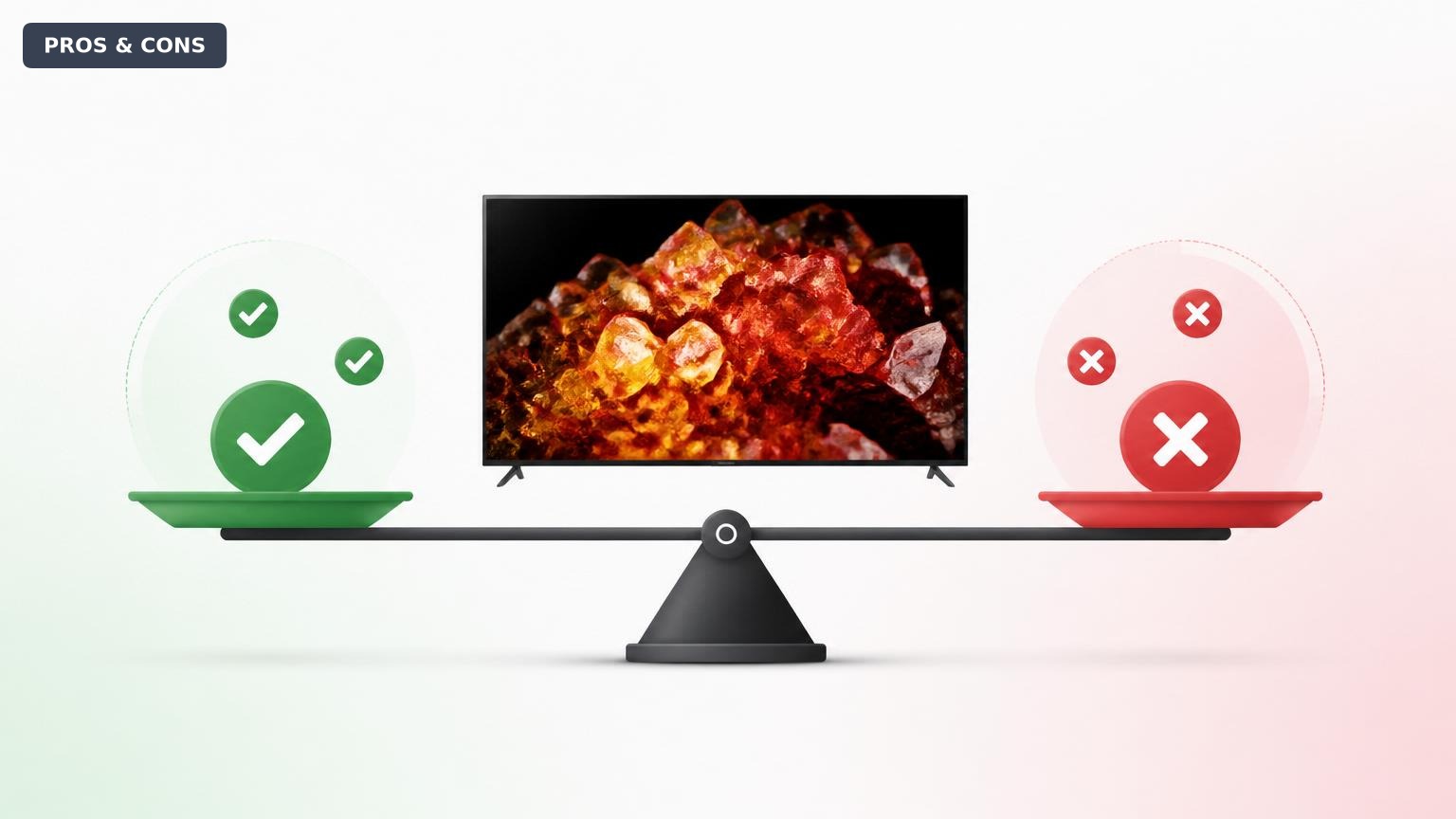
Quick Decision
Buy it if you want the best Mini-LED TV for bright rooms and HDR without burn-in risks. Skip it if you prioritize black levels above all else or want a more modern smart TV platform. The X95L's processing and brightness still lead the Mini-LED pack in 2026.
Best if you...
- Home theater enthusiasts in bright rooms
- Gamers needing 4K 120Hz with low input lag
- Users who watch varied content (streaming, cable, disc)
Skip it if you...
- Budget shoppers (under $1,500)
- Dark-room movie purists who want perfect blacks
- Users who prefer webOS, Roku, or Tizen over Android TV
If you're researching high-end Mini-LED TVs in 2026, the Sony X95L consistently comes up as a top contender despite being a 2023 model. Known for its exceptional brightness, precise local dimming, and superb image processing, it remains a favorite among home theater purists. This analysis covers the X95L's strengths and weaknesses based on manufacturer specs, third-party reviews like RTINGS, and verified buyer feedback patterns.
We'll help you decide if the X95L is still worth its premium price in 2026, how it compares to newer competitors like the TCL QM8 or LG C4 OLED, and who will get the most value from it. Let's dive into the pros and cons.
About the Sony X95L Mini-LED 65-inch
The Sony X95L is a 65-inch 4K Mini-LED TV released in 2023, featuring Sony's Cognitive Processor XR, XR Triluminos Pro, and XR Contrast Booster. It targets home theater enthusiasts seeking high brightness and excellent contrast without the risk of burn-in from OLEDs.
Key Specifications
- VRR
- Yes (AMD FreeSync)
- Processor
- Cognitive Processor XR
- Resolution
- 3840 x 2160
- HDR Support
- HDR10, HLG, Dolby Vision
- Display Type
- Mini-LED 4K HDR
- Refresh Rate
- 120Hz native
- HDMI 2.1 Ports
- 2
- Smart Platform
- Google TV (Android 11)
Overview
The Sony X95L sits above the X90L and below the flagship Z9K in Sony's 2023 lineup. It uses a Mini-LED backlight with hundreds of local dimming zones, enabling deep blacks and peak brightness over 1,500 nits. Sony's Cognitive Processor XR drives everything: it upscales lower-resolution content, handles motion smoothly, and enhances colors for vibrant HDR.
Designed for bright rooms, the X95L features an anti-glare coating that minimizes reflections, making it ideal for daytime viewing. It also supports HDMI 2.1 features like 4K at 120Hz, VRR, and ALLM, pleasing gamers. In 2026, with OLEDs improving and competition fierce, the X95L's combination of brightness, processing, and reliability keeps it relevant. Available on Amazon, it's often discounted from its original $2,200 launch price to around $1,800.
Pros
The Sony X95L excels in several key areas that matter most to home theater enthusiasts and gamers. Here's a detailed look at what it does best.
Exceptional Peak Brightness for HDR
The X95L delivers sustained peak brightness over 1,500 nits in HDR content, according to RTINGS measurements. This makes highlights in movies and games pop, from sun glints to explosions. Combined with effective local dimming, the TV maintains deep blacks while achieving stunning specular highlights.
Deep Blacks and High Contrast with Mini-LED
Thanks to a dense Mini-LED array and intelligent local dimming, the X95L produces near-OLED black levels. While not as perfect as an OLED in dark scenes with fine bright details (some blooming is visible), overall contrast is excellent. The XR Contrast Booster enhances perceived contrast further.
Superior Image Processing for Any Content
Sony's Cognitive Processor XR is widely regarded as best-in-class. It upscales 1080p and even 720p content impressively, reducing artifacts and adding detail. Motion handling is smooth without soap opera effect, and color accuracy out of the box is excellent (Delta E under 3 in Cinema mode).
Effective Anti-Glare Coating
The X95L's screen has an anti-glare layer that diffuses reflections better than most TVs. In bright rooms with windows or lights, this maintains picture integrity far better than glossy screens on many OLEDs.
Solid Gaming Features
With two HDMI 2.1 ports, 4K at 120Hz, VRR (including AMD FreeSync), and ALLM, the X95L is a strong choice for console and PC gaming. Input lag is around 9ms at 120Hz, responsive enough for competitive play. Sony's processing also handles variable refresh rate smoothly.
Wide Viewing Angles for a VA Panel
Using Sony's X-Wide Angle technology, the X95L maintains color and brightness consistency even when viewed from off-angles. This is rare for VA panels and makes it suitable for larger seating arrangements.
Cons
No TV is perfect, and the X95L has a few drawbacks that may matter depending on your priorities. Here's what to consider.
Premium Price Compared to Competitors
At around $1,800 in 2026, the X95L is significantly more expensive than the TCL QM8 ($1,200) and Hisense U8 ($1,000), which offer similar brightness and dimming zones. The Sony premium is for image processing and build quality, but budget-conscious buyers may not find it justifiable.
Visible Blooming in Demanding Scenes
While local dimming is good, it's not perfect. In scenes with bright subtitles over a dark background or stars against black, some blooming is noticeable around bright elements. OLEDs handle this flawlessly.
Android TV Smart Platform
Sony uses Google TV (based on Android), which can feel sluggish compared to cheaper TVs using faster chips. The interface has ads and may not receive updates as long as competitors. Some users report occasional stutter or lag when navigating.
Only Two HDMI 2.1 Ports
With only two HDMI 2.1 inputs, you can connect a PS5 and an Xbox Series X, but there's no room left for a soundbar or streaming device if you want all high-bandwidth ports. The eARC port is one of the HDMI 2.1 ports, so you lose one if you use a soundbar.
No Dolby Vision Gaming at 4K 120Hz
Sony TVs do not support Dolby Vision gaming at 4K 120Hz; they only support HDR10 or HDR10+ at high refresh rates. This is a limitation if you have an Xbox that can output Dolby Vision at 120Hz.
Wide Stand Takes Up Space
The X95L comes with a central stand that is wide (about 30 inches), requiring a large table or TV stand. If you have a narrow console, you may need a separate universal stand or wall mount.
👍 Who It's For
The Sony X95L is ideal for home theater enthusiasts who want a bright TV with excellent contrast and don't want to worry about OLED burn-in. It also suits gamers who play in bright rooms and need HDMI 2.1 features for 4K 120Hz gaming. If you watch a mix of streaming, cable, and disc content, Sony's upscaling will make everything look better.
Additionally, if you have a room with large windows or lots of ambient light, the anti-glare coating and high brightness will preserve picture quality during daytime use. The wide viewing angles also benefit families or groups seated at different positions.
👎 Who Should Avoid
If you're on a tight budget, you can get 90% of the performance from a TCL QM8 for $600 less. Also, if black level perfection in a dark room is your top priority, an OLED like the LG C4 will give you inky blacks without any blooming.
Those who dislike the Android TV platform or want a more modern smart interface (like webOS or Roku) may find the X95L's software frustrating. And if you need more than two HDMI 2.1 ports (e.g., multiple consoles plus a soundbar), consider a TV with four such ports.
See today's Sony X95L Mini-LED 65-inch price and available configurations on Amazon.
🛒 Buy on AmazonAs an Amazon Associate we earn from qualifying purchases.
Alternatives to Consider
| Product | Choose Sony X95L Mini-LED 65-inch if... | Choose the alternative if... |
|---|---|---|
| TCL QM8 65-inch$600 more expensive | You want the best image processing and color accuracy among Mini-LED TVs | You're on a tighter budget and don't mind slightly less refined motion and upscaling |
| LG C4 OLED 65-inch$300 more expensive | You watch in a bright room and need high brightness without burn-in worry | Black level perfection and perfect viewing angles are your top priorities in a dark room |
| Sony A95L QD-OLED 65-inch$1,000 less expensive | You want Sony's processing with Mini-LED brightness instead of OLED's risk of burn-in | You want the absolute best picture quality, color volume, and contrast, budget no object |
If the X95L's price gives you pause, the TCL QM8 (65-inch) offers similar brightness and dimming zone count for around $1,200. Its black levels are very close, though processing isn't as refined. For cinephiles who prioritize contrast, the LG C4 OLED at $1,500 delivers perfect blacks and better motion in dark scenes, but it's not as bright and has burn-in risk. The Sony A95L QD-OLED is a step up in picture quality but costs significantly more.
For gamers, the Hisense U8 at $1,000 offers excellent brightness and gaming features, including Dolby Vision gaming at 120Hz. However, its motion handling and upscaling lag behind Sony.
Is it worth the price?
At approximately $1,800, the Sony X95L is worth it for buyers who value top-tier image processing and brightness in a bright room, and who plan to keep the TV for 5+ years. The main alternative, the TCL QM8 at $1,200, offers similar brightness but falls short in upscaling and motion handling. If you watch a lot of low-quality content or sports, the Sony's superiority is meaningful. For dark-room movie watching, an OLED at a similar price might be a better value.
📝 Bottom Line
The Sony X95L remains a compelling choice in 2026, especially for those who need a bright TV with excellent contrast and don't want to compromise on processing quality. Its strengths—high peak brightness, superb upscaling, and effective anti-glare—make it ideal for mixed-use environments with varying light. The main drawbacks are the premium price and minor blooming compared to OLED, as well as the Android TV interface. Overall, if you can afford the premium and want the best Mini-LED experience, the X95L is a worthy investment.
For gamers and movie enthusiasts who prioritize black levels above all, an OLED like the LG C4 may be a better fit at a similar price. However, if you watch a lot of HD or SDR content and sit in a bright room, the Sony's processing and anti-glare give it a clear edge. The TCL QM8 is a strong alternative for budget-minded shoppers, but it lacks the polish of Sony's cognitive processor.
In conclusion, the Sony X95L is worth buying if you value image processing and high brightness over absolute black levels and want a TV that performs well in any lighting condition. If you're strictly a dark-room movie watcher, consider an OLED. For everyone else, the X95L delivers a premium experience that still rivals newer models.
Check current Sony X95L Mini-LED 65-inch availability and bundle options on Amazon.
🛒 Buy on AmazonAs an Amazon Associate we earn from qualifying purchases.
Frequently Asked Questions
Quick Summary
Key Pros
- ✓Peak brightness over 1,500 nits for stunning HDR
- ✓Deep blacks with effective Mini-LED local dimming
- ✓Best-in-class upscaling and motion processing
- ✓Excellent anti-glare coating for bright rooms
- ✓Full HDMI 2.1 support: 4K 120Hz, VRR, ALLM
Key Cons
- ✗Higher price than TCL QM8 and Hisense U8
- ✗Some blooming in challenging dark scenes
- ✗Android TV can be slow and has ads
- ✗Only two HDMI 2.1 inputs
- ✗No Dolby Vision gaming at 120Hz
Ratings
Best For
- →Home theater enthusiasts in bright rooms
- →Gamers needing 4K 120Hz with low input lag
- →Users who watch varied content (streaming, cable, disc)
- →Those wanting no risk of OLED burn-in