
Is LG C4 OLED 65-inch TV Worth It? Honest Review (2026)
Honest breakdown of strengths, weaknesses, and who should buy the C4 OLED in 2026
Quick Decision
Buy the LG C4 OLED if you want the best picture quality for dark rooms and you're a console gamer with HDMI 2.1 needs. Skip it if you watch TV in a bright room or leave static content on for hours daily. For most home theater enthusiasts, it's a top-tier choice.
Best if you...
- Home theater enthusiasts watching in dark rooms
- Console gamers with Xbox Series X or PS5
- Movie lovers who value Dolby Vision and deep blacks
Skip it if you...
- Viewers in brightly lit living rooms
- Heavy users who watch news or sports tickers for hours daily
- PC gamers needing 144Hz support
If you're in the market for a premium TV in 2026, the LG C4 OLED 65-inch likely tops your list. Known for its stunning picture quality and gaming-friendly features, the C4 series has been a favorite for home theaters since its 2024 release. This analysis covers the C4's strengths and weaknesses based on manufacturer specs and third-party reviews, helping you decide if it's the right investment for your living room. We'll also compare it to key alternatives and discuss practical use cases.
About the LG C4 OLED 65-inch TV
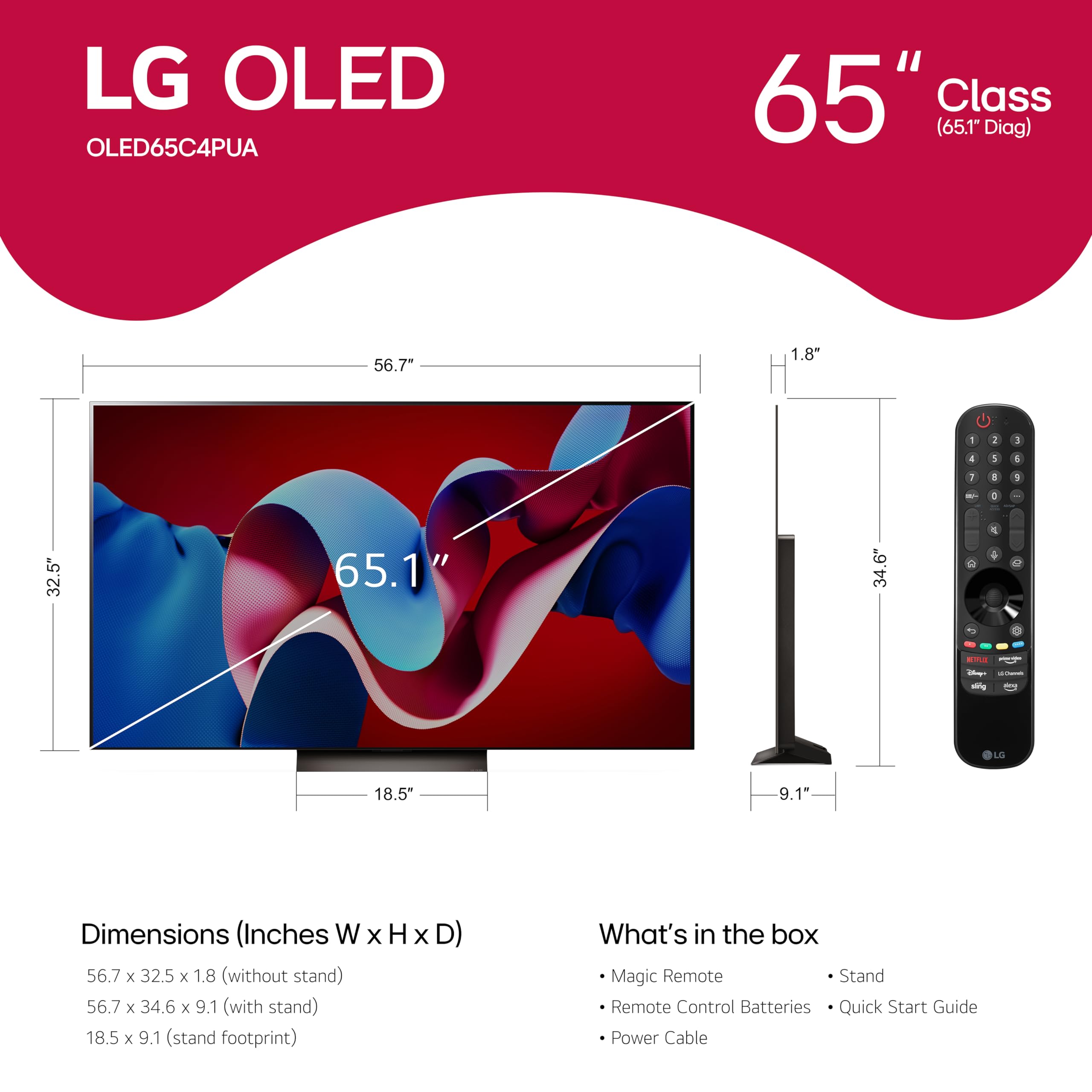
The LG C4 OLED is a 65-inch 4K smart TV featuring OLED technology for perfect blacks and infinite contrast. It uses LG's 2024 processor (α9 Gen7 AI Processor 4K) and supports 120Hz refresh rate, making it suitable for both movie enthusiasts and gamers. The TV runs webOS 24 and includes four HDMI 2.1 ports.
Key Specifications
- Weight
- 46.7 lbs (without stand)
- Processor
- α9 Gen7 AI Processor 4K
- HDMI Ports
- 4x HDMI 2.1
- Resolution
- 4K (3840 x 2160)
- HDR Support
- Dolby Vision, HDR10, HLG
- Display Type
- OLED (WOLED)
- Refresh Rate
- 120Hz native
- Smart Platform
- webOS 24
- Peak Brightness (HDR)
- ~800 nits (10% window)
- Dimensions (without stand)
- 57.1" x 32.7" x 1.8"
Overview
The LG C4 OLED 65-inch TV delivers the brand's latest OLED panel technology with a design that remains nearly bezel-less. It targets buyers who prioritize contrast, color accuracy, and motion handling over sheer brightness. The C4 supports Dolby Vision and Dolby Atmos, and with four HDMI 2.1 ports, it's a strong contender for Xbox Series X and PS5 gamers. LG's webOS 24 platform offers a smooth smart TV experience with access to major streaming apps. Priced around $1,800 on Amazon, the C4 competes directly with the Samsung S95D OLED and Sony A80L OLED.
Pros
The LG C4 OLED excels in several areas that make it a top choice for home theater and gaming. Its most celebrated feature is the panel's ability to deliver perfect blacks and infinite contrast, thanks to OLED self-lit pixels. Additionally, the TV offers outstanding gaming features, including 120Hz native refresh rate and low input lag.
Perfect Blacks and Infinite Contrast
OLED panels produce black by simply turning off pixels, resulting in true black levels that LED-backlit TVs cannot match. This infinite contrast makes HDR content pop with lifelike brightness in small highlights. According to RTINGS measurements, the C4 achieves a near-0 nits black level, meaning shadows are completely dark without blooming. This is especially noticeable in dark movie scenes or games like The Last of Us Part II.
The benefit extends to content with letterbox bars: they disappear into the surrounding darkness, unlike on LCD TVs where bars glow gray. For home theater enthusiasts, this is the single most compelling reason to choose OLED over QLED or Mini-LED.
Outstanding Gaming Performance
With four HDMI 2.1 ports, the C4 supports 4K at 120Hz with VRR (Variable Refresh Rate), FreeSync Premium, and G-Sync Compatible. Input lag measures around 9ms in game mode (RTINGS), making it responsive for competitive gaming. The 120Hz panel also enables 5:5 pulldown for 24p content, reducing judder in movies.
The TV automatically detects gaming consoles and switches to low-latency mode. For PC gamers, the C4 supports 4K at 120Hz with 10-bit color and HDR via HDMI 2.1. It also has a dedicated Game Dashboard to quickly adjust settings.
Wide Viewing Angles
Unlike VA-based LCDs, OLED panels maintain color and contrast even at extreme angles (up to 80 degrees). This makes the C4 ideal for wide seating arrangements or family rooms where viewers sit off-center. The picture does not wash out, so groups can enjoy consistent image quality without fighting for the sweet spot.
Excellent Motion Handling
The α9 Gen7 processor provides effective motion interpolation for sports and fast-action content. The C4 has near-instantaneous response time (0.1ms) typical of OLEDs, which eliminates motion blur. However, OLED stutter can be an issue for 24fps film content—LG's motion smoothing (TruMotion) offers multiple presets to reduce it. For most viewers, the default Cinematic Movement setting works well without introducing soap-opera effect.
Dolby Vision and Dolby Atmos Support
The C4 fully supports Dolby Vision IQ, which adjusts the HDR picture based on ambient light, and Dolby Atmos via eARC for immersive audio. This means you get cinematic HDR and object-based sound with compatible content on Netflix, Disney+, and Blu-ray. The TV's built-in speakers are adequate for casual viewing, but a dedicated sound system is recommended to fully appreciate Atmos.
Slick webOS 24 Smart Platform
webOS 24 retains its hallmark magic remote pointer and adds a customizable home screen. The interface is snappy, thanks to the α9 chip, and supports major streaming apps. The remote includes dedicated buttons for Netflix, Prime Video, Disney+, and LG Channels. The C4 also works with Apple AirPlay 2 and HomeKit, as well as Google Assistant and Alexa built-in.
Cons
No product is perfect, and the LG C4 OLED has trade-offs that may affect certain buyers. The most significant concerns revolve around brightness limitations, burn-in risk, and price. We'll detail these below.
Moderate Peak Brightness
While the C4 produces excellent contrast, its peak brightness in HDR is around 800 nits for a small window (RTINGS). This is lower than high-end QLED TVs like the Samsung QN90C which can reach 1500+ nits. In very bright rooms with direct sunlight, the C4 may look dim and reflections can be distracting. The panel has a semi-glossy finish, but it's not as effective as Samsung's matte options. If your living room is consistently bright, consider a brighter TV.
Risk of Permanent Burn-In
OLED panels are susceptible to burn-in from static elements like news tickers, HUDs, or channel logos. LG uses pixel shifting and logo dimming to mitigate this, but the risk remains for heavy users who watch the same content for hours each day. According to RTINGS long-term test, newer OLEDs have improved but still show burn-in after extended static use. For example, 6000 hours (about 4 hours daily) of CNN could cause visible retention. Warranty does not cover burn-in in most cases.
Expensive Compared to LCD Alternatives
At $1,800, the C4 is roughly $500 more than a 65-inch Sony X90L LCD TV, which offers very good image quality with higher brightness. For budget-conscious buyers, the price premium for OLED might not justify the incremental picture quality, especially if you watch in a bright room or don't need perfect blacks.
No Native Dolby Atmos Pass-Through
The TV does not support Dolby Atmos pass-through over HDMI ARC/eARC from internal apps to a soundbar or AVR; you need to use the TV's own audio system or connect external devices directly to the soundbar. This can be a minor inconvenience for those with Atmos sound systems who want Dolby Atmos from built-in apps like Netflix.
No 144Hz Support
While 120Hz is sufficient for most gamers, the C4 lacks 144Hz support that some PC gamers desire for competitive titles (the LG C3 did not have it either, but the C4 only does 120Hz). Competing TVs like the Samsung S90C offer 144Hz support. This is a niche issue but worth noting for high-refresh-rate PC gamers.
Average SDR Brightness
For standard dynamic range content (SDR), the C4's brightness is around 350-400 nits (LG spec). In a bright room, this can feel subdued. Many LCD TVs easily surpass 500 nits in SDR, so if you watch mostly SDR shows during daytime, the C4 may look less vibrant.
Remote Control Design
LG's magic remote requires a pointer motion that some users find finicky. The remote is also prone to scratches and does not have backlit keys. While functional, it's not as premium as the aluminum remotes from Sony or Samsung.
Burn-in Concern for Heavy Static Content Users
If you use the TV primarily for news channels, sports tickers, or PC desktop usage, the burn-in risk is higher. Even with mitigations, static menus for 8+ hours daily could lead to image retention after a few years. This is a dealbreaker for heavy use cases.
👍 Who It's For
The LG C4 OLED is ideal for home theater enthusiasts who watch movies in a dark or dimly lit room and crave true black levels and infinite contrast. It's also perfect for console gamers who have or plan to get an Xbox Series X or PS5, as the four HDMI 2.1 ports and 120Hz support future-proof the setup. People who value wide viewing angles for group gatherings will appreciate the consistent picture from any seat. Additionally, if you primarily watch HDR content (streaming, 4K Blu-ray) and want Dolby Vision support, the C4 delivers outstanding performance. Finally, design-conscious buyers who want a slim, bezel-less TV for wall-mounting will find the C4's aesthetics appealing.
👎 Who Should Avoid
If your living room is very bright with large windows and you watch mostly daytime TV, the C4's moderate brightness may be underwhelming—consider a high-end QLED like the Samsung QN90C. Heavy users who leave the TV on news channels for 8+ hours daily or use it as a PC monitor for static work should avoid OLED burn-in risk and choose an IPS or Mini-LED LCD. Budget shoppers seeking the best value for money will find comparable picture quality from the Sony X90L for hundreds less, though you sacrifice blacks and viewing angles. Also, if you need 144Hz for PC gaming, the Samsung S90C is a better fit.
See today's LG C4 OLED 65-inch TV price and available configurations on Amazon.
🛒 Buy on AmazonAs an Amazon Associate we earn from qualifying purchases.
Alternatives to Consider
| Product | Choose LG C4 OLED 65-inch TV if... | Choose the alternative if... |
|---|---|---|
| Samsung S95D 65-inch OLED$200 more expensive | You want higher HDR brightness (up to 1300 nits) and better color volume, and don't need Dolby Vision | Dolby Vision support and more HDMI 2.1 ports (4 vs 2) are important to you |
| Sony A80L 65-inch OLEDSimilar price or $100 less | You value superior upscaling and motion processing for movies and sports | You need more than two HDMI 2.1 ports for multiple gaming consoles |
| Samsung QN90C 65-inch Neo QLED$100 less expensive | You watch TV in a bright room and need higher SDR brightness (1500+ nits) with no burn-in risk | Perfect blacks and wide viewing angles are non-negotiable for you |
The main competitors to the LG C4 are the Samsung S90C/S95D and Sony A80L. The Samsung S95D uses QD-OLED technology, offering higher brightness (up to 1300 nits) and better color volume, making it superior for bright rooms and HDR highlights. However, it has less HDMI 2.1 ports (two) and lacks Dolby Vision support. The Sony A80L uses a traditional WOLED panel but has better image processing for upscaling and motion, plus acoustic surface audio. It's often preferred for movies but has only two HDMI 2.1 ports and lower brightness than the C4. For those who want a 144Hz panel, the Samsung S90C supports it, but again no Dolby Vision. Alternatively, the cheaper TCL QM8 Mini-LED offers excellent brightness and black levels for far less money, though local dimming may cause blooming in extreme cases. See the comparison table below for direct guidance.
Is it worth the price?
At approximately $1,800, the LG C4 OLED is worth it for dedicated movie watchers and console gamers who will use its strengths daily. The Samsung S95D offers 40% more brightness and better HDR pop for $200 more, but lacks Dolby Vision. If you can find the C4 on sale for $1,500-1,600, it becomes an excellent value. For non-gamers who watch varied content in a bright room, a $1,300 Sony X90L or $1,400 TCL QM8 may deliver better everyday satisfaction.
📝 Bottom Line
The LG C4 OLED is the right choice for the home theater purist and serious console gamer because it perfectly balances picture quality, gaming features, and value in the OLED market. Its strengths—perfect blacks, infinite contrast, low input lag, and four HDMI 2.1 ports—make it a standout for dark-room movie nights and high-framerate gaming. However, its moderate brightness and burn-in risk are significant drawbacks for bright rooms or heavy static content users. If you can manage its environment and use case, the C4 delivers a viewing experience that few LCD TVs can match for under $2,000. For those who cannot, alternatives like the Samsung QN90C or TCL QM8 offer higher brightness and peace of mind. Ultimately, buy the C4 if you prioritize contrast and motion; skip it if you need brightness or worry about burn-in.
Check current LG C4 OLED 65-inch TV availability and bundle options on Amazon.
🛒 Buy on AmazonAs an Amazon Associate we earn from qualifying purchases.
Frequently Asked Questions
Quick Summary
Key Pros
- ✓Perfect blacks and infinite contrast for stunning HDR and dark room viewing
- ✓120Hz native refresh rate with HDMI 2.1 support for PC/Xbox/PS5 gaming
- ✓Ultra-low input lag (≈9ms) ensures responsive competitive gaming
- ✓Wide viewing angles maintain color and brightness for group watching
- ✓Dolby Vision IQ and Dolby Atmos support enhance cinematic experience
Key Cons
- ✗Moderate peak HDR brightness (≈800 nits) struggles in very bright rooms
- ✗Risk of permanent burn-in from static content like news or game HUDs
- ✗Higher price than comparable LCD TVs by $400-500
- ✗No native Dolby Atmos pass-through for internal apps
- ✗Only 120Hz refresh rate, not 144Hz for competitive PC gaming
Ratings
Best For
- →Home theater enthusiasts watching in dark rooms
- →Console gamers with Xbox Series X or PS5
- →Movie lovers who value Dolby Vision and deep blacks
- →People with wide seating arrangements needing consistent angles