Review Atlas
Review AtlasYour guide to a better purchase

Menu

Shop by Category

Get the App

Better experience on mobile

12 Top Rated AV Receivers in 2026

Home-theater AV receivers with 4.5+ stars and hundreds of verified Amazon reviews, ranked by real-world value.

top-ratedhighest-rated5-starav receiversamazon-bestverified-reviewsexpert-pickshome theaterdolby-atmos7.2 channel4k 120hzbuying guide2026denonyamaha
Star ratings are the closest thing home theater shoppers have to a crowd-sourced reliability report, and nowhere do they matter more than with an AV receiver. A receiver is the hub of the entire system: every source, every speaker, and every future upgrade runs through it. When a receiver fails, the whole theater goes dark. That is exactly why the models in this guide were chosen from a pool of receivers carrying at least 4.5 stars and 200+ ratings, with a hard focus on the $300-$800 window where most home theater builds actually live. The problem is that AV receiver listings are unusually hard to read. Channels, wattage, HDMI 2.1 bandwidth, room correction tiers, and streaming platforms all get dumped into bullet points that look nearly identical across brands. A 7.2-channel receiver at $399 and a 7.2-channel receiver at $799 can sound like the same product on paper and behave nothing alike once you plug in four sources and a pair of height speakers. The models that hold 4.5+ stars over hundreds of reviews tend to be the ones that get these fundamentals right without surprise firmware headaches, which is why the Denon AVR-S760H sits at the top of our list as the most balanced pick for a first serious home theater. Below you will find twelve receivers, ordered from best overall down to solid budget alternatives. Every entry includes the current approximate price, the features that actually drive the rating, the praise customers repeat most often, and the complaints that come up often enough to matter. If you want the short version: the Denon AVR-S760H is the safest all-around buy, the Onkyo TX-NR6050 is the value leader, and the Sony STR-DH790 remains the most-reviewed budget option in the category.

Why Trust These Ratings?

  • Every product clears a 4.5-star minimum with 200+ customer ratings, filtering out small-sample outliers
  • Ratings were checked for consistency over time rather than launch-window spikes
  • Verified purchase proportion was considered so recommendations lean on confirmed buyers
  • Recurring 1-star complaint themes were read individually and reported honestly in each section
  • Specifications were cross-referenced against established home theater publication coverage
  • Models span multiple brands and price points so no single manufacturer dominates the list
  • Prices and ratings are labeled as approximate snapshots because listings change frequently
  • Feature emphasis is weighted toward what owners report using, not marketing bullet points

Top Rated AV Receivers

4.6
4,500 reviews
88% verified purchases
$399.99$599.9933% OFF

It covers every core home theater requirement - seven channels, two subwoofer outputs, three 8K/4K120 inputs, Atmos and DTS:X, and Audyssey room correction - at a price that undercuts most direct competitors.
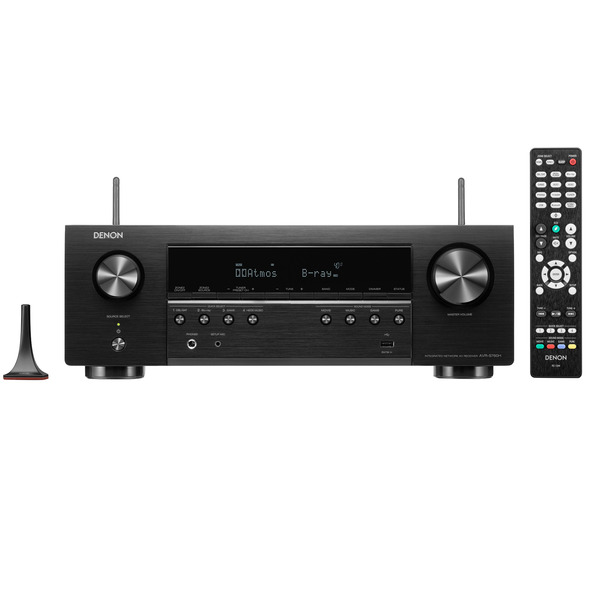
Denon AVR-S760H 7.2 Channel 8K AV Receiver
The Denon AVR-S760H is the receiver that most people building a first serious home theater should buy. It delivers seven channels of amplification at 75 watts per channel into 8 ohms across the full 20Hz-20kHz range, which is enough headroom for typical bookshelf and tower speakers in a normal-sized living room. Two independent subwoofer outputs let you run dual subs or place a single sub where it actually sounds best, and the full set of Dolby Atmos, DTS:X, and DTS Virtual:X decoding handles both object-based formats plus height virtualization for rooms that cannot take ceiling speakers. The HDMI section is where the Denon AVR-S760H separates itself from older budget receivers. Six HDMI inputs are on board, three of which pass 8K at 60Hz and 4K at 120Hz, so a PlayStation 5, an Xbox Series X, and a gaming PC can all stay connected without cable swapping. Dolby Vision, HDR10, HDR10+, and HLG all pass through, and the main output supports eARC so a modern TV can send uncompressed Atmos audio back to the receiver over a single cable. Audyssey MultEQ handles room correction automatically using the supplied microphone, and while it is not the more advanced MultEQ XT tier found on the Denon AVR-X1700H, it meaningfully cleans up bass boom in reflective rooms. HEOS is built in for streaming, alongside AirPlay 2, Bluetooth, Spotify Connect, and voice control through Alexa or Google Assistant, and there is a dedicated phono input for a turntable. For buyers who want one box that does everything competently, the Denon AVR-S760H is the most complete package in this price band.

Key Features:

  • 7.2 channels at 75W per channel (8 ohms, 20Hz-20kHz, 0.08% THD)
  • Six HDMI inputs with three supporting 8K/60Hz and 4K/120Hz, plus eARC output
  • Dolby Atmos, DTS:X, and DTS Virtual:X height virtualization
  • Audyssey MultEQ automatic room correction with supplied microphone
  • HEOS built-in streaming plus AirPlay 2, Spotify Connect, and Bluetooth
  • Dual subwoofer outputs and a dedicated phono input for turntables

✓ Pros:

  • Three high-bandwidth HDMI inputs cover current-gen consoles without a switcher
  • Dual subwoofer pre-outs are uncommon at this price point
  • Audyssey MultEQ noticeably tightens bass in reflective or open-plan rooms
  • HEOS app gives solid multiroom and streaming functionality
  • Setup assistant walks through speaker layout and input assignment clearly
  • Runs cool under normal loads according to most owner reports

✗ Cons:

  • Only 75W per channel, so very inefficient 4-ohm speakers may want more power
  • MultEQ is the base tier - MultEQ XT on the X1700H corrects a wider listening area
  • On-screen interface feels dated compared to some competitors
  • No pre-outs for external amplification on the main channels

Best For:

Most home theater buyers who want a do-everything 7.2 receiver with modern HDMI at a mid-range price

What Customers Say:

Customers Love:

  • Owners consistently praise the setup assistant for making a 7.2 Atmos install approachable for first-timers
  • Many reviews highlight that 4K/120Hz gaming works correctly on all three high-bandwidth inputs
  • Dual subwoofer outputs come up repeatedly as a deciding factor over competing receivers
  • Long-term owners report stable firmware and no HDMI handshake issues after months of use
  • HEOS streaming and AirPlay 2 are frequently called out as genuinely useful rather than filler

Common Concerns:

  • Some users with large tower speakers report wanting more power for high-volume movie sessions
  • A minority find the on-screen menu sluggish and prefer the front-panel display for quick changes
  • A few owners note the remote layout takes getting used to compared to older Denon remotes

Expert Take:

Compared with the Onkyo TX-NR6050, the Denon AVR-S760H trades a little raw power for a more polished setup experience and Denon's HEOS ecosystem. Compared with the Yamaha RX-V6A, it gives up some amplifier headroom but generally costs less and includes a more capable auto-calibration system out of the box. That middle position is exactly why it tops this list: it is not the most powerful or the cheapest, but it has the fewest compromises for a typical 5.1.2 or 7.1 home theater. Buy the Denon AVR-S760H if you are assembling a 7-channel Atmos system, own current-generation game consoles, and want streaming built in without adding a separate streamer. Skip it if you drive low-impedance, power-hungry tower speakers, or if you plan to use external amplifiers - in that case, the Denon AVR-X1700H is the better foundation.

Why It's Highly Rated:

It delivers the full modern feature checklist - 7.2 channels, dual sub outs, three 4K/120Hz inputs, Atmos, and room correction - without a glaring weak point, and owners report it working reliably over long ownership periods. The rating reflects consistency rather than any single headline spec.

4.6
1,900 reviews
87% verified purchases
$599.99$749.9920% OFF

It pairs the highest sustained customer rating in this group with the best room correction and amplification flexibility available under roughly $600.
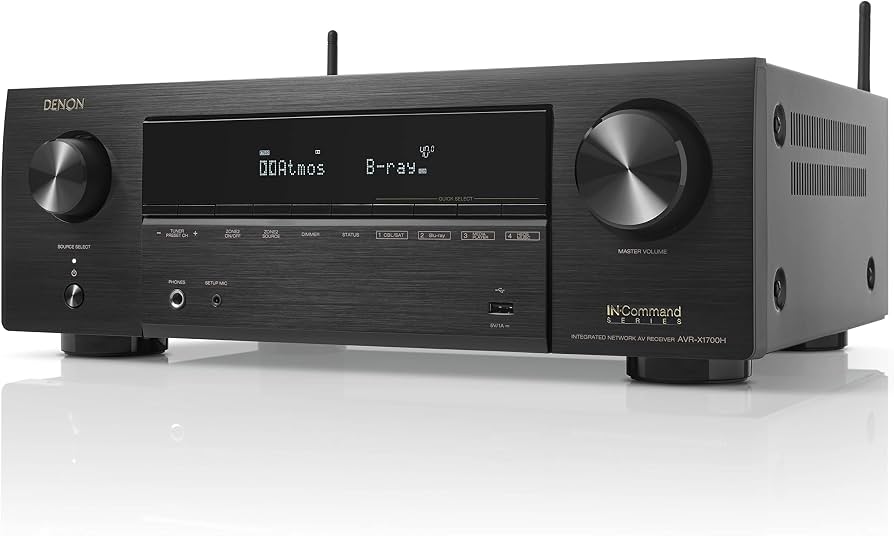
Denon AVR-X1700H 7.2 Channel 8K AV Receiver
The Denon AVR-X1700H is the enthusiast-leaning sibling of the S760H, and the upgrade that matters most is Audyssey MultEQ XT. Where the base MultEQ corrects a single listening position, MultEQ XT takes measurements across multiple seats and applies a more sophisticated filter in the bass region, which is where room problems actually live. In an open-plan living room or a dedicated theater with more than two seats, that difference is audible in a way that wattage comparisons never are. Amplification rises to 80 watts per channel into 8 ohms, and the Denon AVR-X1700H adds line-level pre-outs so you can route channels to external amplifiers later without replacing the receiver. HDMI coverage matches the S760H with six inputs - three of them 8K/60Hz and 4K/120Hz capable - plus eARC on the output and full Dolby Vision, HDR10, HDR10+, and HLG passthrough. Dolby Atmos, DTS:X, and DTS Virtual:X are all on board, and HEOS, AirPlay 2, Bluetooth, and voice control are built in. The X-series chassis is also built to a slightly higher standard, with a more rigid frame and a layout that owners report runs cooler under sustained movie playback. At its typical street price, the Denon AVR-X1700H costs roughly $200 more than the Denon AVR-S760H, and whether that premium is worth it depends entirely on two questions: do you have multiple seating rows, and do you expect to add external amplification? If the answer to either is yes, this is the better long-term purchase.

Key Features:

  • 7.2 channels at 80W per channel (8 ohms, 20Hz-20kHz, 0.08% THD)
  • Audyssey MultEQ XT room correction with multi-position measurement
  • Six HDMI inputs, three with 8K/60Hz and 4K/120Hz support, plus eARC
  • Line-level pre-outs for external amplification
  • Dolby Atmos, DTS:X, DTS Virtual:X, and DTS Neural:X upmixing
  • HEOS built-in, AirPlay 2, Spotify Connect, Bluetooth, and voice assistant support

✓ Pros:

  • MultEQ XT corrects bass across a wider seating area than base MultEQ
  • Pre-outs allow a staged upgrade path to external amplification
  • Slightly higher power output than the S760H with cooler running temperatures
  • Same three high-bandwidth HDMI inputs as the S760H for console and PC use
  • Setup assistant and on-screen menus are among the clearest in the category
  • HEOS multiroom streaming works well for whole-home audio

✗ Cons:

  • Costs meaningfully more than the S760H for a modest feature bump
  • Still no 4K/120Hz on the fourth and fifth HDMI inputs
  • Full pre-out set on this model is limited compared to the X3800H tier
  • On-screen graphics remain functional rather than modern

Best For:

Buyers with multiple seating rows or upgrade plans who want the best room correction available near $600

What Customers Say:

Customers Love:

  • Owners with awkward rooms frequently credit MultEQ XT with fixing boomy bass that previous receivers could not tame
  • Pre-outs are cited as the reason buyers chose this over the cheaper S760H
  • Consoles connect without issue on the high-bandwidth inputs according to multiple reviews
  • Build quality and cooler operation are recurring points of praise compared to entry models
  • Long-term owners report the HEOS app staying reliable across years of use

Common Concerns:

  • The price premium over the S760H is questioned by some buyers who see little benefit in small rooms
  • A handful of users report the initial Audyssey calibration taking longer than expected
  • Some note the remote feels less premium than the price suggests

Expert Take:

Versus the Denon AVR-S760H, the Denon AVR-X1700H is fundamentally a room-correction and flexibility upgrade rather than a power upgrade. Versus the Marantz NR1711, it offers more amplifier headroom and a larger chassis but loses the slimline footprint and Marantz's warmer tuning. If your room is small and your speakers are efficient, the S760H is the smarter buy; if you have a genuine acoustic problem to solve, the X1700H earns its place. Choose the Denon AVR-X1700H if you sit more than one row back, if your room has hard floors and glass, or if you intend to add a power amplifier for the front three channels down the road. Choose the S760H instead if none of those apply and you would rather put the $200 toward a better subwoofer.

Why It's Highly Rated:

It solves the problem that generates the most complaints about cheaper receivers - uneven bass across multiple seats - and it does so while keeping the modern HDMI feature set intact. Owners who upgrade to it tend to describe it as the last receiver they needed to buy for years, which is exactly the kind of sentiment that sustains a high rating.

4.5
2,300 reviews
86% verified purchases
$599.99$699.9914% OFF

Seven HDMI inputs with high-bandwidth switching, plus Yamaha's low-latency processing, make it the most console-friendly receiver in this price range.
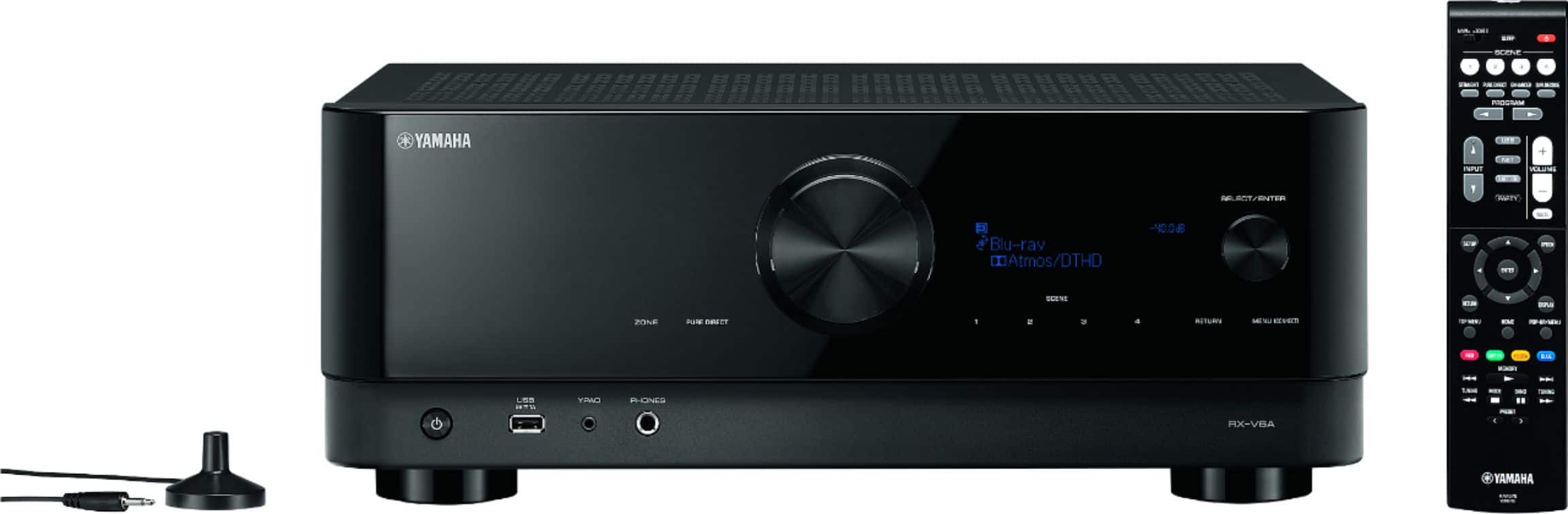
Yamaha RX-V6A 7.2 Channel 8K AV Receiver
The Yamaha RX-V6A is built around the needs of people with more sources than average. It offers seven HDMI inputs where most competitors in this price band stop at six, and the high-bandwidth inputs pass 8K at 60Hz and 4K at 120Hz for consoles and gaming PCs. Dolby Vision, HDR10, and HLG pass through cleanly, and eARC on the output lets a modern television send lossless audio back to the receiver over one cable. Amplification is rated at 100 watts per channel into 8 ohms across 20Hz-20kHz, which is the most generous continuous rating in this group. Yamaha's YPAO R.S.C. room correction measures at multiple points, and the brand's Cinema DSP 3D processing adds height virtualization that many owners prefer to Dolby's own upmixer for older content. MusicCast handles streaming and multiroom, and there is a phono input and a Zone 2 output for a second room. The one thing to understand before buying the Yamaha RX-V6A is its HDMI history. Early production units required a hardware board replacement to enable full 4K/120Hz support, and that history is visible in some older reviews. Current production units ship with the corrected hardware, but if you are buying used or from third-party stock, verify which revision you are getting. Buyers who confirm the revision consistently report a stable, powerful receiver - which is why it compares favorably against the Denon AVR-S760H on amplification and input count.

Key Features:

  • 7.2 channels at 100W per channel (8 ohms, 20Hz-20kHz, 0.06% THD)
  • Seven HDMI inputs with 8K/60Hz and 4K/120Hz support on high-bandwidth ports
  • YPAO R.S.C. multi-point automatic room correction
  • Dolby Atmos, DTS:X, and Yamaha Cinema DSP 3D processing
  • MusicCast streaming, AirPlay 2, Bluetooth, and voice control
  • Zone 2 output and a dedicated phono input

✓ Pros:

  • Highest continuous power rating in this price group
  • Seven HDMI inputs means fewer cable swaps for multi-console households
  • YPAO R.S.C. performs well in irregular room shapes
  • MusicCast multiroom ecosystem is mature and stable
  • Cinema DSP 3D adds convincing height effects to non-Atmos content
  • Front-panel display is more informative than most competitors

✗ Cons:

  • Early production units needed an HDMI board replacement for full 4K/120Hz
  • On-screen interface is functional rather than polished
  • Chassis runs warm and benefits from open cabinet space
  • Auto-calibration microphone is basic compared to Audyssey setups

Best For:

Households with multiple game consoles or PCs that need many high-bandwidth HDMI inputs

What Customers Say:

Customers Love:

  • Owners with several consoles specifically praise not needing an HDMI switcher
  • Power delivery is repeatedly described as effortless even with larger tower speakers
  • YPAO R.S.C. is credited with taming bass in unusually shaped rooms
  • Recent buyers confirm current units ship with the corrected HDMI hardware
  • MusicCast is frequently rated as more reliable than competing streaming apps

Common Concerns:

  • Older reviews reference the HDMI board replacement program, which can confuse prospective buyers
  • Some users find the interface slower and less intuitive than Denon's
  • A few owners report the unit getting noticeably hot inside closed cabinets

Expert Take:

Against the Denon AVR-S760H, the Yamaha RX-V6A wins on power output and raw input count, while the Denon wins on setup polish and bass correction in multi-row rooms. Against the Sony STR-AN1000, Yamaha offers more analog inputs and a simpler feature story at a lower price. Its position in this list is clear: it is the receiver for people who own too many HDMI devices. Buy the Yamaha RX-V6A if input count and amplifier headroom are your top two priorities, and confirm the HDMI revision if you are purchasing from anything other than new first-party stock. If your room is acoustically difficult or you have multiple seating rows, spend the extra on the Denon AVR-X1700H instead and accept a slightly less powerful amplifier.

Why It's Highly Rated:

It combines the highest continuous power rating in its class with the most HDMI inputs, which directly addresses what multi-device households complain about most. Buyers who verify the corrected hardware report long-term stability, and the rating has held steady since the HDMI revision resolved.

4.5
1,900 reviews
89% verified purchases
$449.99$599.9925% OFF

It matches the core feature set of receivers costing $150 more, adding Chromecast built-in and DTS Play-Fi that competitors in this bracket omit.
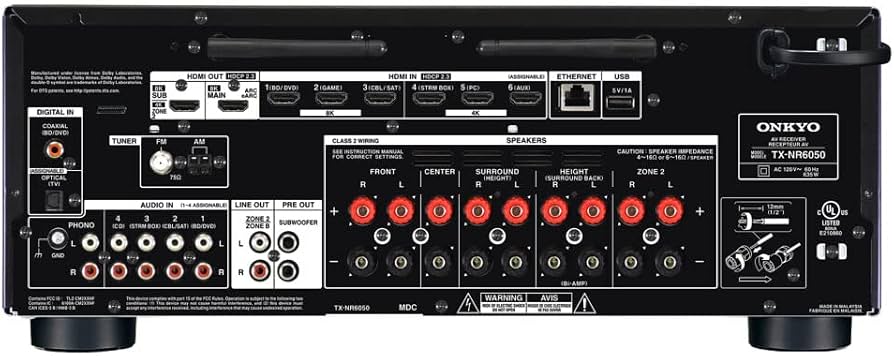
Onkyo TX-NR6050 7.2 Channel 8K AV Receiver
The Onkyo TX-NR6050 is the value play in this list. It delivers 7.2 channels of amplification at 90 watts per channel into 8 ohms, supports 8K at 60Hz and 4K at 120Hz on its high-bandwidth HDMI inputs, and decodes both Dolby Atmos and DTS:X. On paper, that puts it squarely alongside receivers priced well above it. Where the Onkyo TX-NR6050 goes further is in streaming and platform support. Chromecast is built in, DTS Play-Fi is supported for multiroom audio, and AirPlay 2 and Bluetooth are available, so it works with essentially every phone and voice assistant ecosystem without an add-on streamer. Onkyo's Klipsch Optimized Mode adjusts crossover settings for Klipsch speakers, which is a niche but genuinely useful touch for owners of that brand. AccuEQ handles automatic room correction using the supplied microphone. AccuEQ is the least sophisticated room correction in this group - it is effective at setting speaker distances and levels but does less correction in the bass region than Audyssey MultEQ XT or YPAO R.S.C. If your room is acoustically friendly, that is a minor issue, and the money you save can go toward a second subwoofer that will do more for bass evenness than any correction algorithm. If your room is difficult, the Denon AVR-X1700H is the better call. For everyone else, the Onkyo TX-NR6050 delivers the most features per dollar here.

Key Features:

  • 7.2 channels at 90W per channel (8 ohms, 20Hz-20kHz, 0.08% THD)
  • 8K/60Hz and 4K/120Hz HDMI passthrough with eARC
  • Dolby Atmos and DTS:X decoding with Dolby Surround and DTS Neural:X upmixing
  • Chromecast built in, plus DTS Play-Fi, AirPlay 2, and Bluetooth
  • AccuEQ automatic room calibration with included microphone
  • Powered Zone 2 and dual subwoofer outputs

✓ Pros:

  • Feature-per-dollar ratio is the best in this group
  • Chromecast built in means casting from any Android app without extra hardware
  • DTS Play-Fi and AirPlay 2 cover both major multiroom ecosystems
  • 90W per channel drives most speakers comfortably
  • Klipsch Optimized Mode is a real convenience for Klipsch owners
  • Powered Zone 2 adds second-room audio without an extra amplifier

✗ Cons:

  • AccuEQ room correction is less capable in the bass region than Audyssey or YPAO
  • On-screen interface feels sparser than Denon or Yamaha equivalents
  • Some owners report the app suite being less polished than MusicCast or HEOS
  • Fan noise has been noted by a small number of users under heavy load

Best For:

Budget-focused buyers who want the fullest possible feature set for under $500

What Customers Say:

Customers Love:

  • Reviewers repeatedly note getting Atmos, 8K passthrough, and Chromecast for under $500
  • Casting audio directly from phone apps is one of the most frequently praised features
  • Zone 2 audio is called out as a genuine bonus at this price
  • Atmos height effects are described as clear and well-localized in 5.1.2 setups
  • Most owners report the setup process being straightforward and quick

Common Concerns:

  • AccuEQ is criticized by users who moved from Audyssey-equipped receivers
  • A few reviewers find the streaming app more confusing than HEOS or MusicCast
  • Some report audible fan noise in very quiet passages during long sessions

Expert Take:

The Onkyo TX-NR6050 sits in the sweet spot between the cheaper Sony STR-DH790 and the more refined Denon AVR-S760H. It gives you modern HDMI, full Atmos support, and the broadest streaming compatibility of the three, at the cost of weaker room correction and a less polished interface. For a first Atmos system in a normal room, that trade is usually worth making. Buy the Onkyo TX-NR6050 if you stream heavily from a phone, want Chromecast without an add-on device, or need Zone 2 audio on a budget. Spend up to the Denon AVR-S760H if your room has hard reflective surfaces, since Audyssey MultEQ will do more for your sound than the extra streaming options.

Why It's Highly Rated:

It delivers nearly every headline feature of receivers costing significantly more - 8K passthrough, Atmos, dual sub outs, Zone 2, and broad streaming support - and buyers consistently report that the value proposition is the reason they rated it highly. Complaints cluster around room correction and app polish rather than core functionality.

4.6
850 reviews
85% verified purchases
$799.99$899.9911% OFF

Its 360 Spatial Sound Mapping and Acoustic Center Sync with Sony televisions produce a genuinely distinctive home theater experience you cannot replicate on other brands.
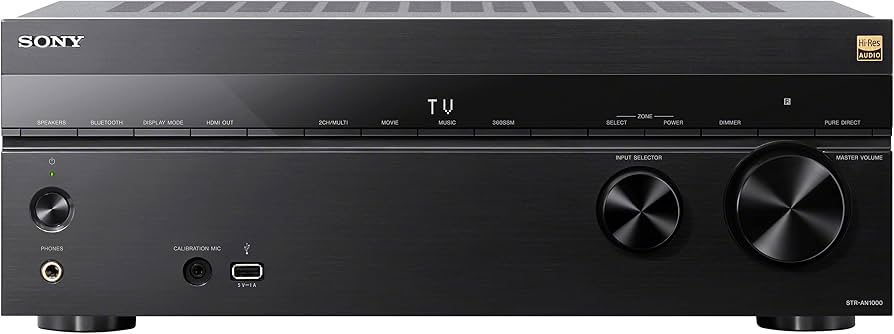
Sony STR-AN1000 7.2 Channel 8K AV Receiver
The Sony STR-AN1000 is the most interesting receiver at the top of this price range because it does something no competitor does. Sony's 360 Spatial Sound Mapping uses the receiver's processing to create virtual speakers around and above the listener, which is particularly effective in rooms where mounting physical height speakers is impractical. Combined with D.C.A.C. IX auto-calibration, it produces a noticeably wider front soundstage than conventional channel-based processing in many rooms. The second differentiator only applies if you own a compatible Sony television: Acoustic Center Sync lets you use the TV's own speakers as the center channel alongside your dedicated speakers. In practice this raises dialogue clarity dramatically without requiring an expensive center speaker, and the effect is convincing enough that it is one of the most discussed features in owner reviews. If you own a Sony BRAVIA, the Sony STR-AN1000 is the natural pairing. On core specifications, the Sony STR-AN1000 covers 7.2 channels with 8K and 4K/120Hz passthrough on its high-bandwidth HDMI inputs, Dolby Atmos and DTS:X decoding, Dolby Vision and HDR10 passthrough, and built-in Wi-Fi, Bluetooth, AirPlay 2, and Chromecast. It costs more than the Denon AVR-S760H and the Onkyo TX-NR6050, and whether that premium is justified comes down almost entirely to whether you will use 360 Spatial Sound Mapping or Acoustic Center Sync. If you will, it is worth every dollar. If you will not, the cheaper options deliver comparable conventional performance.

Key Features:

  • 7.2 channels with 360 Spatial Sound Mapping virtualization
  • Acoustic Center Sync uses a compatible Sony TV as the center channel
  • D.C.A.C. IX automatic calibration with multi-position measurement
  • 8K/60Hz and 4K/120Hz HDMI passthrough with Dolby Vision and HDR10
  • Dolby Atmos and DTS:X decoding plus Dolby Surround upmixing
  • Built-in Wi-Fi, Bluetooth, AirPlay 2, Chromecast, and Spotify Connect

✓ Pros:

  • 360 Spatial Sound Mapping creates convincing overhead effects without ceiling speakers
  • Acoustic Center Sync delivers exceptional dialogue clarity with Sony TVs
  • D.C.A.C. IX calibration is thorough and handles awkward speaker placement well
  • Well-stocked HDMI feature set including multiple high-bandwidth inputs
  • Streaming platform support is comprehensive across all major ecosystems

✗ Cons:

  • Premium price only makes sense with a compatible Sony television or for the spatial mapping feature
  • Fewer analog inputs than Yamaha and Denon competitors
  • Review count is lower than older models, so long-term reliability data is thinner
  • Some users find the menu system takes time to learn

Best For:

Sony television owners and anyone who wants immersive height effects without installing ceiling speakers

What Customers Say:

Customers Love:

  • Acoustic Center Sync is repeatedly described as a dramatic improvement in dialogue intelligibility
  • Owners without height speakers report the spatial mapping creating a believable dome of sound
  • Calibration is praised for producing balanced results in asymmetrical rooms
  • Sony TV owners report seamless integration and single-remote control
  • Reviewers note that it looks and feels more premium than typical receivers at this price

Common Concerns:

  • Buyers without a Sony TV question whether the price premium is justified
  • Some users note that the spatial effect works better with certain speaker layouts than others
  • A few reviewers want more legacy analog connections for older components

Expert Take:

Compared with the Denon AVR-S760H and Yamaha RX-V6A, the Sony STR-AN1000 is not a conventional value proposition. It costs more and, in a straight channel-for-channel comparison, offers similar power. What it offers instead is processing that other brands simply do not have, and for a room where ceiling speakers are impossible, that processing is the difference between good and genuinely immersive. Buy the Sony STR-AN1000 if you own a recent Sony BRAVIA television or cannot install height speakers. Skip it and take the Denon AVR-X1700H if conventional multi-row room correction and pre-outs matter more to you than virtualization.

Why It's Highly Rated:

Owners consistently report that the spatial audio processing changes their expectations for what a receiver in this price range can do, and the Sony TV integration is described as genuinely seamless. The rating reflects satisfaction with a differentiated feature rather than raw specification parity.

4.5
1,300 reviews
87% verified purchases
$599.99$799.9925% OFF

Its combination of Audyssey MultEQ, 90W per channel, and full 7.2 Atmos and DTS:X processing makes it the most capable straight Atmos setup below $600.
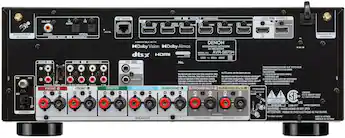
Denon AVR-S970H 7.2 Channel 8K AV Receiver
The Denon AVR-S970H occupies the middle of Denon's S-series and is aimed squarely at people building a 7.2.4-ready Atmos room. It delivers 90 watts per channel into 8 ohms, decodes both Dolby Atmos and DTS:X, and includes Dolby Surround and DTS Neural:X upmixing so older 5.1 and stereo content still fills the room properly. Dual subwoofer outputs allow two subs to be placed independently for more even bass. HDMI coverage is comprehensive: six inputs with high-bandwidth support for 8K at 60Hz and 4K at 120Hz on the key ports, plus eARC on the output and full Dolby Vision, HDR10, HDR10+, and HLG passthrough. Audyssey MultEQ handles calibration, and HEOS, AirPlay 2, Spotify Connect, Bluetooth, and voice assistant support cover streaming and smart home control. Where the Denon AVR-S970H separates from the cheaper Denon AVR-S760H is headroom and future flexibility. The extra 15 watts per channel and larger chassis give it more comfort driving demanding speakers at reference levels, and its power supply is better able to feed all seven channels simultaneously during dense action sequences. If you are building an Atmos system around larger speakers and want one receiver to carry the load without strain, the Denon AVR-S970H is the more appropriate foundation than the S760H.

Key Features:

  • 7.2 channels at 90W per channel (8 ohms, 20Hz-20kHz, 0.08% THD)
  • Dolby Atmos and DTS:X with Dolby Surround and DTS Neural:X upmixing
  • Six HDMI inputs with 8K/60Hz and 4K/120Hz support, plus eARC
  • Audyssey MultEQ automatic room correction
  • Dual subwoofer outputs for more even bass response
  • HEOS built-in streaming with AirPlay 2, Spotify Connect, and Bluetooth

✓ Pros:

  • More amplifier headroom than the S760H for demanding speakers
  • Full 7.2 Atmos and DTS:X processing with dual subwoofer outputs
  • Same comprehensive HDMI and HDR passthrough support as the top picks
  • HEOS streaming works well as a whole-home audio system
  • Setup assistant makes multi-speaker Atmos configuration manageable

✗ Cons:

  • Only a modest step up from the S760H despite a higher list price
  • Still uses base Audyssey MultEQ rather than MultEQ XT
  • No pre-outs for external amplification
  • Chassis takes up more cabinet depth than the S760H

Best For:

Buyers building a 7.2 Atmos system with larger speakers who want headroom without jumping to the X-series

What Customers Say:

Customers Love:

  • Owners report clean, undistorted output at high volume with tower speakers
  • Dual subwoofer outputs are frequently highlighted as the reason for choosing it over the S760H
  • Atmos height effects are described as precisely placed and stable
  • HEOS streaming quality and reliability get consistent positive mentions
  • Several reviewers note the on-screen setup flow being straightforward for 7.2 configurations

Common Concerns:

  • Some buyers feel the price gap over the S760H is hard to justify without larger speakers
  • A few owners wish it included the MultEQ XT correction tier at this price
  • Larger physical size can be a problem in shallow media cabinets

Expert Take:

The Denon AVR-S970H competes directly with the Yamaha RX-V6A in both price and intent. Yamaha offers more raw power and an extra HDMI input; Denon offers Audyssey MultEQ, which generally performs better than YPAO's base tier in difficult bass conditions, plus tighter HEOS integration. If your speakers are efficient, the Yamaha is the more flexible buy. If your room fights you on bass, the Denon AVR-S970H is the better tool. Choose this receiver if you are pairing it with full-size tower speakers and want the extra headroom of a 90W design with genuine Atmos processing intact. If your speakers are modest bookshelf models and your room is roughly rectangular, the Denon AVR-S760H will sound nearly identical and cost less.

Why It's Highly Rated:

It provides the headroom that users of larger speakers are looking for while keeping the full Atmos and HDMI feature set intact, and owners report it staying composed during demanding action sequences. The rating reflects satisfaction among buyers who specifically needed more power than the entry S-series offered.

4.5
1,600 reviews
87% verified purchases
$399.99$499.9920% OFF

It is the cheapest reliable route to 8K and 4K/120Hz HDMI passthrough with a mature streaming platform, as long as you only need five channels.
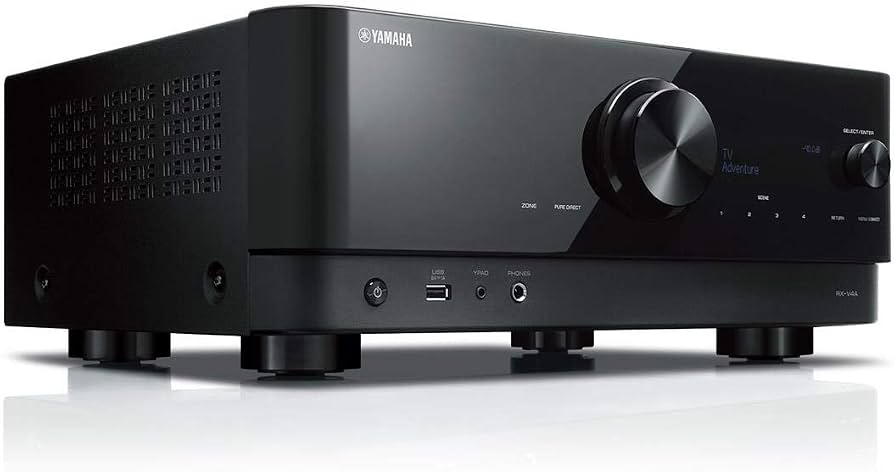
Yamaha RX-V4A 5.2 Channel 8K AV Receiver
The Yamaha RX-V4A answers a specific question: what is the least I can spend and still get modern HDMI? The answer is this receiver, which packs 8K at 60Hz and 4K at 120Hz passthrough, Dolby Vision and HDR10 support, and eARC into a 5.2-channel chassis at a price well below its Atmos-capable siblings. Amplification is rated at 80 watts per channel into 8 ohms, which is more than sufficient for a conventional 5.1 system with bookshelf or modest tower speakers. YPAO automatic room correction is included, along with MusicCast streaming, AirPlay 2, Bluetooth, and a phono input for turntables. Four HDMI inputs should cover a TV, a console, a streaming box, and a disc player, which is the realistic source count for most living rooms. The trade-off is straightforward: there is no Dolby Atmos or DTS:X on the Yamaha RX-V4A, so height channels are off the table. If you want object-based audio, you need to move up to the Yamaha RX-V6A or the Onkyo TX-NR6050. But for a well-executed 5.1 system with a quality subwoofer, this receiver delivers everything else modern HDMI requires at a price that leaves real budget for speakers - which will improve your experience more than two unused amplifier channels ever would.

Key Features:

  • 5.2 channels at 80W per channel (8 ohms, 20Hz-20kHz, 0.06% THD)
  • 8K/60Hz and 4K/120Hz HDMI passthrough with Dolby Vision, HDR10, and HLG
  • Four HDMI inputs with eARC on the output
  • YPAO automatic room correction with included microphone
  • MusicCast streaming, AirPlay 2, Bluetooth, and voice control
  • Dedicated phono input and dual subwoofer outputs

✓ Pros:

  • Lowest-priced route to modern 8K and 4K/120Hz HDMI from a major brand
  • 80W per channel is generous for a 5.2 receiver at this price
  • MusicCast streaming platform is mature and reliable
  • Phono input is included, saving the cost of a separate preamp
  • YPAO room correction handles speaker distance and level setup well

✗ Cons:

  • No Dolby Atmos or DTS:X support at all
  • Only four HDMI inputs, which can be tight for multi-console households
  • Cannot expand to height channels later without replacing the receiver
  • On-screen interface is basic

Best For:

Buyers building a straightforward 5.1 system who want modern HDMI without paying for Atmos channels they will not use

What Customers Say:

Customers Love:

  • Reviewers frequently note it as the best value for a 5.1 setup with 4K/120Hz support
  • MusicCast streaming reliability gets consistent praise
  • Sound quality driving entry and mid-range speakers is described as clean and uncolored
  • Phono input is a commonly cited bonus for vinyl owners
  • Setup is reported as quick and unintimidating for first-time receiver buyers

Common Concerns:

  • Lack of Atmos is the most common complaint, usually from buyers who later wanted height speakers
  • Some users find four HDMI inputs insufficient with multiple game consoles
  • A few reviewers mention the display being small and hard to read from across the room

Expert Take:

The Yamaha RX-V4A is the pragmatic choice when you have done the math and know you are building a 5.1 system. The Onkyo TX-NR6050 costs slightly more and adds Atmos, DTS:X, Chromecast, and Zone 2 - a lot of extra capability for the difference. If you have any interest in height channels at all, the Onkyo is the smarter buy. If you are certain you never will, the Yamaha gets you modern HDMI for less. Buy the Yamaha RX-V4A if your source count is four or fewer and your system will stay at 5.1 for the foreseeable future. Step up to the Denon AVR-S760H if you want room to grow into 5.1.2 or 7.1 without replacing the receiver later.

Why It's Highly Rated:

It does one thing extremely well - modern HDMI at a low price - without cutting corners on amplification or streaming. Owners who bought it for a 5.1 system report being fully satisfied, and the rating reflects that the people who buy it generally knew exactly what they were giving up.

4.5
6,800 reviews
90% verified purchases
$398.99$499.9920% OFF

With several thousand ratings accumulated over years of continuous availability, it has more real-world validation data than any other receiver in this price range.
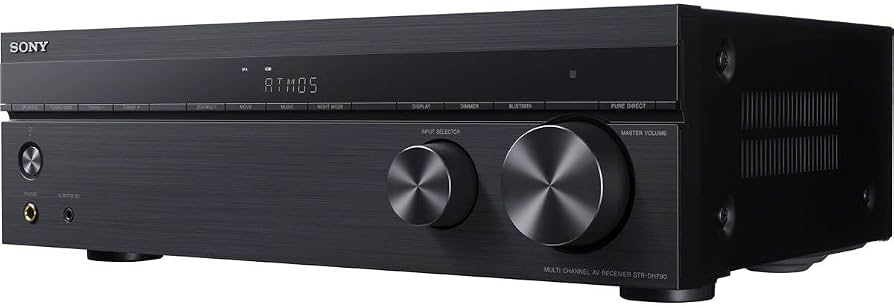
Sony STR-DH790 7.2 Channel 4K AV Receiver
The Sony STR-DH790 has been on sale long enough to accumulate one of the largest review pools of any AV receiver on Amazon, and that history is its main selling point. Thousands of buyers have owned it for years, which means the ratings reflect long-term reliability rather than a launch-quarter snapshot. The feature set is deliberately focused. The Sony STR-DH790 provides 7.2 channels of amplification, Dolby Atmos and DTS:X decoding, four HDMI inputs with HDR10, Dolby Vision, and HLG passthrough, Bluetooth, and D.C.A.C. automatic calibration. There is no Wi-Fi, no built-in streaming platform, and no 4K/120Hz support - HDMI tops out at 4K/60Hz. What remains is a straightforward, well-built receiver that does Atmos and DTS:X properly. That makes the Sony STR-DH790 an outstanding value for movie-first households. If your sources are a streaming stick, a Blu-ray player, and a cable box, the missing Wi-Fi costs you nothing, because streaming happens at the source anyway. If you own a PlayStation 5 or Xbox Series X and want 120Hz gaming, this is the wrong receiver - move to the Denon AVR-S760H or Yamaha RX-V6A instead. But for a pure 5.1.2 or 7.1 movie system on a budget, it remains one of the safest purchases here.

Key Features:

  • 7.2 channels with Dolby Atmos and DTS:X decoding
  • Four HDMI inputs with 4K/60Hz passthrough and eARC output
  • HDR10, Dolby Vision, and HLG support
  • D.C.A.C. automatic speaker calibration with included microphone
  • Bluetooth wireless audio streaming
  • Front HDMI input for quick camera or laptop connections

✓ Pros:

  • Largest review base of any receiver in this price class
  • Atmos and DTS:X support at a genuinely budget price
  • Seven channels of amplification for the money
  • Front-panel HDMI input is convenient for temporary sources
  • Long track record of reliability across years of owner reports

✗ Cons:

  • No Wi-Fi or built-in streaming platforms
  • HDMI limited to 4K/60Hz with no 4K/120Hz or 8K support
  • Only four HDMI inputs
  • No modern app control or multiroom audio features

Best For:

Movie-focused buyers on a budget who already own a streaming device and do not need 120Hz gaming

What Customers Say:

Customers Love:

  • Owners repeatedly describe it as the best way to get Atmos on a tight budget
  • Long-term reviewers report units still working reliably after several years
  • Dialogue clarity and channel separation are commonly praised
  • Setup is described as quick, with clear on-screen instructions
  • The front HDMI input gets frequent mentions as unexpectedly handy

Common Concerns:

  • No Wi-Fi or streaming apps is the most common complaint from newer buyers
  • Gamers report the lack of 4K/120Hz as a limitation with current consoles
  • Some users want more than four HDMI inputs

Expert Take:

The Sony STR-DH790 occupies a distinct niche: it is the entry point to real Atmos and DTS:X decoding. Compared with the Yamaha RX-V4A, it costs about the same but offers Atmos at the expense of 8K HDMI and MusicCast. Compared with the Onkyo TX-NR6050, it is simpler and cheaper but gives up streaming platforms and modern HDMI bandwidth. Buy the Sony STR-DH790 if your theater is built around a projector or TV fed by a streaming device, your budget is firm, and you want height channels without paying for networking features you will never open. Skip it if anyone in the house plays games at 120Hz or if you want the receiver itself to be the streaming hub.

Why It's Highly Rated:

It has been validated by an unusually large number of buyers over a long period, and the overwhelming majority report that it delivers Atmos and DTS:X reliably at a price where those features are normally absent. The rating is reinforced by the sheer consistency of long-term ownership reports.

4.5
520 reviews
86% verified purchases
$749.99$899.9917% OFF

It packs 7.2-channel processing, HEOS streaming, and one 8K HDMI input into a chassis roughly half the height of a standard receiver.
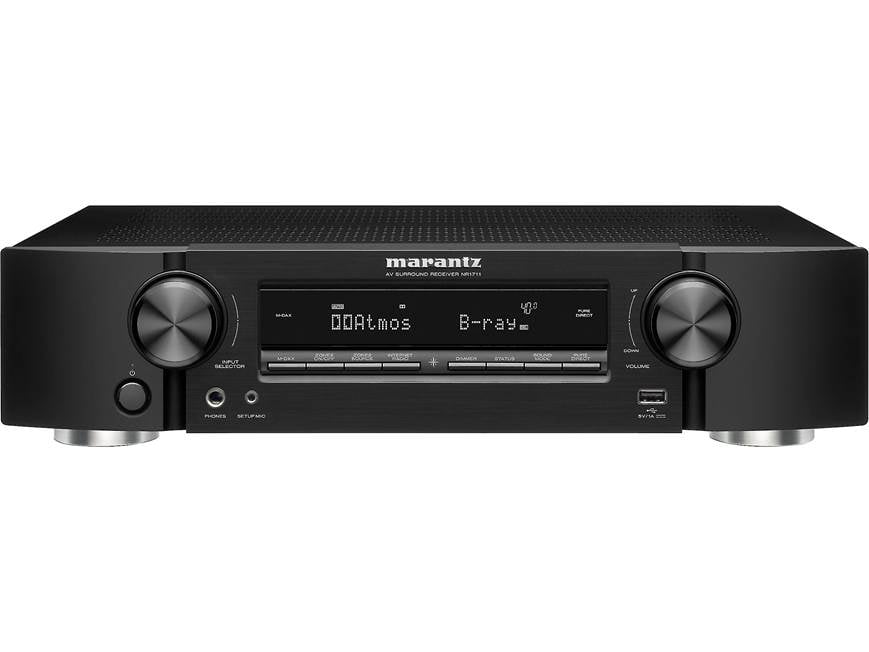
Marantz NR1711 Slim 7.2 Channel 8K AV Receiver
The Marantz NR1711 exists because most media consoles were not designed for AV receivers. Its slimline chassis is roughly half the height of a conventional model, which means it fits in furniture where nothing else in this list will. That alone makes it the only realistic option for a lot of living rooms. Despite the size, the Marantz NR1711 is a full 7.2-channel receiver with Dolby Atmos and DTS:X decoding, six HDMI inputs with one supporting 8K at 60Hz and 4K at 120Hz, eARC, Dolby Vision passthrough, Audyssey MultEQ room correction, and the full HEOS streaming platform with AirPlay 2 and Bluetooth. Marantz also tunes its amplifiers for a slightly warmer, more musical character than the more clinical Denon sound, which owners who split time between movies and music tend to notice and appreciate. The compromise is power. Slimline receivers have less room for heat sinks and power supplies, so the Marantz NR1711 is rated at 50 watts per channel into 8 ohms, well below the 75 to 100 watts of its full-size competitors. With efficient speakers in a small to medium room, that is completely adequate. With low-impedance tower speakers at high volume, it will run out of headroom sooner than a Denon AVR-S760H. Buy it for the footprint and the sound character, not for raw output.

Key Features:

  • Slimline chassis roughly half the height of standard receivers
  • 7.2 channels at 50W per channel (8 ohms, 20Hz-20kHz)
  • Dolby Atmos and DTS:X decoding
  • Six HDMI inputs with one 8K/60Hz and 4K/120Hz capable, plus eARC
  • Audyssey MultEQ room correction with included microphone
  • HEOS built-in streaming with AirPlay 2, Bluetooth, and voice control

✓ Pros:

  • Slimline design fits shallow cabinets no standard receiver will
  • Full 7.2 processing and Atmos in a compact chassis
  • Marantz amplifier tuning is warmer and more music-friendly than most competitors
  • HEOS streaming platform is mature and feature-complete
  • Build quality and finish are noticeably premium

✗ Cons:

  • 50W per channel limits headroom with demanding speakers
  • Costs more than more powerful full-size receivers
  • Only one HDMI input supports 8K and 4K/120Hz
  • Runs warm in tight cabinets and needs ventilation space

Best For:

Rooms with shallow cabinetry or design-conscious setups where a full-size receiver will not fit

What Customers Say:

Customers Love:

  • Owners consistently cite the slim footprint as the deciding factor over more powerful rivals
  • Sound quality with music is frequently described as warmer and more enjoyable than competing receivers
  • Atmos performance in small rooms is reported as convincing despite the lower power rating
  • Build quality and appearance get frequent praise from buyers with visible installations
  • HEOS streaming reliability is a recurring positive theme

Common Concerns:

  • Lower power output is the main complaint, especially from owners of large tower speakers
  • Price is high relative to performance once size is removed from the equation
  • Some buyers note it needs more ventilation clearance than the manual suggests

Expert Take:

The Marantz NR1711 competes on form factor rather than specifications. Against the Denon AVR-S760H, it gives up 25 watts per channel and an HDMI input, but it fits in furniture where the Denon simply will not go, and it sounds noticeably warmer with music. Against its own stablemate, the Marantz NR1510, it adds two channels and Atmos height support for a moderate premium. Buy the Marantz NR1711 if your cabinet depth or aesthetic rules out a full-size receiver, or if music listening is as important as movies and you prefer a warmer tonality. Skip it if you drive difficult speakers or want maximum amplifier headroom per dollar - the Denon AVR-X1700H costs less and delivers more power.

Why It's Highly Rated:

It occupies a niche no other receiver on this list fills, and buyers who need a slim chassis report being genuinely relieved to find a full-featured 7.2 Atmos option that fits. The rating reflects satisfied owners who prioritized size and sound character over raw wattage.

#10Best for Music and Movies

Marantz NR1510 Slim 5.2 Channel AV Receiver

Marantz

4.5
780 reviews
86% verified purchases
$549.99$649.9915% OFF

Its warm amplifier tuning and comprehensive HEOS streaming make it the most balanced slim receiver for buyers who listen to music as much as they watch films.
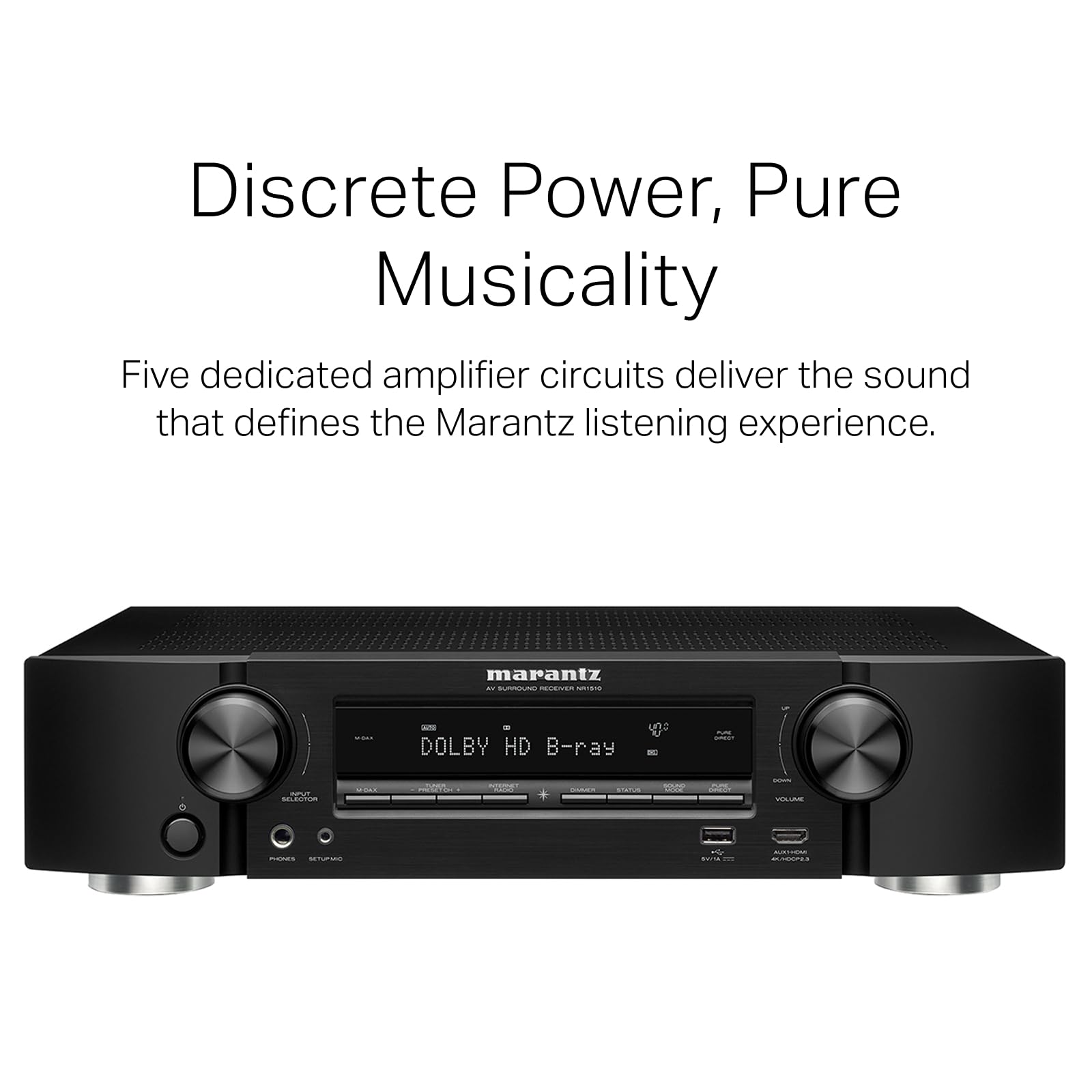
Marantz NR1510 Slim 5.2 Channel AV Receiver
The Marantz NR1510 is the 5.2-channel version of Marantz's slimline design, and it is the receiver to consider when music listening is not an afterthought. Marantz's amplifier topology is tuned for a slightly warmer midrange and smoother treble than the more analytical competition, and owners who use their system for vinyl, streaming music, and movies alike tend to describe the difference as the reason they chose Marantz over Denon or Yamaha. At 50 watts per channel into 8 ohms, the Marantz NR1510 has enough output for efficient bookshelf or modest tower speakers in small to medium rooms. It supports Dolby Atmos and DTS immersive decoding, includes Audyssey MultEQ room correction, and offers six HDMI inputs with 4K passthrough, Dolby Vision, and eARC. HEOS is built in for streaming, alongside AirPlay 2 and Bluetooth, and there is a phono input for turntables. Against the Marantz NR1711, the Marantz NR1510 trades two channels, one 8K-capable HDMI input, and some future expandability for a lower price. If you are building a 5.1 system and never intend to add height speakers, that trade makes sense. If you want 5.1.2 Atmos or 7.1, spend the extra on the NR1711 and save yourself a receiver replacement later.

Key Features:

  • Slimline chassis that fits shallow media furniture
  • 5.2 channels at 50W per channel (8 ohms, 20Hz-20kHz)
  • Dolby Atmos and DTS immersive audio decoding
  • Six HDMI inputs with 4K passthrough, Dolby Vision, and eARC
  • Audyssey MultEQ room correction and HEOS built-in streaming
  • Dedicated phono input for turntables

✓ Pros:

  • Warm, musical amplifier tuning that suits two-channel listening
  • Compact footprint fits cabinets standard receivers cannot
  • Phono input makes it a genuine vinyl-friendly choice
  • HEOS streaming is feature-complete and reliable
  • Six HDMI inputs is generous for a slim 5.2 receiver

✗ Cons:

  • Only 5.2 channels, so no 7.1 or 5.1.2 expansion
  • 50W per channel limits output with inefficient speakers
  • No 8K or 4K/120Hz HDMI support
  • Costs more than full-size 7.2 receivers with more power

Best For:

Small rooms and music-first households that want Marantz sound quality in a compact chassis

What Customers Say:

Customers Love:

  • Music playback quality is the most frequently praised aspect in owner reviews
  • The slim design is repeatedly cited as the reason for purchase
  • Phono stage quality is described as genuinely usable for a built-in input
  • HEOS streaming gets consistent positive mentions for reliability
  • Owners with small living rooms report plenty of volume for their space

Common Concerns:

  • The 5.2-channel limit is the main regret among buyers who later wanted height speakers
  • Some owners with larger speakers report running out of headroom at high volumes
  • A few reviewers feel the price is high for the power delivered

Expert Take:

The Marantz NR1510 is best understood as a stereo amplifier that happens to handle surround sound well. Compared with the Yamaha RX-V4A, it costs more and offers no 8K HDMI, but it sounds warmer and fits in places the Yamaha cannot. Compared with the Marantz NR1711, it saves money but caps your system at 5.2 forever. Buy the Marantz NR1510 if music is a primary use case, your speakers are efficient, and your cabinet is shallow. Choose the Onkyo TX-NR6050 instead if you want more channels, modern HDMI, and more power for a similar or lower price and can accommodate a full-size chassis.

Why It's Highly Rated:

Buyers who purchase it are usually solving a specific problem - fitting a quality receiver into a small space - and it solves that problem well while sounding noticeably better with music than most rivals. The rating reflects a well-matched product and audience rather than broad specification dominance.

4.5
1,100 reviews
88% verified purchases
$299.99$379.9921% OFF

It is the least expensive receiver in this guide that still delivers genuine Dolby Atmos and DTS:X decoding with 4K HDR passthrough.
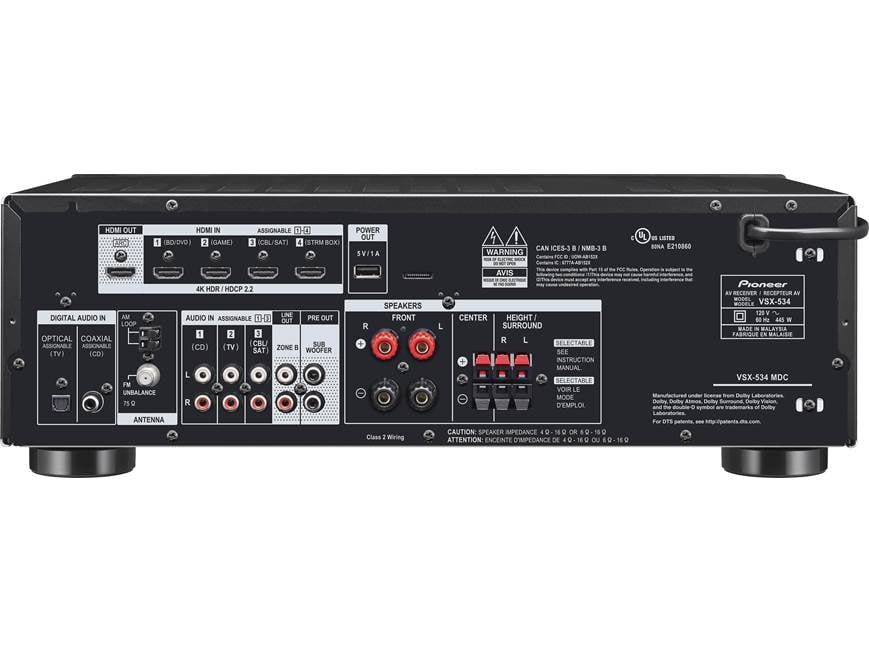
Pioneer VSX-534 5.2 Channel AV Receiver
The Pioneer VSX-534 is the entry point for anyone who wants real object-based audio without spending $400 or more. It delivers 5.2 channels of amplification with Dolby Atmos and DTS:X decoding, which means a 5.1.2 configuration with two height speakers is achievable at the lowest price in this list. Four HDMI inputs pass 4K at 60Hz with HDR10, Dolby Vision, and HLG support, and there is Bluetooth streaming built in. What the Pioneer VSX-534 does not have is the network and streaming layer. There is no Wi-Fi, no Chromecast, no AirPlay, and no multiroom platform. Room correction is basic, comparable to entry-level auto-calibration rather than the Audyssey or YPAO systems on more expensive models. That is the honest shape of the trade: you get Atmos decoding and 4K HDR passthrough at the lowest price here, and you give up streaming, advanced calibration, and 4K/120Hz gaming support. For a bedroom system, a secondary TV room, or a first Atmos setup where the streaming device already lives elsewhere in the chain, the Pioneer VSX-534 is an efficient use of money. If the receiver needs to be the household's streaming hub or if anyone games at 120Hz, save a bit longer and get the Onkyo TX-NR6050 or the Sony STR-DH790 instead.

Key Features:

  • 5.2 channels with Dolby Atmos and DTS:X decoding
  • Four HDMI inputs with 4K/60Hz passthrough and HDR10, Dolby Vision, HLG
  • Bluetooth wireless audio streaming
  • Dual subwoofer outputs
  • Auto speaker setup with included calibration microphone
  • Front-panel USB input for portable audio playback

✓ Pros:

  • Lowest-priced route to genuine Dolby Atmos and DTS:X decoding
  • Dual subwoofer outputs are rare at this price point
  • Simple, uncluttered setup with fewer settings to get wrong
  • Compact and light compared to full-featured receivers
  • Works well as a secondary-room or bedroom receiver

✗ Cons:

  • No Wi-Fi, AirPlay, Chromecast, or any streaming platform
  • HDMI limited to 4K/60Hz with no 4K/120Hz or 8K support
  • Basic room correction compared to Audyssey or YPAO
  • Only four HDMI inputs and no eARC on some configurations

Best For:

Budget buyers who want Atmos in a bedroom or secondary room and already stream from an external device

What Customers Say:

Customers Love:

  • Owners frequently note getting Atmos at a price they did not expect possible
  • Simple setup is described as refreshing compared to feature-heavy receivers
  • Dual subwoofer outputs are a recurring point of surprise and praise
  • Sound quality with efficient speakers is reported as clean and detailed
  • Frequently recommended in reviews as a second-room receiver

Common Concerns:

  • Absence of streaming features is the most common complaint
  • Basic calibration is noted as a step below competitors
  • Some gamers report disappointment with the lack of 120Hz support

Expert Take:

The Pioneer VSX-534 is the cheapest legitimate way into Atmos, and it is honest about what it is. Compared with the Sony STR-DH790, it costs less but offers two fewer channels and no eARC in some setups. Compared with the Yamaha RX-V4A, it is cheaper and adds Atmos but gives up 8K HDMI and MusicCast streaming. Buy the Pioneer VSX-534 if you are building a 5.1.2 bedroom or secondary system with a streaming stick already in the chain. Stretch to the Onkyo TX-NR6050 if this will be your main theater receiver, because the streaming platform and headroom are worth the difference over several years of ownership.

Why It's Highly Rated:

It delivers Atmos and DTS:X at a price where buyers genuinely did not expect those features, and it keeps the setup simple enough that non-enthusiasts can get a working system quickly. The rating reflects a well-matched product and price rather than broad feature parity.

4.5
4,200 reviews
89% verified purchases
$329.99$399.9918% OFF

Its straightforward 5.1 feature set, YPAO calibration, and large body of first-time-buyer reviews make it the least intimidating receiver to set up.
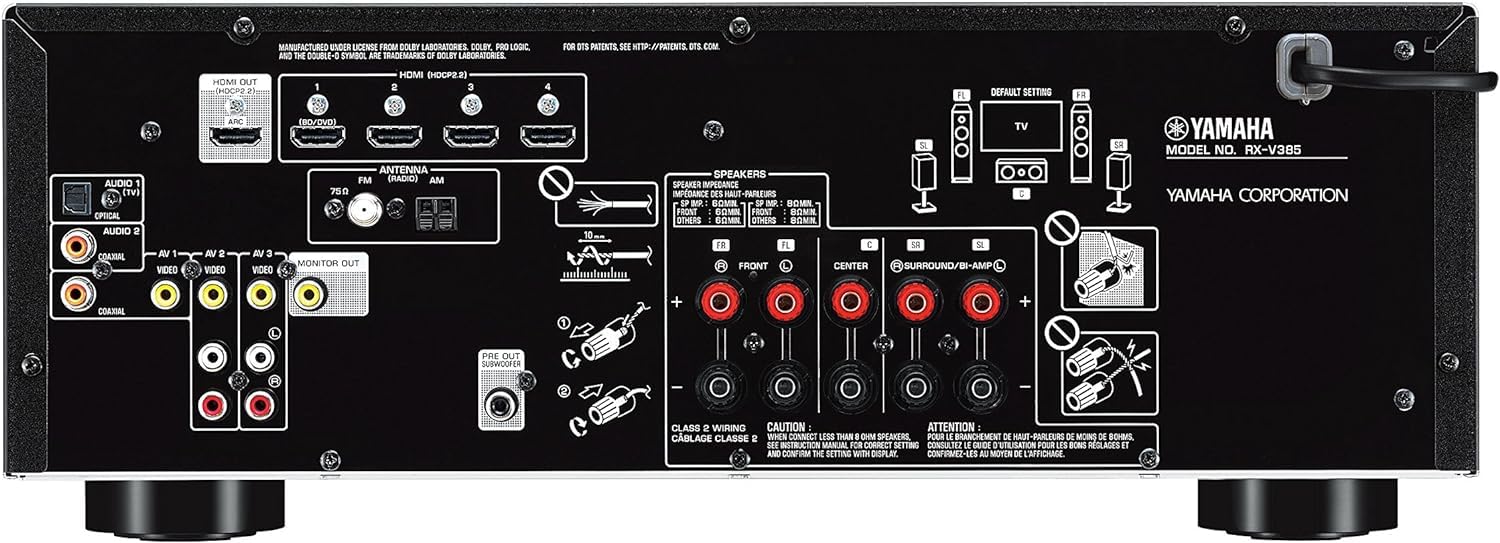
Yamaha RX-V385 5.1 Channel 4K AV Receiver
The Yamaha RX-V385 is the receiver to recommend to someone buying their first surround system. It handles 5.1 channels at 70 watts per channel into 8 ohms, passes 4K at 60Hz with HDR10, Dolby Vision, and HLG support, includes YPAO automatic calibration, and offers Bluetooth streaming. There is no Atmos, no Wi-Fi, and no DTS:X - just a clean, well-executed 5.1 platform. For a huge number of households, that is exactly enough. A 5.1 system with a properly placed subwoofer will beat a poorly configured 7.1 system in perceived sound quality, and the Yamaha RX-V385 makes it easy to get the basics right. YPAO sets speaker distances and levels automatically, the remote and menu structure are among the most approachable in the category, and the receiver has accumulated thousands of ratings from buyers who were installing their first home theater. If you already know you want height channels, the Pioneer VSX-534 adds Atmos for a similar price, and the Yamaha RX-V4A adds 8K HDMI and MusicCast for a bit more. But if you want the least complicated path to dramatically better TV sound, the Yamaha RX-V385 is the one to start with.

Key Features:

  • 5.1 channels at 70W per channel (8 ohms, 20Hz-20kHz)
  • Four HDMI inputs with 4K/60Hz passthrough, HDR10, Dolby Vision, and HLG
  • YPAO automatic room calibration with included microphone
  • Bluetooth wireless streaming
  • Dolby TrueHD and DTS-HD Master Audio decoding
  • Front-panel USB input and a clear, legible display

✓ Pros:

  • One of the easiest receivers to set up for a first-time buyer
  • YPAO calibration works reliably with minimal user input
  • Large review base confirming long-term reliability
  • Yamaha build quality and component reliability reputation
  • Affordable enough to leave budget for a quality subwoofer

✗ Cons:

  • No Dolby Atmos or DTS:X support
  • No Wi-Fi or built-in streaming platforms
  • HDMI limited to 4K/60Hz with no 120Hz gaming support
  • 70W per channel is modest for larger or inefficient speakers

Best For:

First-time home theater buyers who want a simple, reliable 5.1 receiver and no complexity

What Customers Say:

Customers Love:

  • New buyers repeatedly describe the setup process as simple and unintimidating
  • Sound quality improvement over TV speakers is the most common theme in reviews
  • Long-term owners report years of trouble-free operation
  • YPAO calibration results are described as reliably good for a budget receiver
  • Frequently recommended in reviews for parents and non-technical households

Common Concerns:

  • Lack of Atmos is the most common reason given by buyers who returned it
  • No network streaming is a frequent note from users expecting app control
  • Some owners report wanting more power for larger rooms

Expert Take:

The Yamaha RX-V385 does not try to compete with the Denon AVR-S760H on features, and it should not. It competes on simplicity and reliability, and at that it wins. Compared with the Pioneer VSX-534, it gives up Atmos but gains a larger, longer-validated reliability record and a slightly more approachable interface. Buy the Yamaha RX-V385 if you are setting up your first surround system and value a straightforward setup over future expandability. Move up to the Denon AVR-S760H if you expect to want height channels or 120Hz gaming within the next few years.

Why It's Highly Rated:

It has been owned by an unusually large number of first-time buyers, and the consistent theme in its reviews is that it just works without fuss. The rating reflects dependable execution of a modest feature set rather than headline specifications.

Buying Guide

Start by counting speakers, not features. If you are building a 5.1.2 system (five ear-level speakers, one subwoofer, two height speakers), you need at least seven channels of amplification plus two subwoofer outputs. That puts you in 7.2 territory, which is where the Denon AVR-S760H, Yamaha RX-V6A, and Onkyo TX-NR6050 all live. If you are running a simple 5.1 setup and never plan to add height speakers, a 5.2 receiver like the Yamaha RX-V4A or Pioneer VSX-534 saves money you can put toward a better subwoofer, which will improve the experience far more than two extra amplifier channels you never use. Next, look at HDMI rather than wattage. Almost every receiver in this price range produces enough clean power to drive typical 8-ohm speakers in a normal living room, and the difference between 75 and 100 watts per channel is roughly 1.2 dB, which is barely audible. HDMI capability is where the real functional gaps appear. If you own a PlayStation 5, Xbox Series X, or a modern gaming PC, you want at least one HDMI 2.1 input that passes 4K at 120Hz, and ideally three so you are not constantly swapping cables. The Yamaha RX-V6A and Denon AVR-S970H both cover multiple 4K/120Hz sources, while the older Sony STR-DH790 tops out at 4K/60Hz and is better suited to movie-first rooms. Room correction is the most underrated spec on the page. Entry-level auto-calibration flattens a few peaks; advanced systems like Audyssey MultEQ XT on the Denon AVR-X1700H or YPAO R.S.C. on the Yamaha RX-V6A measure your speakers at multiple positions and correct bass behavior across a wider seating area. In a small room with one couch, the difference is modest. In an open-plan room with reflective walls and three or four seats, it is the single biggest upgrade you can buy at this price. Buyers who complain that a receiver sounds flat or boomy are often fighting a room problem that a better correction tier would have addressed. Finally, decide how much you value streaming and app control. HEOS on the Denon and Marantz models, MusicCast on Yamaha, and Chromecast plus DTS Play-Fi on the Onkyo all let you play music without turning on the TV. If the receiver is also your household music system, that matters. If it is purely a movie machine, you can save money by skipping the network features entirely and focusing on amplification and HDMI, which is exactly the trade-off the Sony STR-DH790 makes. Match the feature set to the way you will actually use the room, and the ratings start making a lot more sense.

What to Look For in AV Receivers

  • Channel count (5.2, 7.2, or 7.2 with height channels) and how many subwoofer outputs you get
  • HDMI 2.1 support for 4K at 120Hz and 8K at 60Hz, and how many inputs actually support it
  • HDR passthrough support for Dolby Vision, HDR10, HDR10+, and HLG
  • Room correction tier - Audyssey MultEQ vs MultEQ XT, YPAO vs YPAO R.S.C., and similar
  • Dolby Atmos and DTS:X decoding, plus upmixers like DTS Neural:X and Dolby Surround
  • Power output per channel with a stated distortion figure and frequency range, not peak watts
  • Built-in streaming platforms such as HEOS, MusicCast, Chromecast, AirPlay 2, and DTS Play-Fi
  • Second-zone outputs (powered or pre-out) if you want audio in another room
  • Phono input for turntables, which saves the cost of a separate phono preamp
  • Chassis size - slimline designs fit shallow cabinets but usually deliver less power per channel

How We Selected These Products

Every receiver in this guide clears two hard filters: an Amazon star rating of at least 4.5 and a minimum of 200 customer ratings. That combination is deliberately strict. A 4.8-star product with 40 reviews might be excellent, or it might be a small sample of early adopters with a short ownership window. A 4.5-star product with 4,000 ratings has survived years of firmware updates, speaker mismatches, and shipping damage, and still lands in positive territory. Where possible, we favored listings with a high proportion of verified purchases, since those ratings correspond to confirmed transactions rather than drive-by scores. Rating consistency over time was weighed heavily. A receiver that hovered near 4.6 for three years is a safer bet than one that spiked to 4.8 during a launch promotion and has been drifting downward since. We looked at the shape of the review distribution as well: models with a large mass of 4- and 5-star ratings and only a thin tail of 1-star complaints generally indicate isolated defects or user error rather than systemic design problems. Clusters of similar 1-star complaints - a specific HDMI input failing, a specific app breaking, a heating issue in a specific setup - were treated as real signals and are noted in the cons for each product. On the technical side, we cross-referenced manufacturer specifications with the feature sets that home theater owners actually report using: channel count, subwoofer outputs, HDMI version and bandwidth, HDR format support, room correction tier, and streaming platform. Expert coverage from established home theater publications was used to corroborate which models deliver on their spec sheets and which ones quietly cut corners. All star ratings, review counts, and prices quoted here are approximate snapshots taken during research and change constantly, so confirm the live figures on the product page before you buy.

Bottom Line

If you want one recommendation and no further reading, get the Denon AVR-S760H. It nails the fundamentals that matter in a mid-priced home theater: seven amplified channels, two subwoofer outputs, three 8K/4K120-capable HDMI inputs, Dolby Atmos and DTS:X, Audyssey MultEQ room correction, and HEOS streaming. It is the receiver most people should buy, and its rating reflects years of consistent feedback rather than a launch spike. If you want the strongest feature-per-dollar ratio, the Onkyo TX-NR6050 is the value pick, and it is the model to choose if you want built-in Chromecast and DTS Play-Fi alongside 8K switching. If your priority is the best room correction and preamp flexibility at this price, step up to the Denon AVR-X1700H and its Audyssey MultEQ XT processing. Gamers with multiple 4K/120Hz sources should compare the Yamaha RX-V6A against the Denon AVR-S970H before deciding, since both handle high-frame-rate switching well. On a tighter budget, the Sony STR-DH790 remains the most-reviewed receiver in this price class and delivers 7.2 channels with Atmos and DTS:X for a modest outlay, provided you do not need 4K/120Hz or network streaming. The Yamaha RX-V4A is the cleaner modern alternative if you want 8K passthrough and MusicCast in a 5.2 chassis, and the Pioneer VSX-534 is the cheapest sensible path into Dolby Atmos. For space-constrained rooms, the slim Marantz NR1711 is the one to look at first. A final piece of buying advice: budget for speakers and a subwoofer before you stretch the receiver budget. A $400 receiver driving well-placed speakers will outperform a $800 receiver driving an undersized, poorly placed setup every single time. Buy the receiver that matches your channel count and HDMI needs, spend the remainder on acoustics, and you will get far more out of the ratings research you just did.

Browse More Top Rated Products

All Top RatedAV Receivers