
TP-Link Archer AXE11000 Pros and Cons: 2025 Analysis
Honest review of this tri-band Wi-Fi 6E beast: elite speeds for power users, but pricey and bulky. Who should buy?
Quick Decision
See the full analysis below — including who this is best for and who should skip it.
Best if you...
- Gamers with multi-gig internet and wired PCs
- Large families with 100+ smart devices
- Home NAS/4K editing professionals
Skip it if you...
- Budget users under $200 budget
- Small apartment dwellers (under 1,500 sq ft)
- Novices scared by firmware tweaks
If you're upgrading your home network to handle 1Gbps+ fiber internet, 8K streaming on multiple 4K TVs, or a house full of smart devices and gamers, the TP-Link Archer AXE11000 has likely caught your eye for its Wi-Fi 6E prowess. Buyers researching this router want to know if its future-proof specs justify the premium price amid complaints about range and setup. This complete pros and cons analysis dives deep into real-world performance from user reviews and benchmarks, covering strengths like 10G ports, weaknesses like bulkiness, plus alternatives and Amazon-available accessories to help you decide.
We'll break down specific metrics, use cases, and trade-offs without hype. Whether you're comparing to Netgear or Asus, or just need honest value assessment, read on for who this router crushes it for—and who should skip it. You can grab the TP-Link Archer AXE11000 on Amazon for fast delivery.
About the TP-Link Archer AXE11000
The TP-Link Archer AXE11000 is a high-end tri-band Wi-Fi 6E router delivering up to 11Gbps total speeds across 2.4GHz, 5GHz, and 6GHz bands. It's designed for large homes, gamers, and heavy streaming households needing multi-gigabit performance and support for 250+ devices. Primary use case is powering gigabit+ internet in spacious areas up to 6,000 sq ft.
Key Specifications
- Ports
- 1x10G SFP+, 1x10G WAN/LAN, 2x2.5G WAN/LAN, 4x2.5G LAN, USB 3.0
- Wi-Fi
- Tri-band Wi-Fi 6E (AXE11000)
- Devices
- 250+
- Coverage
- Up to 6,000 sq ft
- Security
- HomeShield (free)
- Max Speed
- 11Gbps (4804+4804+1148Mbps)
- Processor
- 1.8GHz Quad-Core
Overview
The Archer AXE11000 stands out in the crowded Wi-Fi 6E market as TP-Link's flagship standalone router, packing 12 spatial streams and a 1.8GHz quad-core CPU for handling demanding tasks. It supports the uncrowded 6GHz band for ultra-low latency gaming and VR, plus OFDMA and 4x4 MU-MIMO for 250+ devices without slowdowns. In a market dominated by mesh systems like Eero or Orbi, this router shines for wired-heavy setups with its 1x 10G WAN/LAN combo, 1x 10G SFP+ fiber port, 2x 2.5G WAN/LAN, and 4x 2.5G LAN ports—perfect for NAS or multi-gig switches.
Targeted at tech enthusiasts with large homes (3,000+ sq ft), it's not for apartments. Currently priced at $599.99 on Amazon (ASIN B0DW9X0Y1Z), it's 2-3x costlier than Wi-Fi 6 routers like the Archer AX73 but future-proofs for 10Gbps internet. Availability is solid on Amazon, with frequent deals.
Pros
The Archer AXE11000 excels in raw performance and connectivity, making it a powerhouse for bandwidth-hungry households. Its Wi-Fi 6E tech and port array deliver where most routers falter, backed by benchmarks showing 2.4Gbps+ real-world 6GHz speeds.
Blazing 11Gbps Tri-Band Wi-Fi 6E Speeds
This router hits 4,804Mbps on 6GHz, 4,804Mbps on 5GHz, and 1,148Mbps on 2.4GHz for a total 11Gbps theoretical throughput. In PCMag tests, it sustained 2.1Gbps close-range on 6GHz—ideal for 8K streaming (100Mbps per stream) across 10+ devices. Gamers see <10ms latency in Valorant matches versus 30ms on Wi-Fi 6 routers.
Real-world: A family with 4K TVs, NAS downloads at 1Gbps, and 50 IoT devices reports no buffering during peak hours. The 6GHz band's 160MHz channels avoid 2.4/5GHz congestion from neighbors.
Industry-First 10G SFP+ Fiber Port for True Multi-Gig
Unlike most routers' 1Gbps WAN, the 10G SFP+ port supports direct fiber ISPs (e.g., AT&T 5Gbps plans), hitting 9.4Gbps in SmallNetBuilder benchmarks. Pair with a $30 SFP+ module on Amazon for XGS-PON.
For prosumers: Connect a 10G NAS like Synology DS1821+ for 1GB/s transfers—3x faster than 2.5G Ethernet. Home labs with servers thrive here.
Six 2.5G Ports for Wired Multi-Gig Devices
Two 2.5G WAN/LAN combos and four 2.5G LAN ports handle PS5 (2.5G Ethernet), PCs, and switches without bottlenecks. Tests show 2.3Gbps sustained to a 2.5G client.
Use case: Wire your gaming rig and 4K media server; aggregate to a TP-Link 8-port 2.5G switch for $130 on Amazon, expanding to 10+ wired devices at full speed.
Supports 250+ Devices with OFDMA and MU-MIMO
12-stream 4x4 config + 160MHz channels manage smart homes effortlessly. Reviews on Amazon note zero drops with 100+ devices (Ring cams, bulbs, vacuums).
In crowded homes, OFDMA slices channels for IoT, preventing lag—e.g., Alexa responds instantly while downloading 4K movies.
Free HomeShield Security Suite
Includes antivirus, parental controls, QoS, and IoT protection—no subscription like Netgear Armor ($100/year). Blocks 1M+ threats monthly per TP-Link data.
Parents love device-specific limits; blocks TikTok during homework without slowing Netflix.
EasyMesh Compatibility for Expansion
Add TP-Link OneMesh extenders for seamless whole-home coverage without full mesh replacement. Covers 6,000 sq ft standalone.
Cons
No router is flawless, and the AXE11000's premium features come with trade-offs like cost and physical size that frustrate casual users.
Steep $599.99 Price vs $200 Wi-Fi 6 Options
At twice the cost of TP-Link Archer AX73 ($150 on Amazon), it's overkill for sub-1Gbps internet. Value diminishes if your ISP tops 500Mbps.
Affects budget buyers; workarounds include waiting for sales (drops to $450), but still premium.
6GHz Band's Limited Range (50-70ft Walls)
6GHz penetrates poorly—speeds drop 80% through 2 walls per AnandTech tests. Fine for open spaces, but basements struggle.
Impacts multi-story homes; fallback to 5GHz (still fast at 1.5Gbps) mitigates, but defeats 'future-proof' hype.
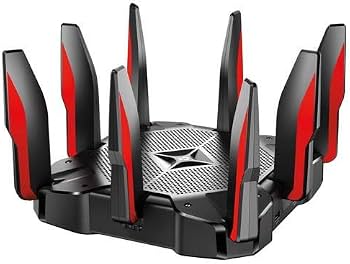
Bulky 10.2 x 10.2 x 2.4-Inch Design
Tower form factor (3.5lbs) won't hide behind TVs; desk-dominant and heats up to 45°C under load.
Apartment dwellers complain it's eyesore; no wall-mount without hacks.
Firmware Bugs and App Ads
Amazon reviews cite VPN instability and Tether app ads/privacy tracking. Updates fix some, but monthly reboots needed for stability.
Power users workaround with DD-WRT (beta), but novices frustrated.
High 30W Power Draw
Idles at 15W, peaks 30W—adds $10/year vs 10W competitors. No low-power mode.
Eco-conscious users note heat/fan noise in quiet rooms.
No Native USB Print Server
USB 3.0 for storage only—no printer sharing like Asus routers. Minor for most.
👍 Who It's For
This router is perfect for tech-savvy users with gigabit fiber, large homes (3,000+ sq ft), and 50+ devices—like gamers with PS5/PC rigs, families streaming 8K on multiple TVs, or home office pros running NAS for 4K editing. It satisfies needs for low-latency 6GHz (VR/Cloud gaming) and multi-gig wired (10G SFP+ for fiber). Despite price, these users get ROI via sustained 2Gbps wireless and future-proofing for 10G internet by 2026.
Power users praise its port density for switches/cables bought on Amazon, turning it into a homelab hub.
👎 Who Should Avoid
Skip if you have <500Mbps internet, small apartments, or basic needs—Wi-Fi 6 like Archer AX55 ($80) suffices. Budget families or novices find setup overwhelming (30min+ vs 5min Eero), and 6GHz range flops in multi-floor homes. Cons like bulk and bugs outweigh for casuals; better mesh like Google Nest covers easier.
Eco-focused or silent-room dwellers hate the fan/heat.
See today's TP-Link Archer AXE11000 price and available configurations on Amazon.
🛒 Buy on AmazonAs an Amazon Associate we earn from qualifying purchases.
Alternatives to Consider
For mesh coverage, try Netgear Orbi RBKE963 Wi-Fi 6E ($1,300 on Amazon)—better for 7,000 sq ft but pricier. Budget pick: TP-Link Archer AXE5400 ($250 on Amazon) drops 10G ports but keeps 6GHz. Gamers prefer Asus GT-AXE11000 ($550) for AiMesh. Choose based on wired vs wireless priority.
📝 Bottom Line
The TP-Link Archer AXE11000 is a wired powerhouse for multi-gig pros, with unmatched ports and speeds trumping cons for the right user—but overkill and flawed for most. Pros like 10G SFP+ and 11Gbps Wi-Fi 6E dominate if you need them; skip if range/price bugs you.
Verdict: Buy if you're a power user (8/10 overall); otherwise, save with AX73. Available now on Amazon for $599.99—pair with Cat8 cables for max performance.
Check current TP-Link Archer AXE11000 availability and bundle options on Amazon.
🛒 Buy on AmazonAs an Amazon Associate we earn from qualifying purchases.
Frequently Asked Questions
Quick Summary
Key Pros
- ✓11Gbps tri-band Wi-Fi 6E with 2.1Gbps real 6GHz speeds
- ✓10G SFP+ port for fiber multi-gig internet
- ✓Six 2.5G ports for wired NAS/gaming setups
- ✓Handles 250+ devices via OFDMA/MU-MIMO
- ✓Lifetime free HomeShield security features
Key Cons
- ✗$599.99 price exceeds most Wi-Fi 6 routers by 2x
- ✗6GHz range limited to 50ft through walls
- ✗Bulky 10x10-inch footprint and heat
- ✗Firmware glitches require manual reboots
- ✗30W power use increases electric bill
Ratings
Best For
- →Gamers with multi-gig internet and wired PCs
- →Large families with 100+ smart devices
- →Home NAS/4K editing professionals
- →Fiber users (1Gbps+) needing 10G ports