
Is Sennheiser HD 560S Worth It? Honest Review (2026)
A balanced guide to the strengths, weaknesses, and ideal buyers of Sennheiser's HD 560S in 2026
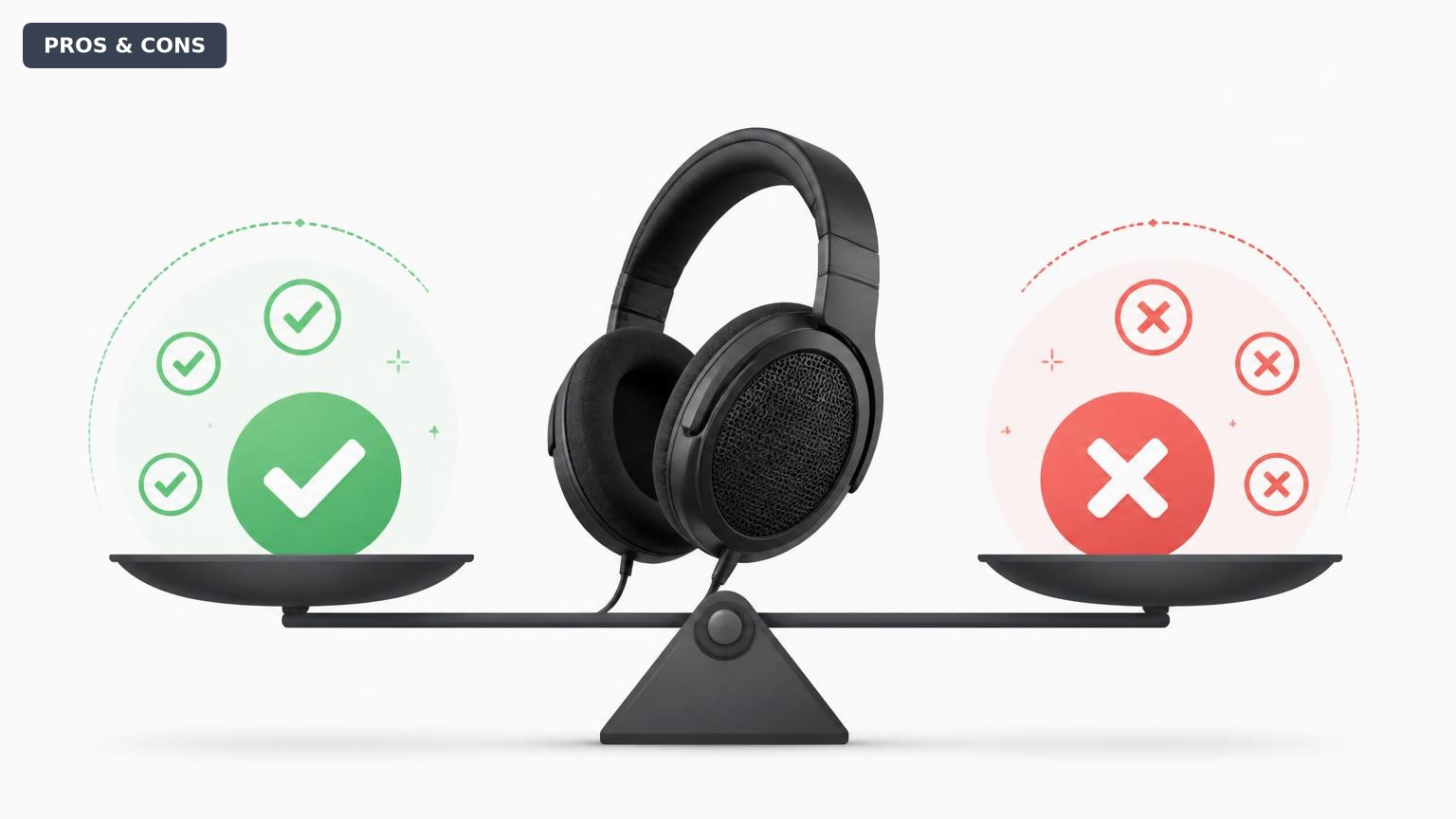
Quick Decision
Buy them if you want a neutral, open-back, wired headphone for home listening, studio work, or competitive gaming at around $200. Skip them if you need noise isolation, Bluetooth convenience, or punchy bass for bass-heavy genres. The HD 560S reward accuracy and detail, not impact or portability.
Best if you...
- Audiophiles on a budget who want a neutral reference sound
- Beginner and hobbyist mixing engineers
- Competitive gamers who play in a quiet room
Skip it if you...
- Commuters and frequent travelers
- Office workers in open-plan environments
- Bass heads who mostly listen to EDM, hip-hop, or pop
If you are looking for an open-back headphone under $250 in 2026, the Sennheiser HD 560S is almost certainly on your shortlist. It remains one of the most discussed wired headphones of the past several years, praised for its neutral tuning and wide soundstage. This guide breaks down the HD 560S's real strengths and weaknesses using published specifications and broad expert consensus, so you can decide if they fit your listening habits. You can check the current price on Amazon or through major audio retailers, but the analysis below is independent of any marketplace.
We will cover the key specs, who should buy them, who is better off with a closed-back or more bass-forward alternative, and how they compare to rivals like the HD 6XX, HiFiMan HE400se, and Philips Fidelio X2HR. You will also find a quick FAQ and a final verdict. The goal is not to make the HD 560S sound perfect; it is to help you understand whether the trade-offs are worth it for your specific setup.
About the Sennheiser HD 560S
The Sennheiser HD 560S are open-back, over-ear dynamic headphones designed for neutral, reference-grade sound. With a 120-ohm impedance and a 1.8m detachable cable, they are aimed at home listeners, gamers, and audio enthusiasts who value accuracy over exaggerated consumer tuning.
Key Specifications
- THD
- <0.2% (1 kHz, 100 dB SPL)
- Type
- Open-back, dynamic, over-ear
- Cable
- 1.8 m, detachable, 3.5 mm plug; 6.3 mm adapter included
- Color
- Black
- Weight
- 240 g
- Impedance
- 120 ohms
- Frequency Response
- 6 Hz–38 kHz
- Sound Pressure Level
- 110 dB (1 kHz / 1 Vrms)
Overview
First introduced in late 2020, the Sennheiser HD 560S remains an important reference point in the entry-level audiophile market. It uses a dynamic driver in an open-back housing, which means the rear of the driver is exposed to the air. That design gives the sound a natural, speaker-like spatial quality, but it also means there is almost no noise isolation. Sennheiser lists a frequency response of 6 Hz to 38 kHz, an impedance of 120 ohms, and a total harmonic distortion of less than 0.2% at common listening levels.
The headphones are aimed at home listeners who care about accuracy: music fans who want to hear recordings as the producer intended, beginner mixing engineers, and gamers who want precise positional audio. With a typical street price around $200, they sit between budget-friendly entry models and more expensive audiophile gear. They are not designed for portable use, but their combination of comfort, neutrality, and easy-to-drive performance keeps them popular in 2026.
Pros
The HD 560S earns its reputation for one main reason: neutral, transparent sound at a reasonable price. Here are the specific areas where these headphones excel.
Reference-Grade Neutral Tuning
Sennheiser designed the HD 560S to deliver a linear, uncolored frequency response. Published specs list a range of 6 Hz to 38 kHz, and the company emphasizes a near-flat response through the midrange. For acoustic music, vocals, and orchestral recordings, this means you hear the original mix rather than a colored consumer sound.
The tuning is not completely flat in the way a laboratory monitor is; it has a slight extra energy in the upper treble to make sibilance and mixing decisions clear. Still, this is closer to neutral than almost anything else at this price. If you want to know exactly what a song, movie soundtrack, or game engine is doing, the HD 560S's honesty is a real advantage.
For musicians and hobbyist engineers, this tonal balance is useful for editing, EQing, and checking a mix. The lack of hype means you won't be flattered by boosted bass or artificially sweetened highs.
Wide, Speaker-Like Soundstage
Because the driver backs are open to the air, the HD 560S creates a much larger sense of space than typical closed-back headphones. In games that use stereo or virtual surround, that airiness makes it easier to point at footsteps, gunfire, or environmental cues without an EQ. The imaging is not just broad; it is stable as you turn your head, which is rare under $300.
You will not get the holographic width of some $500 planar headphones, but the presentation still feels far more like listening to speakers in a room than like wearing a pair of studio cans. This is one of the main reasons people keep the HD 560S as their dedicated desktop headphone.
Lightweight and Comfortable for Long Listening Sessions
At 240 grams, the HD 560S is lighter than most open-back rivals, including the Sennheiser HD 600 series and several planar models. The velour ear pads and breathable cloth headband distribute pressure evenly, and the clamp force is moderate rather than tight. Many users can wear them for three or four hours without feeling fatigue.
That comfort really matters for mixing, long study sessions, or marathon gaming. A headphone that sounds good but causes hot spots is a dealbreaker; the HD 560S avoids that problem with a simple, purposeful design.
Easier to Drive Than Most Open-Back Competition
A 120-ohm impedance is higher than typical consumer cans, but the 110 dB SPL sensitivity at 1 kHz/1 V means they do not need a heavy desktop amplifier. Plugged into a laptop, PC sound card, or a decent USB dongle, they get to satisfying volume without noise. That is not true of some 300-ohm models like the HD 600 or HD 6XX.
You will still benefit from a dedicated headphone amp/DAC for cleaner dynamics and slightly better control, but the HD 560S is forgiving of weaker sources. That makes it a smart first open-back for someone who is not ready to build a full audio stack.
Detachable Cable and Standard Connector
The 1.8-meter cable is detachable and terminates in a standard 3.5mm plug, with a 6.3mm adapter included. If the cable wears out or you want a shorter or longer cable, you can replace it without soldering. The angled 3.5mm plug also helps when your output jack is mounted close to other cables.
This is not an exotic proprietary connector; it is the same jack used by most laptops and desktop PCs. For a product designed to stay home, the long cable is useful on a desk, and the standard plug means compatibility with the majority of phone and computer outputs (with a USB adapter, if needed).
Low Distortion for Clean Playback
Sennheiser specifies total harmonic distortion below 0.2% at 1 kHz and 100 dB SPL. That number indicates the driver remains clean at somewhat high listening levels, so complex passages do not turn into mud. You can push the volume into loud orchestral crescendos or heavy rock choruses without obvious strain.
Low distortion contributes to the sense of control that makes the HD 560S useful for critical listening. It is not just a flat response on paper; the headphone actually keeps its composure when the music gets dense.
Strong Value at a $200 Price Point
The HD 560S often sells for around $199.99 in 2026, occasionally less during sales. That puts it in the same territory as the Philips Fidelio X2HR and Audio-Technica ATH-M50x, while it frequently undercuts pricier Sennheiser models such as the HD 600. At this price, the engineering is strong enough that they are frequently compared to headphones that cost twice as much.
For a first pair of open-back headphones, that value per dollar is outstanding. You get a legitimate neutral reference sound, a respected brand, and replaceable parts, all for less than the cost of many midrange Bluetooth models.
Cons
No headphone is perfect, and the HD 560S makes specific design sacrifices for sound quality. These are the drawbacks you should know before buying.
Open-Back Design Leaks Sound and Lets Noise In
The same open-back construction that gives the HD 560S its spacious soundstage is also its biggest limitation. In a quiet room, you will hear your refrigerator, keyboard clicks, and conversations if someone talks nearby. People around you will also hear your audio at moderate volume, so you cannot use them in a library, office, or during a commute without becoming a nuisance.
There is no workaround for this; it is the nature of an open-back design. If you listen in a private space, it is a non-issue. If you share a room, a closed-back model is the better choice.
Bass Is Accurate, Not Exciting
The HD 560S intentionally does not boost the low end. Sub-bass notes are present but not prominent, and the overall balance is tilted toward clarity instead of impact. For EDM, hip-hop, dubstep, or action movies, the lack of rumble and slam can make the experience feel flat compared to solid closed-back rivals.
Some listeners address this with EQ, and the HD 560S responds well to a gentle low-shelf boost. But if you do not want to tweak settings and simply want a fun, punchy sound out of the box, the HD 560S may not satisfy. If you expect the kind of low-end emphasis you get from consumer Bluetooth models, you will be disappointed.
Needs a Quiet Environment and a Decent Source
Although the HD 560S is easier to drive than many audiophile headphones, they are not made for phones or noisy environments. A smartphone headphone jack (or dongle) can often drive them to moderate volume, but at higher levels the soundstage can compress and the bass may sound anemic. A cheap desktop USB dongle or a dedicated amp/DAC will do a better job.
More importantly, you must be in a quiet location to hear the detail they offer. The HD 560S rewards good recordings and clean sources; poor-quality audio files or noisy motherboards will be laid bare. They are the wrong tool for someone who mostly listens to streaming radio on a phone in a busy room.
All-Plastic Build Feels Less Premium Than the Price
Sennheiser chose a simple matte black plastic construction to keep weight down and cost reasonable. The headband adjustments and earcup yokes function fine, but the overall feel is noticeably more utilitarian than the aluminum or higher-grade plastics used in some $300+ competitors. If you like luxury materials or a sturdy metal frame, the HD 560S will feel basic.
The upside is repair-ability: you can buy replacement earpads and headbands, and the parts are relatively easy to swap. But plastic housings can crack if mishandled, so they are not ideal for travel.
No Bluetooth, Microphone, or Inline Controls
There is no Bluetooth chip, no integrated mic, no volume button, and no play/pause button. This is a purely analog, wired product. In 2026, that feels limiting to users who have moved most of their listening to a phone without a headphone jack for phone calls or video meetings.
You can add a detachable mic like a ModMic, and you can use a USB DAC with 3.5mm output for a phone, but those add cost and clutter. If you need a single headset that handles calls and music from one device, the HD 560S is not it.
Not Portable or Travel-Friendly
Open-back headphones, by design, are too leaky for commuting, flights, or shared hotel rooms. The HD 560S also lacks built-in folding hinges and does not come with a carrying case. Its 1.8m cable and bulky earcups mean it will not easily fit in a laptop bag alongside other gear.
Nothing about the product suggests it was meant to leave the house. If your listening happens in two different rooms or on the move, you need a second, closed-back pair or a more portable option.
👍 Who It's For
The HD 560S is for the person who listens primarily in a quiet room and cares about what is actually in the recording. Mixing engineers, music students, and audiophiles on a budget will appreciate the neutrality, and gamers who want precise positional cues in a private room will also love them.
If you spend hours at a desk and want a reference-grade sound without spending $400, the HD 560S delivers. They are especially good for acoustic music, vocals, classical, and jazz, where natural timbre matters more than thumping bass.
You will get the most value if you already have a laptop or desktop with a decent headphone output or are willing to spend a little on a USB DAC. If that describes you, the HD 560S can be your daily driver for years.
👎 Who Should Avoid
Avoid these if you need isolation for an open-plan office, commute, or shared living space. The open-back design simply does not work in noisy or social environments; you will hear everyone, and they will hear your music.
If you listen mostly to EDM, hip-hop, or other bass-heavy genres, you will probably find the HD 560S too flat and lacking in low-end punch. A closed-back model like the Audio-Technica ATH-M50x or a bass-boosted open-back like the Philips Fidelio X2HR will be more satisfying.
Also avoid these if you rely on Bluetooth connectivity, built-in microphones for calls, or a lightweight wireless headset for gaming. The HD 560S is a wired, home-only tool that asks you to accept its limitations in exchange for sound quality.
See today's Sennheiser HD 560S price and available configurations on Amazon.
🛒 Buy on AmazonAs an Amazon Associate we earn from qualifying purchases.
Alternatives to Consider
| Product | Choose Sennheiser HD 560S if... | Choose the alternative if... |
|---|---|---|
| Drop + Sennheiser HD 6XXAbout $20 more expensive than the HD 560S | You want a neutral open-back that is easier to drive and does not require a dedicated amplifier for decent volume. | You already own a solid headphone amp and want the HD 6XX's warmer, more vocal-focused midrange. |
| HiFiMan HE400seOften $50 to $80 less expensive than the HD 560S | You prefer a lightweight, consistent open-back that works with a normal headphone jack and has a more accurate tonal balance out of the box. | You specifically want planar bass speed and lower-frequency extension, and you do not mind using a stronger amplifier. |
| Philips Fidelio X2HRUsually $30 to $60 less expensive than the HD 560S | You want a flatter, more articulate sound for gaming footsteps and studio-style listening in a quiet room. | You want a bass-boosted, fun open-back for movies and music and do not need strict reference neutrality. |
| Audio-Technica ATH-M50xCan be $30 to $50 less expensive than the HD 560S | You need the HD 560S's open soundstage and neutral response for mixing in a quiet, isolated room. | You need closed-back isolation and a portable, foldable design for travel or shared spaces. |
Alternatives to the HD 560S depend on what you value most. The Drop + Sennheiser HD 6XX, a legendary open-back, is priced around $220 and trades a little extra midrange warmth for a more rolled-off top end; it needs a stronger amp. The HiFiMan HE400se is a budget planar that offers more sub-bass extension and speed, but it is heavier and less comfortable for long sessions. For a fun, bass-forward open-back that is easier to drive, the Philips Fidelio X2HR is a solid choice, though its tuning is less accurate.
If you absolutely need closed-back isolation, the Audio-Technica ATH-M50x is a common recommendation, but it trades the HD 560S's open soundstage and natural timbre for a more compact, bass-boosted, and portable design. For a warmer, more lush sound, the Meze 99 Classics are a different price tier. In every case, the HD 560S remains the reference for neutral, competent open-back sound in its price range.
Is it worth the price?
At approximately $200, the HD 560S is absolutely worth it for anyone building their first wired high-fidelity setup and who listens in a quiet room. They deliver a level of neutrality that usually costs $300+ and they are easier to drive than the HD 600 line. If you need portability or a bass-heavy tone, the money is better spent on a closed-back alternative; for the right user, this purchase is a near-no-brainer.
📝 Bottom Line
The Sennheiser HD 560S is the right choice for home listeners who prioritize neutral, unexaggerated sound and want an open-back experience under $250. It is not for anyone who needs isolation, portability, or a fun bass boost; there are better-suited headphones for those use cases.
On the positive side, the HD 560S combine a wide, airy soundstage, a light 240g comfort, and a tonal balance that is remarkably honest for $200. The biggest negatives are the open-back leakage, the weak sub-bass impact, and the plain plastic build. If you can live with those trade-offs, they outperform many rivals in clarity and imaging.
Buy them if you have a quiet room and a decent source and you value accuracy over hype. Skip them if you travel, share your listening space, or want a thumping low-end; the ATH-M50x or Fidelio X2HR will make you happier at a similar price. If your use case matches, the HD 560S is a worthy investment and one of the best values in open-back audio for 2026.
Check current Sennheiser HD 560S availability and bundle options on Amazon.
🛒 Buy on AmazonAs an Amazon Associate we earn from qualifying purchases.
Frequently Asked Questions
Quick Summary
Key Pros
- ✓Neutral, reference-style tuning
- ✓Wide, airy soundstage and precise imaging
- ✓Lightweight 240g design with plush velour pads
- ✓Relatively easy to drive for an open-back at 120 ohm / 110 dB SPL
- ✓Detachable 1.8m cable with standard 3.5mm connector
Key Cons
- ✗Open-back design leaks audio and provides no isolation
- ✗Bass-light tuning not ideal for bass-heavy music or movies
- ✗High impedance (120 ohm) still benefits from a decent DAC/amp
- ✗Plastic build feels less premium than price suggests
- ✗No mic, Bluetooth, or inline controls
Ratings
Best For
- →Audiophiles on a budget who want a neutral reference sound
- →Beginner and hobbyist mixing engineers
- →Competitive gamers who play in a quiet room
- →Classical, jazz, and acoustic music listeners