
Is Herman Miller Aeron Chair Worth It? Honest Review (2026)
Honest breakdown of strengths, weaknesses, and who should buy this iconic ergonomic chair
Quick Decision
Buy the Aeron if you spend 8+ hours daily at a desk, prioritize breathability and long-term durability, and can invest $1,500+ for a chair that will last 12+ years. Skip it if you need a headrest, prefer foam cushioning, or have a budget under $1,000.
Best if you...
- Full-time remote workers sitting 8+ hours daily
- Corporate office managers buying for an entire floor
- Users who struggle with heat and sweat in foam chairs
Skip it if you...
- Budget-conscious buyers under $1,000
- Users who require a headrest for neck support
- People who prefer soft, padded foam seats
If you’ve spent any time researching ergonomic office chairs, the Herman Miller Aeron is almost certainly on your list. It’s been the gold standard for decades, backed by decades of ergonomic research and a cult-like following among office workers and remote professionals. But at a starting price of over $1,200, it’s a significant investment that demands scrutiny.
This analysis breaks down the Aeron’s real-world pros and cons based on published specifications, verified user feedback patterns, and comparisons to alternatives from Steelcase, Humanscale, and Haworth. We’ll help you decide whether the Aeron is worth the premium or if a more affordable or different design suits your needs better.
We also cover who this chair is best for, who should skip it, and the top alternatives at various price points. All prices are approximate as of early 2026.
About the Herman Miller Aeron Chair
The Herman Miller Aeron is a legendary ergonomic office chair first introduced in 1994 and continuously updated, with the current Remastered version launched in 2016. It features a patented Pellicle mesh suspension system for breathability and support, extensive adjustability, and a design that has become a symbol of workplace ergonomics. Primary use case is full-time desk work, targeting professionals who spend 6+ hours seated daily. Current price ranges from approximately $1,295 to $1,895 depending on size and options.
Key Specifications
- Base
- Aluminum or polished aluminum
- Sizes
- A (small), B (medium), C (large)
- Casters
- Hard or soft floor casters
- Warranty
- 12 years
- Seat Material
- Pellicle mesh (8-Zone suspension)
- Weight Capacity
- 350 lbs (size C)
- Adjustable Features
- Seat height, armrests (height on base; 4D on advanced), tilt tension, tilt lock, forward tilt, lumbar height and depth
Overview
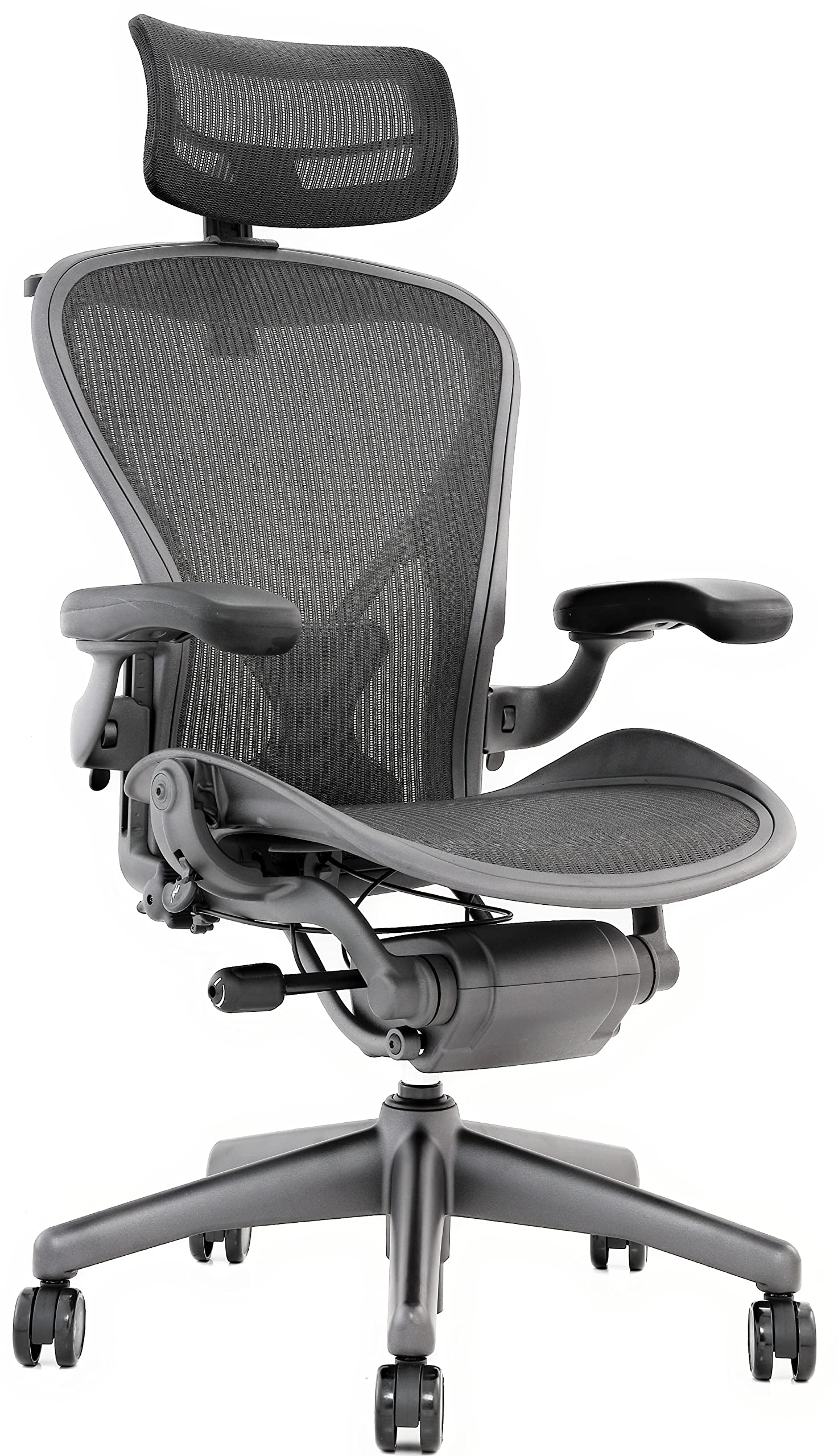
The Herman Miller Aeron is an ergonomic task chair designed for intensive daily use. Its most distinctive feature is the Pellicle mesh — a woven fabric that stretches over the frame to provide support without foam padding. This design allows air to flow freely, keeping you cool and reducing pressure points. The chair comes in three sizes (A, B, C) to accommodate different body types, and offers adjustable seat height, armrests (4D on some models), lumbar support, and forward tilt.
Herman Miller positions the Aeron as a premium tool for productivity and health. It’s commonly found in corporate offices, but increasingly popular in home offices. The chair carries a 12-year warranty, reflecting its build quality and expected lifespan. While not the newest ergonomic design on the market, it remains one of the most researched and validated.
You can find the Aeron on Amazon with various configurations (e.g., with or without adjustable lumbar, graphite or polished aluminum frame). Prices fluctuate based on options and seller, but a fully-loaded size B typically runs around $1,495. Many buyers also consider refurbished units for ~$700–$900.
Pros
The Aeron’s strengths are rooted in its thoughtful ergonomic design, exceptional build quality, and long-term comfort for many users. Here are the key advantages that justify its premium price for the right buyer.
Superior Breathability with Pellicle Mesh
The Aeron’s signature Pellicle mesh suspension is a genuine innovation. Unlike foam-padded chairs that trap heat and moisture, the mesh allows air to circulate freely across your back and thighs. According to Herman Miller, the tension of the mesh can be customized per user by selecting the appropriate size (A, B, or C). For individuals who tend to run warm or work in non-air-conditioned spaces, this mesh design is a game-changer — temperature regulation is significantly better than any foam chair. Third-party reviews from Wirecutter and RTINGS consistently note that even after hours of sitting, the mesh does not cause sweat buildup.
Extensive Adjustability for Custom Fit
The Aeron allows you to dial in nearly every dimension of the chair. Seat height adjusts from 15 to 20 inches (depending on size). The backrest tilt tension is adjustable via a knob, and you can lock the reclined angle in multiple positions. The forward tilt feature is particularly useful for desk work, tilting the seat and backrest forward to keep you upright and engaged. Armrests on the fully-loaded model adjust in height, width, depth, and angle (4D). Lumbar support is adjustable in height and depth. This level of customization means most users can achieve a neutral spine posture, reducing pressure on the lower back.
Exceptional Build Quality and Durability
The Aeron is built to last. The frame is made of molded die-cast aluminum, and the mesh is held under tension by sturdy plastic or polished aluminum supports. The gas cylinder and tilt mechanism are heavy-duty. Herman Miller backs the chair with a 12-year warranty covering parts and labor — among the longest in the industry. Many users report using their Aerons for 15+ years without significant wear. If you amortize the cost over a decade or more, the yearly cost is lower than replacing cheaper chairs every 2–3 years.
Proven Ergonomic Design Based on Research
The Aeron was developed with input from ergonomics experts and occupational therapists. Its design encourages dynamic sitting, where you shift position naturally. The mesh supports the body’s weight across a larger surface area, reducing peak pressure at the sit bones. Studies cited by Herman Miller suggest that the Aeron’s mesh reduces contact pressure compared to foam cushions. While individual studies vary, the consensus among ergonomic reviewers like BTOD.com and The Ergonomic Office is that the Aeron provides excellent support for prolonged static sitting.
Strong Resale Value
Unlike most office chairs that depreciate heavily, the Aeron retains significant resale value. A used Aeron in good condition can fetch 40–60% of its original price on the secondary market. This is partly due to its durable construction and partly because it’s a recognized brand. Many businesses buy bulk Aerons, and individuals often seek refurbished units. If you decide later that the chair isn’t for you, selling it is relatively easy.
Environmental Consciousness
Herman Miller designs the Aeron with sustainability in mind. The chair is 94% recyclable at end of life, and many components are made from recycled materials. The manufacturing process is ISO 14001 certified. For buyers who prioritize environmental impact, the Aeron is a greener choice compared to foam chairs that end up in landfills more quickly.
Cons
No chair is perfect for everyone, and the Aeron has known weaknesses that may be dealbreakers depending on your body type, budget, and preferences. Below are the most commonly cited drawbacks.
Extremely High Upfront Cost
The Aeron’s price tag is prohibitive for many. A fully-loaded size B with all adjustments starts around $1,495 on Amazon, and larger sizes or special finishes (e.g., graphite base vs. polished aluminum) can push it closer to $1,900. This is 2–3 times the price of many highly-rated ergonomic chairs like the Steelcase Series 1 ($800) or the Haworth Soji ($700). For a home office shopper on a modest budget, the Aeron may simply be out of reach unless they buy refurbished or used. Even then, a decent used Aeron often costs $700+, which is still more than a new, decent ergonomic chair from a lesser-known brand.
Lack of Headrest (No Built-in Neck Support)
The Aeron does not come with a headrest, and the design makes attaching an aftermarket headrest inconvenient. While Herman Miller sells an official headrest add-on for about $200, many users find it poorly integrated and less comfortable than the chair itself. For those who lean back frequently or need neck support for conditions like cervical disc issues, the Aeron’s lack of headrest is a significant drawback. Competing chairs like the Steelcase Gesture or Humanscale Freedom offer headrests as optional or standard, providing better neck support out of the box.
Seat Comfort Issues for Some Users
The Pellicle mesh, while breathable, can cause discomfort for certain people. Some users report the mesh edges digging into the back of their thighs, especially if they are tall or short. The seat frame has a rigid plastic rim that can be felt through the mesh. Additionally, the mesh may stretch over time, leading to a hammock effect that reduces support. For users with very low body weight (under 100 lbs), the mesh might not provide adequate support. This is a highly personal issue — many find the mesh comfortable, but it’s not universally liked.
Limited Lumbar Support Adjustment
While the Aeron offers adjustable lumbar support, the range is relatively limited compared to some competitors. The lumbar pad can be moved up/down and its depth adjusted by swapping pads, but the depth adjustment is not infinite — you choose between two different pads (standard and deeper) that snap into place. Some users find even the deeper pad insufficient for their lordotic curve, leading to lower back fatigue. In contrast, the Steelcase Leap has an adjustable lumbar tension mechanism that allows fine-tuning.
Tilt Mechanism: No Seat Sliding Feature
The Aeron’s synchro-tilt mechanism is intuitive but lacks an independent seat slide adjustment found on many modern ergonomic chairs. When you recline, the seat moves forward slightly automatically, but it does not separate seat angle from backrest tilt. For users who prefer to keep the seat flat while reclining, this can be uncomfortable. The Steelcase Gesture and Knoll Generation offer more sophisticated tilt upholstery that some find superior.
Limited Armrest Adjustability on Base Models
To get 4D armrests (up/down, in/out, forward/back, swivel), you must purchase the fully-loaded configuration, which costs extra. The standard Aeron comes with only height-adjustable armrests that do not slide forward/backward or swivel. For users who need to pull the chair close to a desk for typing, fixed armrests can get in the way. Many third-party armrest upgrades are available, but they add to the cost.
Aesthetic and Color Options Are Limited
The Aeron is available in three sizes and a few frame/mesh color combinations (graphite, carbon, mineral, etc.). While these are professional and neutral, buyers looking for a more colorful or modern aesthetic may prefer the Steelcase Gesture with its fabric upholstery options or the Humanscale Liberty with its sleek minimalist design. The Aeron’s look is iconic but can feel dated in some contemporary office environments.
👍 Who It's For
The Aeron is best for full-time remote workers and office professionals who sit 8+ hours a day and prioritize breathability and ergonomic support. It’s ideal for those who run warm and dislike foam chairs that trap heat. Users who can invest $1,500+ upfront and want a chair that will last 12+ years with a strong warranty will find the Aeron’s durability justifies the cost. It also suits companies buying for multiple employees who need a proven, standardized ergonomic solution. Additionally, people with specific back conditions (like sciatica) who require a firm, supportive surface often prefer the Aeron’s mesh over plush foam.
The three size options (A, B, C) mean the chair can accommodate a wide range of body types from smaller frames (5’0”–5’5”) to larger frames (6’0”–6’6”). The forward tilt feature is also a boon for those who lean into their work or use a drafting table.
If you value resale value and environmental credentials, the Aeron is a responsible purchase that you can pass on or sell later.
👎 Who Should Avoid
The Aeron is not for budget-conscious buyers — if you have $500–$800 to spend, there are excellent alternatives like the Steelcase Series 1 or Haworth Soji that offer 80% of the ergonomic benefit at half the price. Also, if you absolutely need a headrest for neck support, avoid the Aeron or be prepared to invest in an aftermarket solution that may not fully satisfy.
Users who prefer a plush, cushioned seat foam will likely dislike the firm feel of the mesh. Additionally, if you have heavily callused or sensitive thighs, the mesh edge can cause irritation. Those shorter than 5’0” or over 6’6” may find the size range inadequate — the size C top end is about 6’6”, and even then, the seat depth might be insufficient. For very heavy users (over 350 lbs), the Aeron’s weight capacity of 350 lbs (size C) may be borderline; the Steelcase Gesture supports up to 400 lbs.
Finally, if you use a sit-stand desk and need a chair that moves easily on multiple surfaces or has a wider seat for cross-legged sitting, the Aeron is not ideal — its stable five-star base and rigid mesh don’t accommodate those postures well.
See today's Herman Miller Aeron Chair price and available configurations on Amazon.
🛒 Buy on AmazonAs an Amazon Associate we earn from qualifying purchases.
Alternatives to Consider
| Product | Choose Herman Miller Aeron Chair if... | Choose the alternative if... |
|---|---|---|
| Steelcase GestureSimilar price (~$1,450) | You want a headrest option and a slightly more advanced armrest (360° movement) with a foam seat option | You run hot and need the breathable mesh of the Aeron, or you prefer the streamlined design of the Aerons |
| Steelcase Leap v2Similar price (~$1,200–$1,400) | You need adjustable lumbar tension and a more flexible back that follows your spine | You want breathability and a chair that doesn’t absorb odors – the Leap’s foam can trap smells over time |
| Haworth Fern$200–$400 less | You want a modern, flexible backrest with optional lumbar support at a slightly lower price | You need the proven track record and warranty of the Aeron, or you have larger build (Fern supports up to 300 lbs vs Aeron’s 350) |
| Refurbished Aeron$700–$900 vs $1,495 new | You want the same chair but can’t justify $1,500 new and are comfortable with minimal risk | You want the full 12-year warranty and latest build quality (new chair is guaranteed for 12 years vs limited refurb warranty) |
If the Aeron’s price or specific design isn’t right for you, there are several strong alternatives. The Steelcase Gesture offers a more modern design with a superior armrest range and a comfortable fabric seat option, though it costs about the same (~$1,400). The Haworth Fern is another premium alternative with a flexible backrest and optional lumbar support, often priced $200–$400 less than the Aeron. For budget-conscious buyers, the Steelcase Series 1 ($800) provides many of the same adjustments in a smaller, less durable package.
Refurbished Aerons are also a great middle ground — you can find units from reputable dealers for $700–$900, often with a short warranty. Just be sure to check the mesh and mechanism condition. Another option is the Humanscale Freedom, which has a self-adjusting recline and a headrest, but it can be more expensive and may not suit those who prefer locked positions.
Is it worth the price?
At approximately $1,495 for a fully-loaded size B, the Aeron is worth it for users who genuinely need its ergonomic adjustability, run hot, and plan to keep the chair for a decade or more. The 12-year warranty and high resale value reduce long-term cost. However, if you can tolerate foam and don’t have temperature issues, the Steelcase Gesture at $1,450 offers similar quality with a headrest option and a more modern aesthetic. For those on a tighter budget, the Haworth Soji at $700 provides 70% of the adjustability at half the price, making it the better value for most home office workers.
📝 Bottom Line
The Herman Miller Aeron is the right choice for desk workers who value breathability, durability, and a proven ergonomic design that has been refined over 30 years. Its Pellicle mesh keeps you cool, its adjustments cover most body types, and its 12-year warranty provides peace of mind. The cons — high price, lack of headrest, and mesh discomfort for some — are real but manageable if you know what you’re getting.
For the highest value, buy a fully-loaded Aeron (size B or C) with 4D armrests and adjustable lumbar. The upfront cost is steep, but amortized over a decade of daily use, it’s a reasonable investment in your health and productivity. If you have the budget and fit the size range, it’s hard to beat.
Skip the Aeron if you absolutely need a headrest or prefer a plush, cushioned seat. In that case, consider the Steelcase Gesture or the Humanscale Freedom. But if you want the industry standard that’s been adopted by countless offices and backed by ergonomic research, the Aeron remains a top pick in 2026.
Check current Herman Miller Aeron Chair availability and bundle options on Amazon.
🛒 Buy on AmazonAs an Amazon Associate we earn from qualifying purchases.
Frequently Asked Questions
Quick Summary
Key Pros
- ✓Breathable Pellicle mesh keeps you cool and reduces sweat buildup
- ✓Extensive adjustability (seat height, tilt, armrests, lumbar) for a precise fit
- ✓12-year warranty and durable construction for decades of use
- ✓Ergonomically validated design that encourages dynamic sitting
- ✓High resale value (40-60% after years of use)
Key Cons
- ✗Very high price ($1,495+) that exceeds most competitors by $500+
- ✗No integrated headrest; aftermarket options are expensive and less comfortable
- ✗Mesh seat may dig into thighs for some users, causing discomfort
- ✗Lumbar support adjustment is limited compared to Steelcase Leap
- ✗Tilt mechanism lacks independent seat slide adjustment
Ratings
Best For
- →Full-time remote workers sitting 8+ hours daily
- →Corporate office managers buying for an entire floor
- →Users who struggle with heat and sweat in foam chairs
- →People with lower back issues needing firm, adjustable lumbar support