
Is Echelon EX-4S Connect Bike Worth It? Honest Review (2026)
A balanced look at the Echelon EX-4S's strengths, weaknesses, and who should buy this connected bike in 2026.
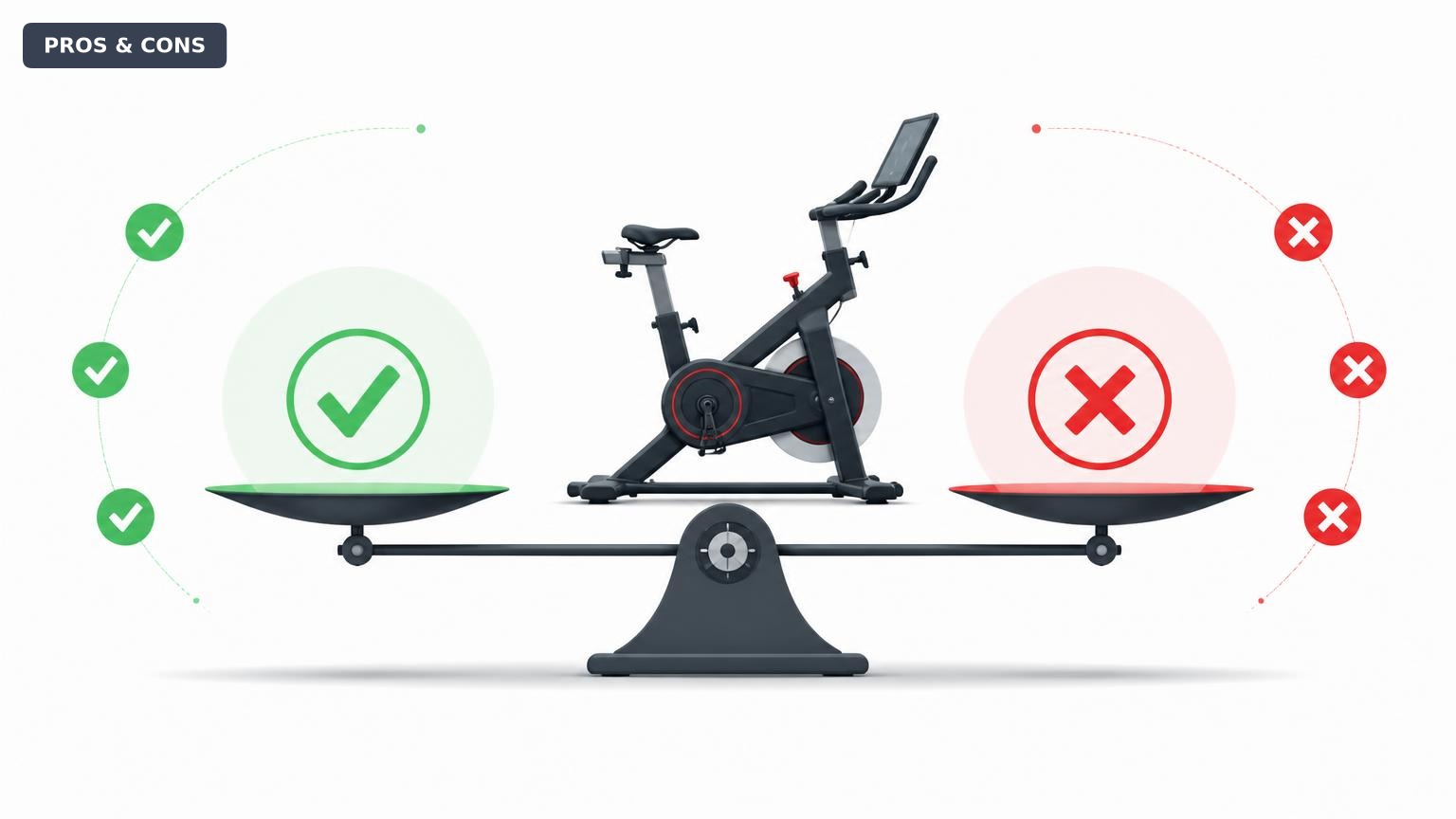
Quick Decision
Buy it if you want a large rotating touchscreen and integrated live classes without Peloton pricing. Skip it if you're unwilling to pay the ~$39.99/month Echelon Fit membership or if you expect auto-adjusting resistance.
Best if you...
- Value-focused riders who want a built-in screen without Peloton pricing
- Multi-sport fitness users who'll use the rotating screen for strength and yoga classes
- Households with multiple riders of different heights and abilities
Skip it if you...
- Subscription-averse riders who refuse recurring app fees
- Cyclists who want auto-adjusting resistance to match instructor cues
- Tech-flexible users who already own a tablet and prefer using their own fitness apps
Thousands of shoppers land on the Echelon EX-4S every month while comparing it against the Peloton Bike and deciding whether a connected, screen-equipped bike is worth the investment. The central question is whether the EX-4S's rotating 21.5-inch display and hundreds of dollars in savings make up for what it gives up versus the market leader. This guide addresses that question directly, with specific numbers and honest comparisons.
To build this analysis, we pulled Echelon's published specifications, cross-referenced them with expert assessments from major fitness and tech publications, and reviewed consistent patterns in verified buyer feedback. You'll see exact figures where they exist, clear trade-offs where they don't, and a final verdict on who should buy this bike — and who should skip it.
We'll also cover the real cost of ownership — including the subscription you can't avoid — and point you to alternatives and accessories worth considering before you buy the EX-4S on Amazon.
About the Echelon EX-4S Connect Bike
The Echelon EX-4S is a connected indoor cycling bike with a 21.5-inch HD touchscreen that rotates, 32 levels of magnetic resistance, and access to Echelon's live and on-demand class library through the Echelon Fit app. It's built for riders who want the integrated screen experience of a Peloton-style bike at a lower price point. Its primary use case is home-based connected cycling plus off-bike workouts like strength, yoga, and HIIT.
Key Specifications
- Pedals
- Dual-sided (SPD clip-in and toe cage)
- Display
- 21.5-inch HD touchscreen, rotates
- Warranty
- 12 months parts and labor; 24 months on frame
- Dimensions
- Approximately 59 x 22 x 60 inches (L x W x H)
- Resistance
- 32 levels, magnetic belt drive
- Connectivity
- Wi-Fi and Bluetooth
- Subscription
- Echelon Fit, about $39.99/month (required for classes)
- Product Weight
- Roughly 105 lbs
- Max User Weight
- 300 lbs
Overview
The Echelon EX-4S sits in the middle of Echelon's bike lineup, between the bring-your-own-tablet EX-3 and the premium EX-5S. Its defining feature is the 21.5-inch HD touchscreen that rotates on its mount, letting you swing the display away from the bike for floor-based workouts. That's something the standard Peloton Bike doesn't offer at any price, and it's the main reason this model has stayed relevant since it arrived a few years ago.
Under the screen, the EX-4S is a solid piece of hardware: a steel frame rated for 300-lb riders, a belt-driven magnetic resistance system with 32 levels, dual-sided pedals (SPD clips on one side, toe cages on the other), and adjustable seat and handlebars that suit a wide range of heights. Echelon's Fit app delivers live and on-demand classes, and the subscription costs less per month than Peloton's. The bike occupies about 59 x 22 inches of floor space and includes transport wheels for moving it between rooms. It's available on Amazon as well as Echelon's own site, with pricing that regularly fluctuates between roughly $799 and the $999.99 list price.
Pros
The EX-4S wins over buyers in three areas: screen features, hardware completeness, and price. The strengths below are the specific reasons most owners choose it over a Peloton, a screenless bike, or a cheaper basic spin bike.
A 21.5-Inch Rotating Touchscreen
The 21.5-inch HD touchscreen is the reason to buy this bike. It rotates, so you can position the display for cycling and then swing it around for strength, yoga, HIIT, boxing, and mobility workouts on the floor. The standard Peloton Bike has a fixed screen that only faces the rider; only the $2,445 Peloton Bike+ offers rotation. At almost half that price, the EX-4S gives you similar versatility for off-bike training.
The screen streams classes over Wi-Fi in high definition and pairs via Bluetooth with headphones or a heart-rate monitor. Instructor cues, cadence, resistance targets, and output metrics are visible at a glance on a display large enough to follow without squinting — a real advantage over the EX-3, which requires balancing your own tablet on a mount.
One limitation to know up front: the console is locked to Echelon's ecosystem, so you can't load Netflix or YouTube. If you want to binge shows while riding, a separate device and stand are the workaround.
Roughly $450–$1,450 Cheaper Than Peloton
At the $999.99 list price, the EX-4S undercuts the Peloton Bike (about $1,445) by roughly $450 and the Peloton Bike+ (about $2,445) by about $1,450. During Echelon's frequent sales, the gap widens further. You're not giving up much hardware for that savings — the bike includes a 21.5-inch rotating screen, 32 levels of magnetic resistance, dual-sided pedals, and a 300-lb weight rating.
The subscription savings are smaller but real: Echelon Fit costs about $39.99 per month, roughly $4 less than Peloton's $44 membership. That's about $48 a year in your pocket, and over a typical five-year ownership period, the combined upfront and subscription difference can total several hundred dollars. For buyers who are price-sensitive but still want a screen-based connected ride, that math is compelling.
32 Levels of Quiet Magnetic Resistance
The EX-4S uses a belt-driven magnetic resistance system, meaning there's no metal-on-metal contact and no friction pads to wear out. The result is a genuinely quiet ride — quiet enough for an apartment with a floor mat underneath, and noticeably quieter than a dishwasher running in the next room. There's essentially no maintenance beyond basic cleaning and occasional belt tension checks.
With 32 resistance levels, the range spans easy recovery spins (levels 1–8) to challenging standing climbs (20–32). That's enough granularity for beginners and reasonably fit riders alike. The Echelon app tracks cadence, speed, output, and estimated calories in real time, and the resistance knob is reliable and mechanical — no motors to fail, no batteries to charge. The trade-off is that you're the one adjusting resistance manually, which we'll examine in the cons.
Dual-Sided Pedals: SPD Clips and Toe Cages Included
The EX-4S ships with dual-sided pedals: a Shimano-compatible SPD clip on one face and a standard toe cage on the other. Riders with cycling shoes can clip straight in, while sneaker riders use the cage side — and both riders in a household can share the bike without any pedal swapping.
For newcomers, the cage side means no immediate $80–$150 cycling shoe purchase. For experienced cyclists, the SPD side enables proper pull-and-push pedaling, which matters on hard intervals and climbs. Some buyers will eventually upgrade to lighter aftermarket pedals, but the included set is far from a weak point.
One Membership Covers Cycling and Off-Bike Classes
Echelon Fit is $39.99 per month (or around $399 per year), which is not cheap — but unlike cycling-only subscriptions, it unlocks every class type Echelon offers: cycling, treadmill, rowing, strength, yoga, boxing, HIIT, and scenic outdoor rides. If you're replacing a gym membership, that breadth is meaningful. The rotating screen is what makes the floor classes practical, so the membership's value is higher on the EX-4S than on a screenless Echelon.
The app gives each member of a household their own profile, with separate metrics, history, and challenge participation. Classes are added regularly, and the library is large enough for daily variety, even if it's smaller than Peloton's catalog. For riders who will actually use the strength or yoga side of the membership, the EX-4S is the best-value way to access it.
Stable Frame with a 300-lb Weight Rating
Echelon rates the EX-4S for riders up to 300 lbs — slightly above Peloton's 297-lb rating — and the steel frame handles heavier riders without wobble or creaking, even during standing climbs. The bike itself weighs roughly 105 lbs, so once it's in position, it stays put.
The seat and handlebars adjust both vertically and fore-aft, which covers riders from roughly 4-foot-11 to 6-foot-4, depending on inseam. That adjustability, plus the dual-sided pedals, makes the EX-4S a genuinely shareable household bike.
Cons
No connected bike is perfect at this price, and the EX-4S has real compromises. The drawbacks below are the most commonly cited reasons riders choose a different bike, and each one matters more to some buyers than to others.
The $39.99/Month Membership Is Effectively Mandatory
The single biggest drawback is the recurring subscription. Without an active Echelon Fit plan, the EX-4S screen displays basic metrics but cannot stream live or on-demand classes, and trainer-led programs and challenges disappear. For most buyers, that means the $1,000 bike becomes a manual exercise bike until the subscription is resumed.
At $39.99 per month, that's about $480 per year — two years of membership nearly doubles the bike's total cost. Worse, you can't substitute a cheaper third-party app. The console is locked to Echelon, so strategies used with screenless bikes — like pairing the Peloton App ($12.99/month) or Apple Fitness+ ($9.99/month) — simply don't work here. If subscriptions are a deal-breaker, this isn't your bike.
Manual Resistance Means Extra Work During Intervals
Resistance on the EX-4S is adjusted with a mechanical knob — there's no auto-follow to match the instructor's cues. When a coach says 'go to two, then push to three,' you have to look at the resistance readout and physically twist the knob to hit the target. During steady rides this is fine; during Tabata or interval formats, with cues every 30 to 60 seconds, it can get hectic.
The standard Peloton Bike also uses manual resistance, so $1,445 Peloton buyers don't get this feature either. It's only the Peloton Bike+ and bikes like the NordicTrack S22i that auto-adjust, and both cost significantly more. If you're coming from an auto-resistance bike, the difference will be noticeable; if you're new to connected cycling, it's simply part of the learning curve and many riders adapt within a couple of weeks.
Smaller, Less Polished Class Library Than Peloton
Expert assessments, including reviews from PCMag and Tom's Guide, consistently describe Echelon's class library as solid but a step behind Peloton's in size and production polish. Echelon has fewer instructors, a thinner live schedule outside peak times, and more variation in class production quality. Music is licensed and integrated into rides, but program design and scenic production generally feel less curated than Peloton's.
For most weekly riders, the library is still big enough to avoid repetition — Echelon adds content regularly. But for riders who follow a specific instructor daily or expect a premium, consistent production experience, the gap is real. It's the trade-off that comes with paying less, and it's the most frequently mentioned reason former Peloton users occasionally feel underwhelmed.
The Screen Can't Run Third-Party Apps
The EX-4S console is a purpose-built Echelon device; you cannot install Netflix, YouTube, Spotify, or a web browser. If your ideal ride involves watching a show or listening to your own playlist through the bike's speakers, this console won't do it. Riders end up adding a tablet or phone on a separate stand, which somewhat defeats the purpose of the large built-in screen.
Audio pairing works over Bluetooth, so you can connect headphones for Echelon content, but the bike can't receive audio from your phone to play through its speakers. It's a notable ecosystem limitation that screenless bikes don't have — on a Schwinn IC4, your tablet controls the experience and can run any app you want.
Assembly and Setup Take Up to an Hour
The EX-4S arrives almost entirely flat-packed. You'll attach the stabilizer bars, seat, handlebar, pedals, and console, and the process typically takes 30–60 minutes with the included tools. Several steps are easier with two people, and at roughly 105 lbs, moving the assembled bike up stairs is a genuinely two-person task.
Echelon offers optional white-glove delivery and assembly for an extra fee, which is worth considering if you live above the first floor or don't own a good socket set. For everyone else, budget an hour on delivery day and have a friend on standby.
Heart-Rate Monitoring Requires an Extra Purchase
The EX-4S does not come with a heart-rate monitor. To track accurate heart rate and calorie data in the app, you'll need a Bluetooth chest strap or armband — Echelon's own armband sells for around $50, and compatible third-party options also work. Without one, the app estimates calories from profile data, which is less accurate for training purposes.
Serious cyclists will likely already own a strap. Casual riders who just want a good workout may not care. But it's an accessory cost worth folding into your overall budget rather than discovering after purchase.
The Stock Saddle Is Firm and Narrow
Like nearly all factory exercise bike seats, the EX-4S saddle is hard and narrow. New riders — and anyone with limited saddle time — often describe significant discomfort within the first few rides. The most common first accessory purchase across verified owner feedback is a gel seat cover or a wider replacement saddle, which runs $15–$60.
It's an easy fix, and the fitness industry-wide nature of this issue makes it a minor con. But it's worth knowing before your first ride so you don't conclude the bike itself is uncomfortable.
👍 Who It's For
The Echelon EX-4S makes the most sense for riders who want the connected-bike experience — built-in screen, live classes, instructor-led training — but who balked at the price of a Peloton. If your bike budget is around $1,000 and you're already comfortable spending roughly $40 a month on fitness, the EX-4S delivers the closest thing to an all-in-one setup at that price. The rotating screen adds real versatility: you can take a 20-minute cycling class, then pivot the display and do a 15-minute core session without moving equipment or pulling out a separate tablet.
It's also a strong choice for shared households. The SPD/toe-cage pedals accommodate different shoe styles, the seat and handlebars adjust across a wide height range, and the Echelon app supports multiple profiles so each rider's stats stay separate. For families where parents or roommates mix cycling with strength and yoga, the membership covers all class types for everyone.
Finally, if you're in an apartment, the quiet magnetic resistance system is a meaningful advantage over friction-based budget bikes. Combined with a floor mat, the EX-4S won't disturb neighbors during early-morning rides.
👎 Who Should Avoid
If you refuse to pay a monthly subscription, the EX-4S is the wrong purchase. The screen's entire value proposition hinges on the Echelon Fit membership; without it, you're left with a $1,000 unconnected spin bike and no path to a cheaper alternative like the $12.99/month Peloton App on your own tablet. A screenless bike like the Schwinn IC4, or even a budget Sunny Health & Fitness model, serves these riders better.
Riders who want auto-adjusting resistance should also look elsewhere. If the idea of turning a knob mid-interval to match instructor targets sounds like a chore, the Peloton Bike+ and NordicTrack S22i are the bikes that solve that — at substantially higher prices. Similarly, if you already own a high-quality tablet and are happy using multiple fitness apps, the EX-4S's locked-down console will frustrate you.
And if your total budget, bike plus accessories, must stay under $600, the EX-4S is simply out of reach once you factor in the membership. The Echelon EX-3 — no screen, but compatible with the same app — is the better fit for that budget, as is a used bike from a previous generation.
See today's Echelon EX-4S Connect Bike price and available configurations on Amazon.
🛒 Buy on AmazonAs an Amazon Associate we earn from qualifying purchases.
Alternatives to Consider
| Product | Choose Echelon EX-4S Connect Bike if... | Choose the alternative if... |
|---|---|---|
| Peloton BikeApproximately $450 more expensive | You want a rotating 21.5-inch screen and would rather save roughly $450 than pay for Peloton's larger class library. | Peloton's bigger, more polished on-demand library and instructor roster matter more to you than the rotating screen or the savings. |
| Peloton Bike+Approximately $1,450 more expensive | You want a rotating screen and don't want to spend roughly $1,450 extra for auto-follow resistance. | Auto-follow resistance and the most polished connected-fitness content ecosystem justify the large price premium. |
| Schwinn IC4Comparable price (usually $999, frequently discounted to $899) | You want a built-in screen with one integrated ecosystem and no need to supply your own tablet. | You prefer app freedom — Zwift, Peloton App, Apple Fitness+ — and don't mind using your own tablet as the screen. |
| NordicTrack S22i Studio CycleApproximately $600 more expensive at MSRP | You want a simpler, less expensive connected bike without needing incline/decline simulation. | Auto-resistance, incline and decline training, and iFit's scenic ride library justify roughly $600 more. |
Within Echelon's own lineup, the EX-3 is the obvious budget alternative — it drops the built-in screen entirely and instead mounts a tablet or phone to the frame. Buyers who already own a good tablet will save roughly $400–$500 and still access the same Echelon Fit classes; the trade-offs are a smaller screen, no rotation, and a less stable tablet mount during vigorous rides. For riders who prioritize the integrated screen experience, the EX-4S is the one.
Outside Echelon, the Schwinn IC4 (also sold as the Bowflex C6) is the best pick for app-flexible riders. At a comparable ~$999, the IC4 has 100 levels of magnetic resistance and works with any app — Peloton App, Zwift, Apple Fitness+, Echelon's included — but it has no screen, so your device does all the work. Dedicated-class riders who just want one seamless screen will prefer the EX-4S, while tech-savvy cyclists who want platform freedom (or who'll eventually want a smart trainer for Zwift) will get more long-term value from the IC4.
Is it worth the price?
At approximately $999 list (and $799–$849 on sale), yes — the EX-4S is worth it for riders who accept the monthly membership and plan to use the rotating screen for both cycling and floor classes. The main alternative is the Schwinn IC4 at the same price, which gives app flexibility but no integrated screen; it's the better value only if you'd rather avoid ecosystem lock-in. For the all-in-one connected experience, the EX-4S beats the Peloton Bike on value for riders who can live with a smaller class library.
📝 Bottom Line
The Echelon EX-4S is the right choice for value-conscious riders who want a built-in screen, a rotating display for off-bike classes, and connected fitness without Peloton pricing. It is not the right choice for riders who refuse a monthly subscription, want auto-adjusting resistance, or want a console that can run Netflix and YouTube.
The strongest reasons to buy are the rotating 21.5-inch screen (a feature the standard Peloton doesn't offer), the substantial upfront savings of roughly $450–$1,450 versus Peloton, and a quiet, solid 32-level magnetic resistance system with dual-sided pedals. The most significant concessions are the effectively mandatory $39.99/month Echelon Fit membership, the manual resistance knob that slows interval-focused riders, and a class library that, while sizeable, is less polished than Peloton's. If you're coming to this bike from a basic spin bike and can stomach the subscription, those cons are relatively minor.
Bottom line: buy the EX-4S if integrated classes and a rotating screen fit your workout style and your budget allows ~$40/month for the membership. Skip it if you'll resent the recurring fee or if app flexibility matters — in that case, the Schwinn IC4 at roughly the same price is the better buy. Before you order, you can check current pricing and bundles for the EX-4S on Amazon, where it often drops to the $799–$849 range during promotions.
Check current Echelon EX-4S Connect Bike availability and bundle options on Amazon.
🛒 Buy on AmazonAs an Amazon Associate we earn from qualifying purchases.
Frequently Asked Questions
Quick Summary
Key Pros
- ✓21.5-inch HD touchscreen rotates for off-bike classes — a feature the standard Peloton Bike lacks entirely
- ✓Roughly $450–$1,450 cheaper than Peloton's Bike and Bike+ while keeping a built-in screen
- ✓32 levels of quiet magnetic resistance with no friction pads to maintain
- ✓Dual-sided pedals accept SPD cleats on one side and regular sneakers on the other
- ✓One Echelon Fit membership (~$39.99/month) covers cycling, strength, yoga, HIIT, boxing, and more
Key Cons
- ✗Effectively mandatory $39.99/month Fit membership adds about $480/year on top of the bike price
- ✗Manual resistance knob requires you to adjust levels yourself during classes
- ✗Smaller and less polished class library than Peloton, per expert reviews
- ✗Console is locked to Echelon — no Netflix, YouTube, Spotify, or web browser
- ✗30–60 minutes of assembly and a roughly 105-lb frame that needs two people for stairs
Ratings
Best For
- →Value-focused riders who want a built-in screen without Peloton pricing
- →Multi-sport fitness users who'll use the rotating screen for strength and yoga classes
- →Households with multiple riders of different heights and abilities
- →Beginners who want guided classes without managing a separate tablet