
Is Breville Stand Mixer Worth It? Honest Review (2026)
Balanced look at what the Breville Bakery Chef does well, where it falls short, and who should buy it in 2026.
Quick Decision
Buy the Breville Bakery Chef if you bake cakes, cookies, and meringues a few times a week and want a compact mixer that keeps you honest about mixing time. Skip it if you plan to grind meat, roll pasta, or mix large bread batches — the KitchenAid ecosystem or a bigger machine serves those jobs better.
Best if you...
- Home bakers who bake cakes, cookies, or meringues weekly
- Bakers who want to track mixing time without a separate timer
- Households with limited counter space
Skip it if you...
- Large-batch bread bakers who routinely make 2+ loaves
- Home cooks who want a pasta roller, meat grinder, or grain mill attachment
- Budget shoppers looking for the lowest price per quart
Anyone shopping for a stand mixer in 2026 is probably weighing the Breville Bakery Chef against the KitchenAid Artisan, the default choice in this category. Breville enters the conversation with a genuinely different feature — a built-in LCD timer — plus a compact footprint and a motor rated at 1000 watts. At a typical street price of $399-$449, it deserves a closer look before you commit.
This analysis covers the Breville Bakery Chef's real strengths and weaknesses using manufacturer specifications, published third-party reviews, and documented buyer feedback patterns. We'll walk through the detailed pros and cons, the specific user types who should buy it, the main alternatives, the price question, and the accessories worth pairing with it. We'll also note where to find the best prices, including Amazon listings, so you can decide with the full picture in front of you.
No machine is perfect. The goal here is not to sell you on the Breville or talk you out of it — it's to help you match a mixer to the way you actually bake.
About the Breville Stand Mixer (Bakery Chef 5.5 Qt)
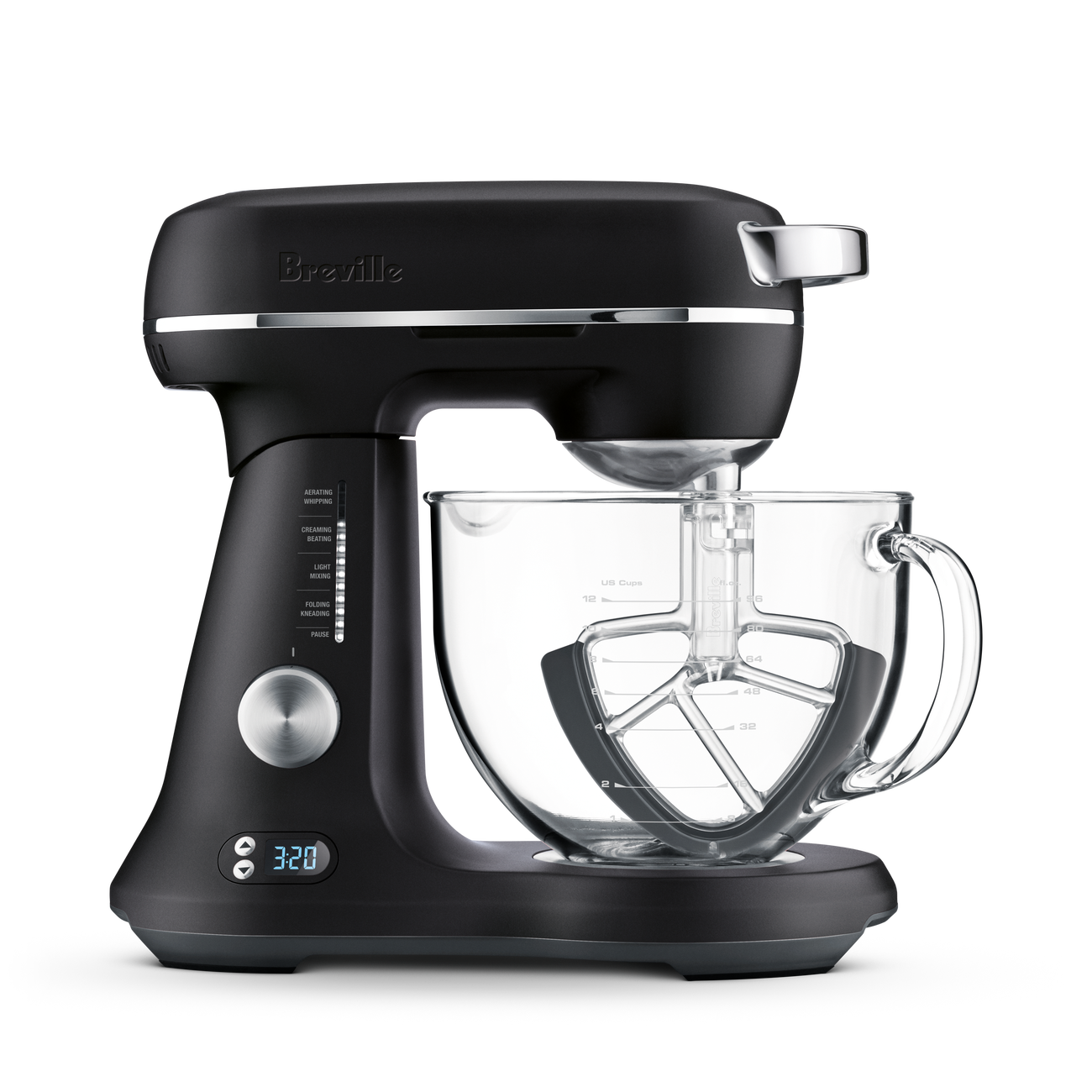
The Breville Bakery Chef is a compact 5.5-quart tilt-head stand mixer with a 1000-watt motor, 12 speed settings, and a built-in LCD timer. It is designed for home bakers who want precise control over mixing times — creaming, whipping, and kneading moderate batches without taking over the counter.
Key Specifications
- Motor
- 1000 watts (manufacturer specification)
- Speeds
- 12
- Weight
- Approx. 20 lb (9 kg)
- Display
- Backlit LCD count-up timer
- Capacity
- 5.5 qt / 5.2 L stainless steel bowl
- Warranty
- 5-year limited motor warranty (manufacturer)
- Included tools
- Flat beater, wire whisk, dough hook
Overview
The Breville Bakery Chef is a tilt-head stand mixer with a 5.5-quart stainless steel bowl, a 1000-watt motor, and 12 speed settings. Its signature feature is the backlit LCD screen, which counts up the time you've been mixing — a practical aid for recipes that specify precise mixing durations. A planetary mixing action moves the beater around the bowl as it spins, so ingredients are drawn from the edges into the center rather than left in an unmixed ring.
The mixer ships with a flat beater, a wire whisk, and a dough hook, meaning it covers the three core stand mixer jobs out of the box without extra purchases. It targets home bakers who turn out cakes, cookies, meringues, and the occasional loaf of bread, and who value control over raw power above all. In the broader market, it sits slightly above the KitchenAid Artisan on price, and well above budget machines from Hamilton Beach and Cuisinart's entry line.
You can find the Breville Bakery Chef on Amazon, where it's usually stocked and periodically discounted: https://www.amazon.com/s?k=breville+bakery+chef&linkCode=gg3&tag=ra075-20
Pros
The Breville Bakery Chef stands out in a few specific ways, and several are unique in its price class. Here is what it genuinely does well, with the caveat that some of these strengths only matter for certain kinds of bakers.
Pro 1 — LCD Count-Up Timer Keeps Your Mixing Consistent
The most distinctive feature on the Bakery Chef is the LCD screen that counts up as the mixer runs. If a recipe says 'beat butter and sugar for 4 minutes,' you can glance at the mixer instead of a phone timer or wall clock — the screen shows elapsed seconds and minutes right on the machine.
This matters in practice because over-mixed cakes are usually just cakes left on the machine too long, and under-mixed ones were cut short. The count-up also helps with whipping cream or egg whites, where timing matters as much as technique. The screen is backlit and legible in typical kitchen lighting.
One honest limitation: the timer is elapsed-time only. It won't count down, beep, or stop the motor for you. But as an aid to consistent results, it's a genuinely useful tool that few competitors offer at this price.
Pro 2 — 1000-Watt Motor With 12 Speeds and a Soft Start
Breville's published specifications list the Bakery Chef's motor at 1000 watts — more than the 325-watt rating on the KitchenAid Artisan — and 12 speed settings give you fine control from a slow fold up to high-speed whipping. The range covers everything from gently blending meringue to beating heavy cookie dough.
The low-speed start is a practical detail that reduces flour clouds: the beater eases up to the speed you selected rather than jerking into motion. Combined with the 1000-watt motor, the machine holds a consistent speed through most batters and doughs that fit in the 5.5-quart bowl.
For a typical home baker doing cakes, cookies, frosting, and occasional bread dough, there is more headroom than a 300-watt budget machine. The motor still slows under a heavy, dense dough — that is true of every home stand mixer — but for ordinary workloads the power is comfortably sufficient.
Pro 3 — Planetary Mixing Action Reaches the Whole Bowl
The planetary mixing action rotates the head around the bowl while the beater spins, so the tool sweeps the entire surface instead of leaving an unmixed ring around the edges. That translates to fewer pauses to scrape down the sides when you're creaming butter and sugar or folding in chocolate chips.
With the flat beater, cookies, cake batter, and buttercream come out consistent across the bowl. The wire whisk whips cream and egg whites with good aeration, and the dough hook handles moderate-knead bread recipes. It's a standard mechanism in this class, but the Bakery Chef executes it without wobble or binding.
For dense batters such as carrot cake with lots of add-ins, you'll still stop once or twice to scrape — but the uniform mixing action does most of the work for you.
Pro 4 — Three Core Tools Included Out of the Box
The flat beater, wire whisk, and dough hook that ship in the box cover the three jobs most buyers want a stand mixer for: general mixing, aeration, and kneading. There are no surprise accessory purchases required to have a complete day-one experience.
The tools click into the head and eject with a button mechanism, so swapping from the beater to the whisk takes seconds — handy when a recipe moves from creaming butter to folding in whipped egg whites. The stainless steel bowl snaps in and out via the tilt head, and a storage bracket on the machine keeps the tools close at hand.
Unless you specifically need a fourth or fifth tool, the included set is enough for months of routine baking.
Pro 5 — Compact Footprint for a 5.5-Quart Bowl
The Bakery Chef is dimensionally smaller than the KitchenAid Artisan while offering the same nominal bowl capacity. If counter space is tight, the compact body fits under most standard upper cabinets with the head lowered, and it doesn't jut forward as much as many full-size mixers.
That said, the machine weighs roughly 20 pounds, so it's not something you want to lift regularly; it's best positioned as either a permanent counter resident or a dedicated cabinet slot. The payoff is that real 5.5-quart capacity can live in a kitchen where a larger mixer would feel overwhelming.
For apartment kitchens and narrow counters, that trade-off is worth paying attention to.
Pro 6 — Five-Year Motor Warranty and Solid Build
Breville backs the Bakery Chef with a 5-year limited motor warranty in its documentation, which is substantially longer than the one-year warranties that come with many budget mixers and some rivals. It speaks to confidence in the machine's long-term durability.
The body uses a substantial, weighted construction that keeps the mixer planted on the counter during kneading, with no walking or rattling across the surface. That steadiness is one of those qualities you only notice when using a weaker, lighter machine side by side.
Combine the warranty with the simple three-tool mechanism, and you have reasonable assurance this will be a decade-scale purchase for most home bakers.
Cons
Every mixer is a bundle of trade-offs, and the Bakery Chef is no exception. The following limitations matter more to some bakers than others — think about how you'll actually use the machine before letting any single con decide for you.
Con 1 — Very Limited Accessory Ecosystem
This is the biggest practical difference between the Breville and the KitchenAid competition. KitchenAid offers dozens of hub-mounted attachments — pasta rollers, meat grinders, spiralizers, ice cream makers — that snap onto the front of the mixer. Breville's Bakery Chef has essentially no comparable range of official accessories.
What you get in the box is what you get: a flat beater, a wire whisk, and a dough hook. There's no official way to turn this mixer into a pasta machine or a grain mill. For home cooks who want one machine to grow with their cooking, that's a genuine constraint.
If your plan is solely cakes, cookies, and whipped cream, this con won't matter. If you can see yourself buying attachments in a few years, it's the strongest reason to choose a KitchenAid instead.
Con 2 — Premium Price for the Capacity
The Bakery Chef lists around $449.99 and typically sells in the $399-$429 range on Amazon, with prices fluctuating through the year. The KitchenAid Artisan often drops below $350 during promotions, and the Cuisinart Precision routinely lands near $250-$300.
You are paying a meaningful premium for a 5.5-quart machine. The Breville's justification is the LCD timer, the compact footprint, and the fit-and-finish level — genuinely nice qualities, but not functional capabilities a cheaper mixer lacks.
For budget-sensitive buyers, that premium is hard to swallow, especially since the mixing performance difference between the Breville and a $280 Cuisinart is far smaller than the price gap.
Con 3 — 5.5-Quart Capacity Is Tight for Bread
Five and a half quarts is standard for a tilt-head mixer, but it's at the small end for bread dough. A typical single loaf — about 3 to 4 cups of flour — kneads comfortably, and you can push to 5 cups for larger loaves or pizza dough. Beyond that, dough tends to climb the hook or crowd the sides of the bowl.
For recipes with 6 or more cups of flour, or double-batch pizza dough, you'll need to split the dough and work in stages, or use a larger machine. This is the same fundamental limitation the KitchenAid Artisan has, so it's not a Breville-specific flaw; it's a capacity reality of the 5.5-quart class.
If your baseline is a multi-loaf bake, this machine will frustrate that workflow, and the KitchenAid Pro 6000 or an Ankarsrum will serve you better.
Con 4 — Noticeably Loud at High Speeds
User feedback and third-party reviews describe the Bakery Chef as louder than the KitchenAid Artisan at comparable speeds — especially when whipping at high speed or kneading a stiff dough. It's not a shriek, but it's an audible whir that runs through the motor and bowl.
In an open-plan kitchen, you'll likely raise your voice over it. If you typically bake early in the morning or while a baby naps nearby, noise is a legitimate consideration. The Artisan at equivalent settings tends to be quieter, though it's not silent either.
This is a moderate annoyance rather than a dealbreaker, but it's the kind of thing that becomes noticeable on a 15-minute knead.
Con 5 — Proprietary Parts Are Costly to Replace
Everything about the Bakery Chef — bowl, beaters, whisk, dough hook — is proprietary to Breville. You can't swap in a cheap third-party bowl or use KitchenAid tools in a pinch, and Breville's own replacements are more expensive and less often discounted than comparable KitchenAid parts.
An extra bowl for a second batch or for washing rotation is a meaningful added cost, and spare parts pricing sits above the equivalent KitchenAid items. For households that expect to buy accessories over a decade of use, that adds a hidden premium to the purchase price.
The included tools are dishwasher-safe, so in practice most owners won't need replacements for years, but the option set is narrower and pricier than the KitchenAid path.
Con 6 — Timer Is Elapsed-Time Only
The LCD is a count-up display; it does not beep, count down, or stop the motor automatically. So for a recipe that says 'mix for exactly 4 minutes,' you still have to manage the stopping yourself — the display just makes it easier to glance at the mixer instead of your phone.
That's not an unreasonable design choice; almost nothing in this price class offers a countdown auto-off, and many bakers actually like seeing elapsed time without programming anything. But if you hoped the timer would automate the 'stop at 4 minutes' step, it won't.
It's a modest con, and the ones who will feel it most are those who expected a hands-free feature.
👍 Who It's For
The Breville Bakery Chef is a smart buy for the home baker who cares about technique and consistency, because the LCD timer genuinely changes the way you mix — you can see exactly how long the butter and sugar have creamed, or how many minutes the egg whites have been whipping. If your baking routine is cakes, cookies, meringues, frosting, and the occasional single loaf, the machine handles all of it without strain and fits well on the counter.
It's also right for households with limited counter space. The mixer's footprint is smaller than the KitchenAid Artisan's, which makes it easier to keep out or to store under a standard upper cabinet. Finally, if you appreciate Breville's design philosophy — controls that put information in front of you, solid construction, and an appliance that looks deliberate in a modern kitchen — the Bakery Chef is consistent with that ethos.
If you're upgrading from a hand mixer or a budget stand mixer, the leap in capability is immediately visible, and the included tools cover your first several months of recipes without needing add-ons.
👎 Who Should Avoid
Skip the Breville Bakery Chef if your baking is built around large batches. A 5.5-quart bowl handles a single loaf or a double batch of cookies, but double-loaf bread recipes or heavy doughs above roughly 5 cups of flour will crowd the bowl and strain the motor, forcing you to split dough and knead in stages.
It's also not the machine for home cooks who want one appliance that also grinds meat, rolls pasta, or spins ice cream. KitchenAid's hub-mounted accessory line has been the standard for decades, and the Breville has no official equivalent. Budget-conscious shoppers should also look hard at the Cuisinart Precision, which delivers a similar feature set for about $150 less during sales — if the timer isn't a must-have, the savings are hard to ignore.
See today's Breville Stand Mixer (Bakery Chef 5.5 Qt) price and available configurations on Amazon.
🛒 Buy on AmazonAs an Amazon Associate we earn from qualifying purchases.
Alternatives to Consider
| Product | Choose Breville Stand Mixer (Bakery Chef 5.5 Qt) if... | Choose the alternative if... |
|---|---|---|
| KitchenAid Artisan 5 QuartOften $50-$150 cheaper when on sale | You bake mostly single-batch cakes, cookies, and meringues and want the LCD timer to keep your mixing consistent. | You want a lower sale price and access to KitchenAid's huge catalog of hub attachments for pasta, meat grinding, and more. |
| Cuisinart Precision Stand Mixer 5.5 QtAbout $150-$200 cheaper | You want the Breville's feature set — 12 speeds, planetary head, timer — plus Breville's more polished build and design. | You want to save roughly $150 and are fine with a comparable feature set in a slightly less refined package. |
| KitchenAid Pro 6000 Series 6 QtComparable $400-$500 street price | You prioritize counter-space savings and prefer the Breville's more compact design over a bulkier larger machine. | You need the extra quart of bowl capacity for bread batches and want the stronger motor that a larger machine provides. |
| Ankarsrum Assistent Original 7LRoughly $300 or more expensive | You bake bread occasionally and want a simpler, less expensive machine that handles batters well. | You're a serious bread baker kneading stiff or heavy doughs regularly and want the most capable home mixer on the market. |
The most obvious alternative is the KitchenAid Artisan 5 Quart, the perennial default in this class. It has a deeper accessory ecosystem, more brand ubiquity, and frequently a lower sale price; the Breville counters with the LCD timer, a smaller footprint, and a motor rated higher on paper. If widening your mixer's future abilities matters more than the timer, the Artisan is the safer bet — if you want the information display and don't plan to attach anything else, the Breville is the better fit.
The Cuisinart Precision Stand Mixer (5.5 Qt) is the value-adjacent rival: a similar planetary head, 12 speeds, a count-up timer, and often a street price near $250-$300, which undercuts the Breville meaningfully. For bakers who want larger capacity, the KitchenAid Pro 6000 Series 6 Qt provides a bigger bowl and a stronger motor at a comparable $400-$500 street price, with the usual KitchenAid accessory compatibility. And for serious bread bakers, the Ankarsrum Assistent Original 7L is the benchmark for heavy doughs, though at roughly $700+ it costs considerably more.
Is it worth the price?
At approximately $449 list and $399-$429 typical street price, the Breville Bakery Chef is worth it for the home baker who will actually use the LCD timer and values a compact footprint. For anyone who mainly mixes light batters once or twice a month, the Cuisinart Precision at around $250-$300 delivers a similar feature set for meaningfully less. The Breville earns its premium through build polish and the timer experience — you pay for that refinement, and it's only a good value if those details matter to you.
📝 Bottom Line
The Breville Bakery Chef is the right choice for the home baker who wants precision and consistency in a compact machine. Its LCD timer is unique in this class, the 1000-watt motor (per manufacturer specifications) has real headroom for typical batters, and the planetary mixing action does an even job without constant scraping. The small footprint and thoughtful controls make it a pleasant addition to a working kitchen.
Its limits are equally clear: the 5.5-quart bowl caps the machine at single-loaf bread batches, and the accessory ecosystem is nearly nonexistent compared with KitchenAid's. At $449 list, it also carries a premium over the Cuisinart Precision, which offers a similar feature set for about $150 less during sales.
Buy it if you bake regularly and will appreciate the timer and the build quality. Skip it if you need a mixer that can grow into pasta rolling, meat grinding, or big-batch bread days — for those jobs, the KitchenAid Artisan or Pro 6000 delivers more versatility at a similar or lower price. You'll find the Bakery Chef on Amazon — allowing for typical price fluctuations — at around $400-$430.
Check current Breville Stand Mixer (Bakery Chef 5.5 Qt) availability and bundle options on Amazon.
🛒 Buy on AmazonAs an Amazon Associate we earn from qualifying purchases.
Frequently Asked Questions
Quick Summary
Key Pros
- ✓LCD count-up timer keeps you aware of exactly how long you've been mixing
- ✓1000-watt motor (manufacturer spec) with 12 speeds and a soft start
- ✓Planetary mixing action covers the bowl evenly with fewer scraping pauses
- ✓Flat beater, wire whisk, and dough hook included out of the box
- ✓Compact footprint fits tighter kitchens than the KitchenAid Artisan
Key Cons
- ✗Limited official accessories — no pasta rollers, meat grinders, or grain mills
- ✗Premium $449 list price vs KitchenAid and Cuisinart alternatives
- ✗5.5-quart bowl maxes out around one large loaf of bread
- ✗Noticeably louder than comparable mixers at high speeds
- ✗Proprietary parts are expensive and rarely discounted
Ratings
Best For
- →Home bakers who bake cakes, cookies, or meringues weekly
- →Bakers who want to track mixing time without a separate timer
- →Households with limited counter space
- →People who appreciate Breville's design and control philosophy