Administrative law quietly shapes modern governance, regulating everything from environmental protections to workplace safety through agencies like the EPA and FDA. For advanced learners, understanding it means decoding how unelected bureaucrats wield delegated power—and when courts step in. Missteps here can doom regulatory challenges or policy advocacy.
In this guide, you'll learn the definition, sources, processes, judicial review standards, and pivotal Supreme Court cases like Chevron (overruled) and Loper Bright. Expect deep dives with real-world examples, no fluff. It's designed for law students, practitioners, or policy pros—advanced but accessible.
Allocate 45-60 minutes: 20 for core concepts, 25 for cases. Pair with primary sources for mastery.
▸What You'll Need
- •Solid grasp of U.S. constitutional law and separation of powers (prerequisite)
- •Access to free case law sites like supremecourt.gov or Google Scholar (required)
- •Legal dictionary for terms like 'arbitrary and capricious' (recommended; see products)
- •Note-taking app or paper for diagramming agency processes (optional)
Estimated Time: 45-60 minutes
Difficulty: advanced
▸Step-by-Step Instructions
Step 1: Define Administrative Law and Its Scope
Administrative law is the body of law governing executive branch agencies' operations, including their creation, powers, and accountability. It fills gaps left by legislatures, enabling agencies to implement statutes via rules, enforcement, and adjudication.
Why it matters: Agencies issue thousands of rules yearly, impacting 1 in 5 U.S. civil penalties (per recent data). Scope covers rulemaking (legislative-like), adjudication (judicial-like), and licensing/enforcement (executive-like). Analogy: Think of Congress as a chef writing recipes (statutes); agencies as cooks adapting them daily.
Expect holdings from cases like Myers v. United States (1926) limiting agency independence.
💡 Tips:
- •Use analogies to teach: Agencies as 'fourth branch' with checks.
⚠️ Warnings:
- •Avoid equating it to criminal law—focus is civil/regulatory.
Step 2: Identify Sources of Administrative Law
Primary sources: Administrative Procedure Act (APA, 1946), organic statutes creating agencies (e.g., Clean Air Act), Constitution (Art. II delegation), and common law.
Secondary: Agency manuals, executive orders (e.g., EO 13992 on regulation). Why key? Courts defer to agencies under standards but scrutinize ultra vires acts.
Pro tip: APA §706 sets review standards—memorize 'arbitrary, capricious, abuse of discretion.'
💡 Tips:
- •Bookmark 5 U.S.C. §§551-559 (APA rulemaking).
Step 3: Understand Agency Structure and Powers
Agencies like independent (FTC, multimember) vs. executive (EPA, Cabinet-led). Powers: Delegated rulemaking (notice-and-comment under APA §553), formal/informal adjudication (§554+), prosecutorial discretion.
Limits: Nondelegation doctrine (J.W. Hampton, 1928), major questions (West Virginia v. EPA, 2022). Analogy: Agency as orchestra conductor interpreting score (statute).
Post-2024 SCOTUS shifts emphasize textualism.
⚠️ Warnings:
- •Don't overlook removal protections (Humphrey's Executor, 1935).
Step 4: Break Down Rulemaking Process
Informal (most common): Notice, comment, final rule (30/60-day delays). Formal: Trial-like hearings (rare post-Vermont Yankee, 1978).
Why matters: 4,000+ rules/year via Federal Register. Expect economic analysis (State Farm). Hybrid rulemaking supplements exist.
Diagram: ANPR → NPRM → Comments → Final Rule.
💡 Tips:
- •Track via regulations.gov for real petitions.
Step 5: Explore Adjudication and Enforcement
Adjudication: APA hearings, ALJ decisions (e.g., SSA disability). Enforcement: Inspections (Marshall v. Barlow's, 1978), penalties.
Key: Due process applies (Goldberg v. Kelly, 1970 welfare). Analogy: Agency as prosecutor, judge, jury—checked by courts.
Step 6: Master Judicial Review Standards
APA §706: Review legality. Standards: Constitutional, ultra vires, substantial evidence, arbitrary/capricious.
Hard look review (State Farm, 1983): Agencies must explain reasoned decisions. No deference post-Loper Bright (2024). Skidmore deference survives for persuasiveness.
💡 Tips:
- •Chart: Chevron Step 1 (ambiguity?), Step 2 (reasonable?)—now history.
Step 7: Analyze Landmark Case: Chevron and Loper Bright
Chevron USA v. NRDC (1984): Two-step deference to agency statutory interp if ambiguous/reasonable. Overruled by Loper Bright Enterprises v. Raimondo (2024, 6-3): Courts decide all questions (statutory stare decisis exception).
Impact: Ends agency deference era; agencies lose ~70% challenges now harder. Why pivotal: Deregulation wave.
⚠️ Warnings:
- •Pre-Loper cases still bind circuits.
Step 8: Review Other Key Cases
- •
Citizens to Preserve Overton Park v. Volpe (1971): 'Hard look' arbitrary/capricious review.
- •
Motor Vehicle Mfrs. Ass'n v. State Farm (1983): Reversed passive restraint rule for ignoring alternatives.
- •
West Virginia v. EPA (2022): Major questions doctrine—no clear statement for big economic/political shifts.
Study holdings: Predictable, explainable agency action.
💡 Tips:
▸Pro Tips
- •Read cases bottom-up: Facts → Holding → Dicta → Concurrences for nuances.
- •Mnemonic for review standards: 'CUSS' (Constitutional, Ultra Vires, Substantial Evidence, Scope of Review).
- •Follow RegInfo.gov for upcoming rules to apply concepts.
- •Diagram agency-statute-court triangle for every case.
- •Post-Loper, argue textualism over expertise.
- •Pair with podcasts like 'SCOTUSblog' for audio recaps.
- •Update outlines yearly—SCOTUS shifts fast.
▸Common Mistakes to Avoid
- •Assuming Chevron deference survives: It's dead post-2024; courts interpret independently.
- •Confusing rulemaking (prospective rules) with adjudication (case-specific).
- •Ignoring major questions doctrine in climate/energy challenges.
- •Overlooking APA timelines: 60 days to challenge final rules.
- •Forgetting Skidmore lives: Persuasive weight for non-precedential guidance.
▸Troubleshooting
Problem: Struggling to distinguish deference levels (e.g., Chevron vs. Auer).
Solution: Chart post-Loper: No Chevron/Auer; Skidmore/Mead factors only. Read Kisor v. Wilkie (2019) for remnants.
Problem: Overwhelmed by case volume.
Solution: Prioritize APA quartet: Overton Park, State Farm, Chevron, Loper. Use casebooks for synthesis.
Problem: Applying old precedents in memos.
Solution: Check SCOTUSblog or Cornell LII for June 2024 updates. Seek prof review for exams.
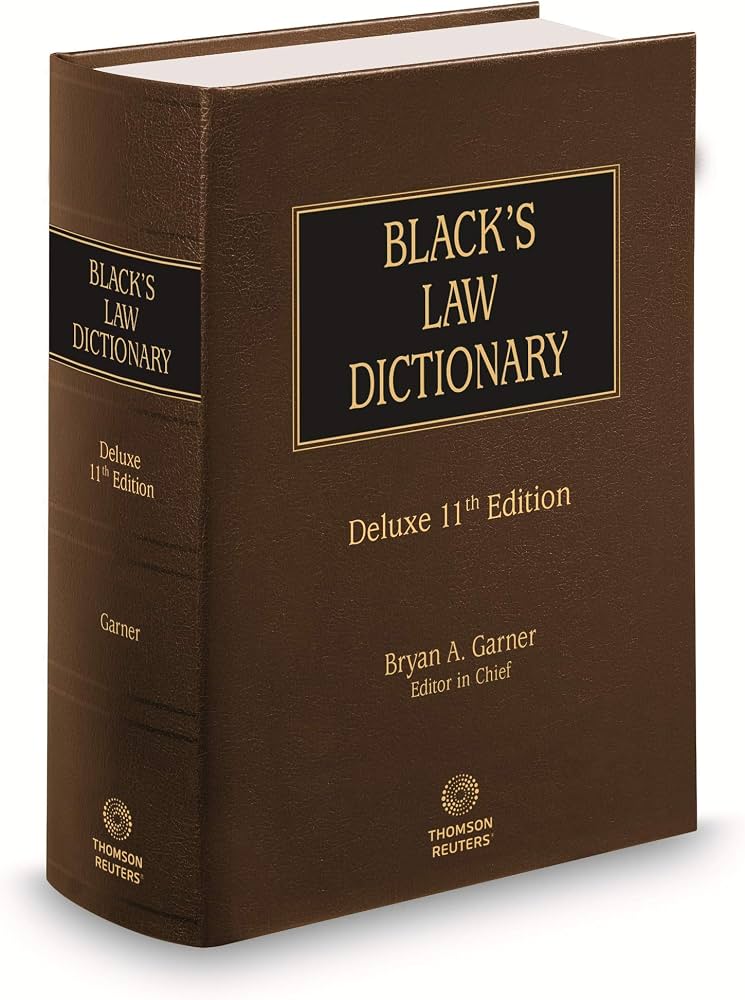
Black's Law Dictionary, 11th Edition (Thumb Index)
Defines 50,000+ terms precisely, essential for advanced admin law jargon like 'remedial order' or 'nonacquiescence.'
Best for: Quick lookups during case reading or briefing agency actions.
Price Range: $70-$90
Examples & Explanations: Administrative Law, Sixth Edition by Ronald W. Cass
Breaks complex cases into hypotheticals and explanations, perfect for self-testing advanced concepts.
Best for: Law school exam prep or practitioner refreshers on judicial review.
Price Range: $50-$65
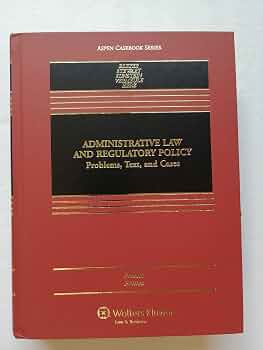
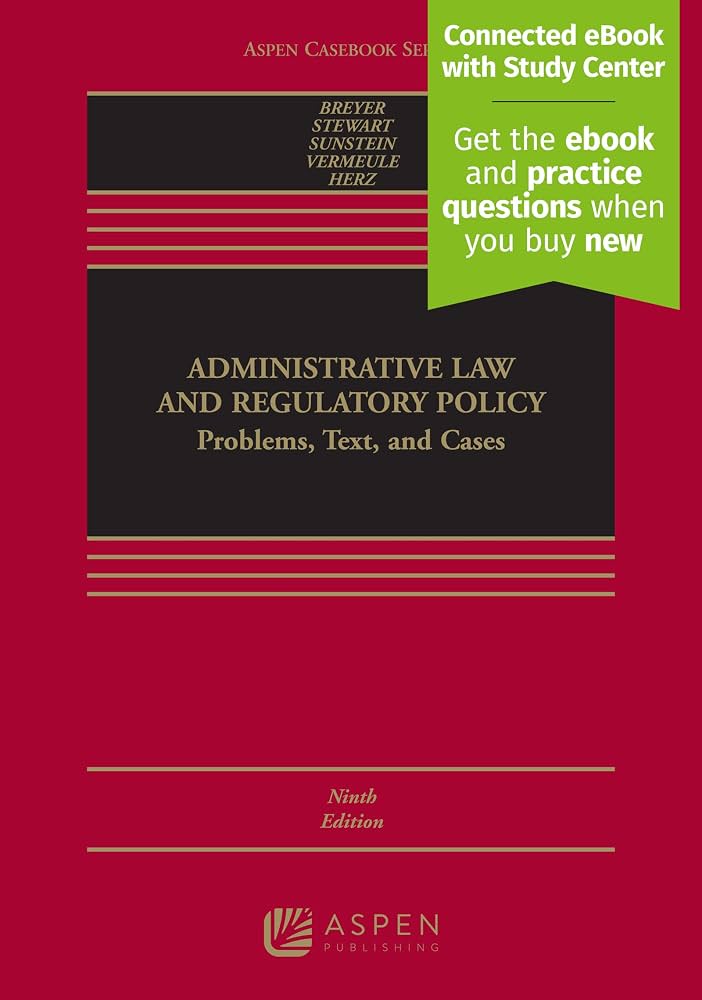
Administrative Law and Regulatory Policy: Problems, Text, and Cases, Ninth Edition by Stephen Breyer
Comprehensive casebook with problems mimicking real agency disputes; authored by Justice Breyer.
Best for: Deep study of Chevron-era reasoning and modern critiques.
Price Range: $200-$250
Glannon Guide to Administrative Law: Learning Administrative Law Through Multiple-Choice Questions
Interactive Q&A format reinforces key cases and standards interactively.
Best for: Bar prep or quick mastery of arbitrary/capricious tests.
Price Range: $40-$55
2024 Supplement: Administrative Law Keyed to Strauss, Ginsburg, et al.
Updates post-Loper Bright and Corner Post for current law.
Best for: Practitioners tracking 2024 SCOTUS impacts.
Price Range: $45-$60