
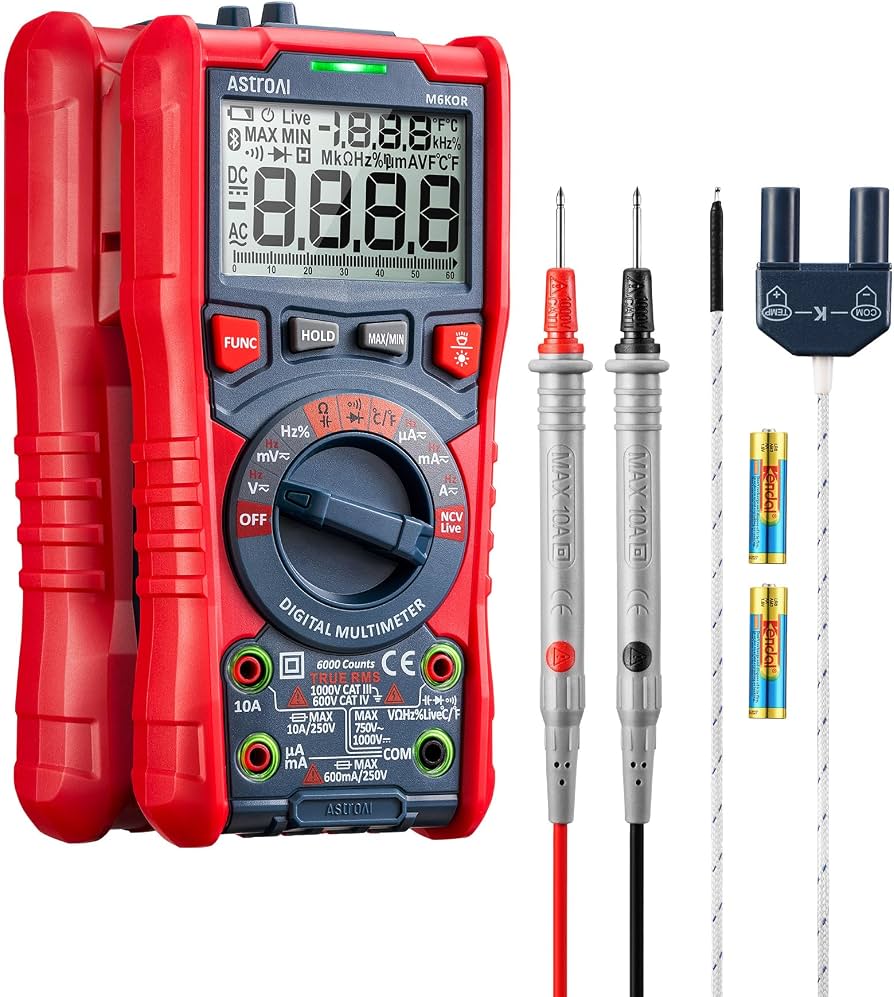
AstroAI Digital Multimeter TRMS 6000 Counts
Essential for open circuit voltage test on any 12V battery.
$13-$15
AstroAI Digital Multimeter TRMS 6000 Counts Accurate DC voltage readings for beginners with auto-range and clear display.
Get the App
Better experience on mobile
Quickly check your 12V battery's charge level at home with simple tools—no guesswork, prevent breakdowns.
Nothing's worse than a dead 12V battery leaving you stranded, whether it's for your car, RV, boat, or solar setup. Testing ensures it's fully charged (around 12.6-12.8 volts) before issues arise, saving you from unnecessary replacements or jumps.
In this beginner guide, you'll learn reliable methods using a multimeter for voltage checks and optional load testing for deeper insights. We'll cover safety, step-by-step instructions, and what readings mean success.
Expect 10-20 minutes total, with no advanced skills needed—just basic tools and caution around batteries.
Estimated Time: 10-20 minutes Difficulty: beginner
Before touching the battery, wear safety gloves and eye protection. Batteries contain acid and can spark or explode if mishandled.
Park your vehicle on a flat surface, turn off the engine, and remove keys. Disconnect the negative (-) terminal first using a wrench to avoid short circuits—this is crucial for 12V systems like cars or ATVs.
Success looks like: Battery isolated safely, no risk of accidental power flow.
💡 Tips:
⚠️ Warnings:
Inspect terminals for corrosion (white powdery buildup). Wipe with a clean cloth dipped in baking soda-water solution (1:1 ratio), then rinse with water and dry.
Use a wire brush if needed for stubborn corrosion. Clean connections ensure accurate readings—dirty terminals can drop voltage falsely.
Success looks like: Shiny, corrosion-free terminals.
💡 Tips:
⚠️ Warnings:
Turn on the digital multimeter and set it to DC voltage (V⎓), 20V range—common for 12V batteries.
Insert red probe into V/Ω port, black into COM. Test on a known source like AA battery (1.5V) first to verify.
Success looks like: Multimeter displays correct test voltage.
💡 Tips:
Let battery rest 1-2 hours if recently charged (avoids surface charge illusion). Touch red probe to positive (+) terminal, black to negative (-).
Note the reading: Fully charged = 12.6-12.8V; 75% = 12.4V; discharged <12.2V.
Success looks like: Steady reading above 12.6V—no fluctuations.
💡 Tips:
⚠️ Warnings:
Compare to chart:
For AGM or lithium 12V batteries, thresholds vary slightly (AGM ~12.8V full).
Success looks like: Voltage confirms full charge; if low, proceed to charge.
💡 Tips:
Connect load tester per instructions (clamps to terminals). Apply load for 10-15 seconds.
Voltage should hold above 9.6V under load for healthy battery. Drops below? Weak cells.
Success looks like: Passes load test without significant drop.
💡 Tips:
⚠️ Warnings:
Reattach positive (+) first, then negative. Tighten securely.
Start engine or load; recheck voltage after 5 mins running (should be 13.7-14.7V charging).
Success looks like: Battery reconnected, system functions normally.
💡 Tips:
Problem: Voltage reads 0V
Solution: Check probe connections and multimeter batteries. Ensure terminals are clean.
Problem: Fluctuating readings
Solution: Secure probes fully; test in stable environment away from chargers.
Problem: Voltage good but won't start vehicle
Solution: Perform load test—battery may have weak CCA. Seek pro sulfation check.
Problem: Reads high but drops fast
Solution: Surface charge; rest and retest. Or parasitic drain—check with ammeter.
Accurate DC voltage readings for beginners with auto-range and clear display.
Best for: Essential for open circuit voltage test on any 12V battery.
Price Range: $13-$15
Simple load tester verifies real capacity under load, beyond just voltage.
Best for: Confirm starter batteries for cars/RVs hold charge during cranking.
Price Range: $20-$25
Digital tester with voltage, CCA, and health percentage—no load needed.
Best for: Quick, non-invasive tests for automotive 12V batteries.
Price Range: $25-$35
Heavy-duty for repeated use, tests up to 1000 CCA.
Best for: Pro-level verification for marine or powersports batteries.
Price Range: $50-$60
Essential for open circuit voltage test on any 12V battery.
AstroAI Digital Multimeter TRMS 6000 Counts Accurate DC voltage readings for beginners with auto-range and clear display.
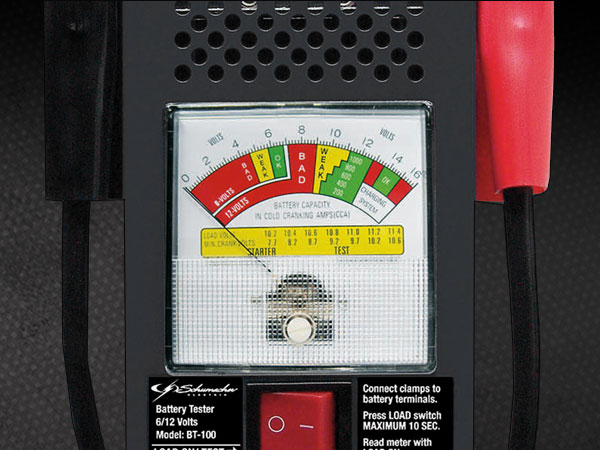
Confirm starter batteries for cars/RVs hold charge during cranking.
Schumacher BT-100 Battery Tester Simple load tester verifies real capacity under load, beyond just voltage.
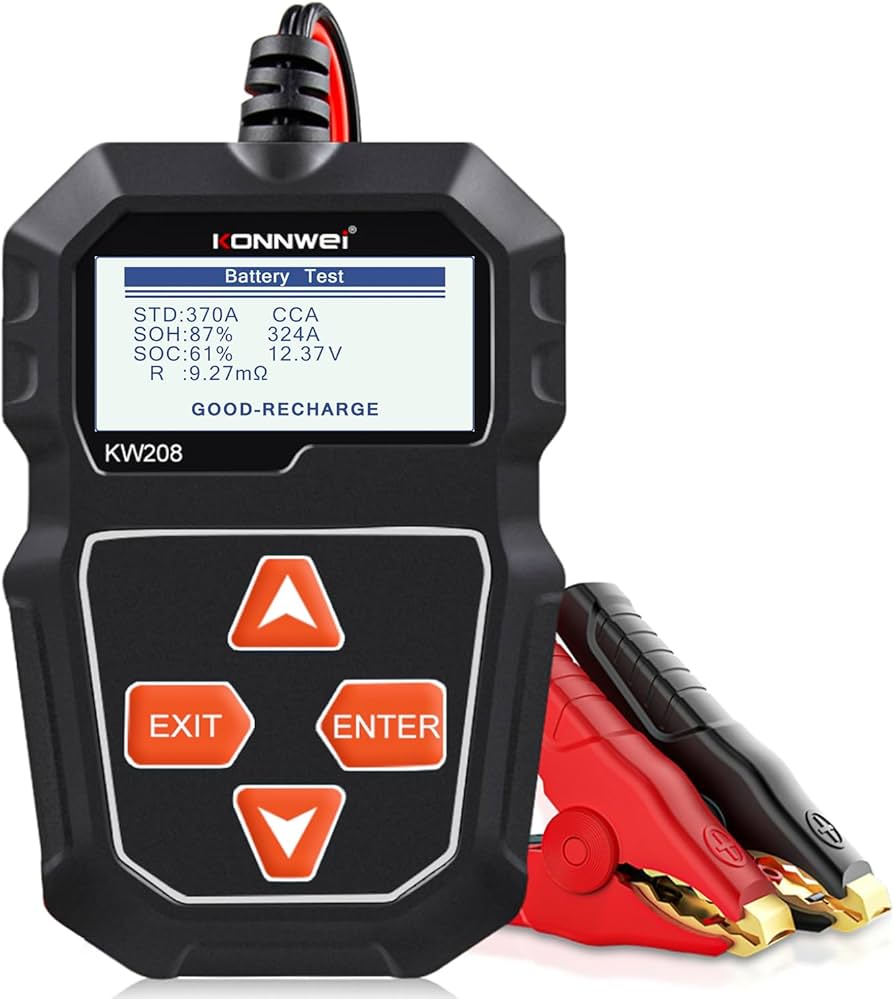
Quick, non-invasive tests for automotive 12V batteries.
KONNWEI KW208 Car Battery Tester Digital tester with voltage, CCA, and health percentage—no load needed.
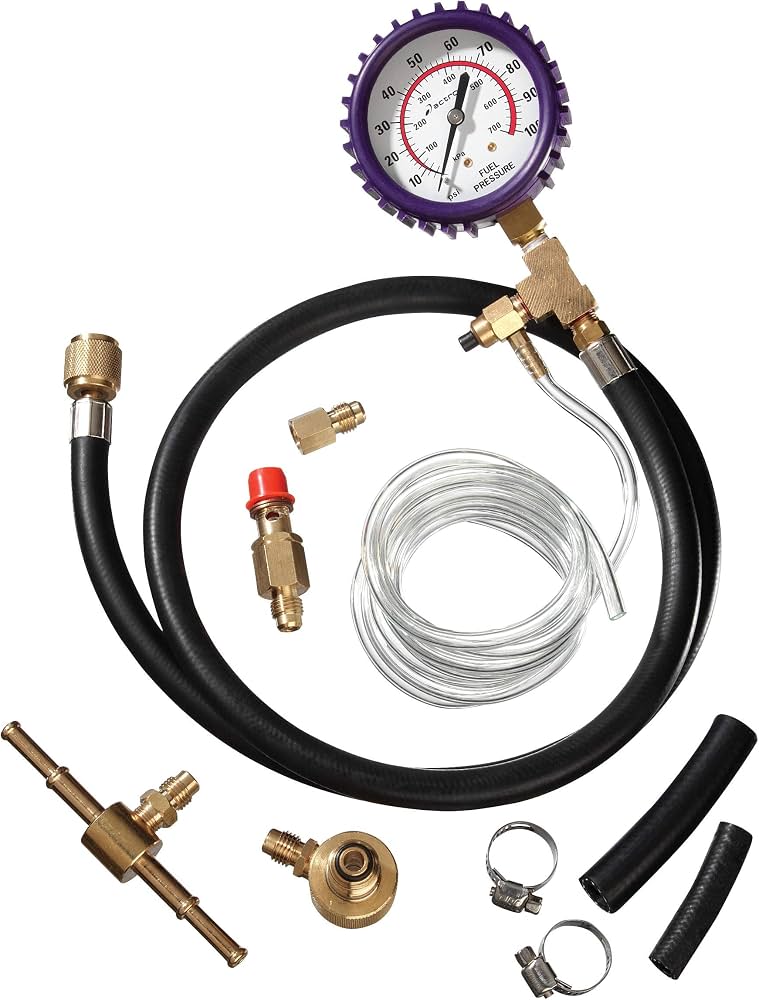
Pro-level verification for marine or powersports batteries.
ACTRON CP7838 Battery Load Tester Heavy-duty for repeated use, tests up to 1000 CCA.