Choosing the wrong cut-off wheel can lead to poor cuts, damaged grinders, or even dangerous shattering. Whether you're cutting metal, stainless steel, or masonry, the right wheel makes the job faster, cleaner, and safer. This guide walks you through the key factors: diameter, thickness, abrasive type, RPM ratings, and safety considerations. By the end, you'll confidently select the perfect wheel for any task.
▸What You'll Need
- •Angle grinder (check arbor size: typically 5/8-inch or M14 thread)
- •Variety of cut-off wheels for comparison
- •Tachometer (optional, to verify grinder RPM)
- •Safety glasses, gloves, and hearing protection
- •Material to cut (sample of steel, stainless, masonry, etc.)
Estimated Time: 15-20 minutes to read; 1 hour for hands-on selection practice
Difficulty: beginner
▸Step-by-Step Instructions
Step 1: Check Your Grinder's Arbor Size and Maximum RPM
Most angle grinders have a 5/8-inch arbor (common in the US) or an M14 thread (common in Europe). Look for this specification on the grinder's label or manual. Also note the tool's maximum RPM (e.g., 11,000 RPM for a 4.5-inch grinder). Never use a wheel rated for a lower RPM than your grinder's speed—it can fly apart. Write down these numbers; you'll need them to match with wheel labels.
💡 Tips:
- •If you lose the manual, search online for your grinder model + 'arbor size'.
- •Some grinders have adjustable speed; always run at or below wheel rating.
⚠️ Warnings:
- •Using a wheel with an RPM rating lower than your grinder's speed is extremely dangerous.
Step 2: Identify the Material You Will Cut
Cut-off wheels are designed for specific materials. A wheel for mild steel may wear out quickly on stainless steel or masonry. Common categories: mild steel, stainless steel, aluminum, tile, brick/concrete, and cast iron. For example, cutting stainless requires a wheel with zirconia alumina or ceramic grain; for masonry, use a diamond or silicon carbide wheel. If you cut multiple materials, consider a multi-purpose wheel (e.g., aluminum oxide with a special bond) or dedicated wheels for each.
💡 Tips:
- •For occasional mixed cutting, a general-purpose wheel works but may sacrifice life.
- •Check the wheel label for 'Type 1' (flat) or 'Type 27' (depressed center) - both cut but Type 27 allows flush cutting.
Step 3: Select the Correct Diameter for Your Grinder
Common diameters: 4-1/2 inch (most popular), 5, 6, 7, and 9 inches. The wheel diameter must match the grinder's intended size. Using a 5-inch wheel on a 4.5-inch grinder is dangerous because the guard may not cover it. The diameter affects cutting depth: a 4.5-inch wheel cuts about 1.5 inches deep; a 7-inch wheel cuts about 2.5 inches. Choose the largest diameter your grinder accepts for deeper cuts, but ensure the guard fits.
💡 Tips:
- •For thin materials (sheet metal), a smaller diameter is fine and gives better control.
- •If you need a deeper cut than your grinder can take, consider a larger grinder or use both sides (cut halfway, flip).
⚠️ Warnings:
- •Do not remove the wheel guard to fit a larger diameter; it's a critical safety device.
Step 4: Choose the Right Thickness (Thin vs. Thick)
Cut-off wheels range from about 0.045 inches (1.0 mm) to 0.125 inches (3.2 mm) thick. Thin wheels (0.045-0.060 inch) cut faster, create less heat, and produce a narrower kerf—ideal for precision cutting, thin metal, and stainless steel. Thick wheels (0.090-0.125 inch) are more durable, last longer, and are better for heavy-duty cutting, grinding, and notching. However, they generate more heat and friction, which can discolor stainless steel. For most DIYers, a medium thickness (0.060-0.080 inch) offers a good balance.
💡 Tips:
- •For thin stainless sheet, a 0.045 inch wheel minimizes heat and blueing.
- •For structural steel or rebar, a thicker (0.090 inch) wheel resists breakage.
⚠️ Warnings:
- •Thin wheels are fragile; avoid side-loading them (twisting the grinder sideways).
Step 5: Pick the Abrasive Material and Bond
The abrasive grain determines cutting efficiency and material compatibility. Aluminum oxide (brown, white) is standard for ferrous metals (steel, iron). Zirconia alumina (blue, green) lasts longer on stainless steel and hard alloys. Ceramic (often brown/grey) is premium for high-pressure cutting of tough metals. Silicon carbide (black, green) is for non-ferrous metals (aluminum, brass) and masonry. Diamond (grit embedded in metal) is for tile, concrete, and stone. The bond (resin, vitrified, or metal) affects how the grain wears. Resin bond is common for cut-off wheels; diamond wheels use a metal bond.
💡 Tips:
- •For DIY steel cutting, aluminum oxide is fine; upgrade to zirconia for longer life.
- •Diamond wheels are expensive but last very long for masonry; use wet cutting to reduce dust.
⚠️ Warnings:
- •Do not use a silicon carbide wheel on steel—it will wear out fast and can overheat.
Step 6: Verify the Wheel's RPM Rating Matches Your Grinder
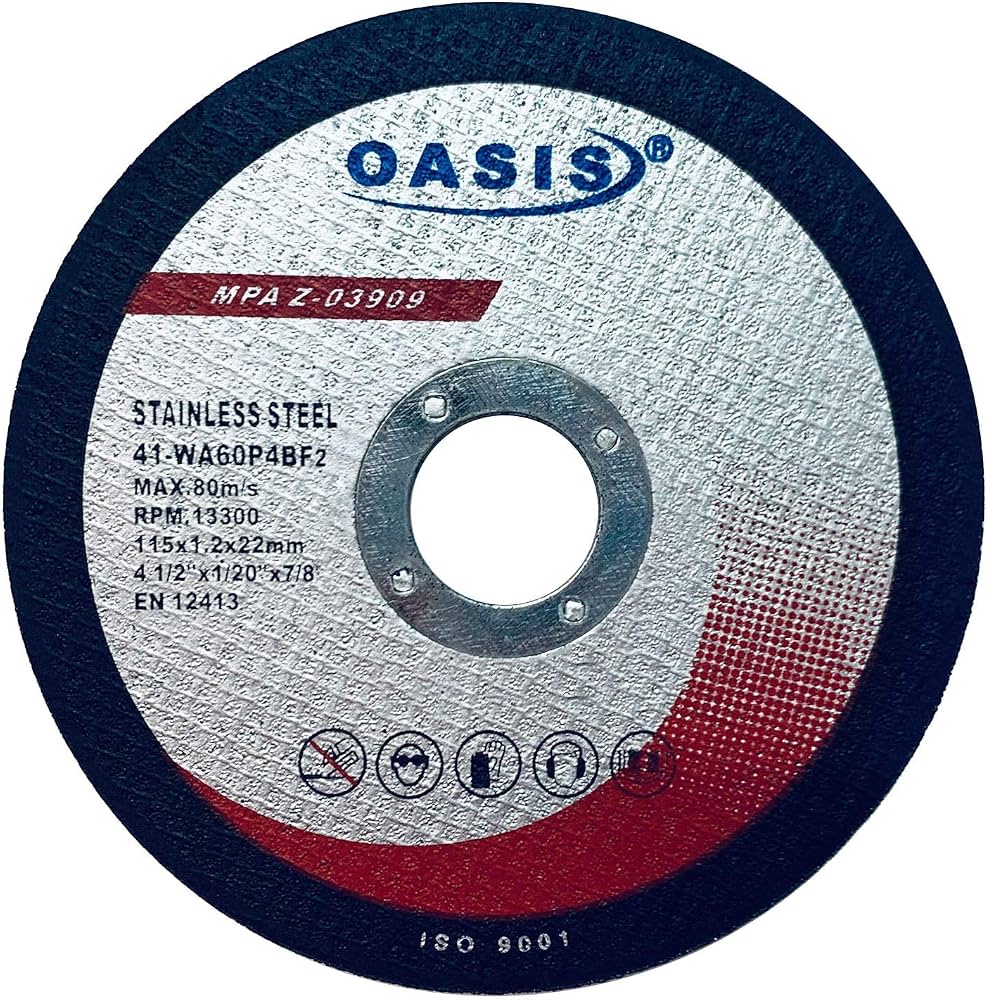
Every cut-off wheel has a maximum safe RPM printed on it (e.g., 'Max RPM 13,300'). Compare this to your grinder's no-load RPM. If the wheel's max is lower than the grinder's, do not use it. If the wheel's max is higher, it's safe but overkill. Also check the wheel's operating speed (often the same as max). A general rule: for a 4.5-inch grinder at ~11,000 RPM, most wheels rated 13,300 are safe. For larger grinders (7-inch at 8,000 RPM), ensure wheels are rated for at least 8,000 RPM.
💡 Tips:
- •If your grinder is variable speed, set it to the wheel's recommended RPM range.
- •The label may list both 'RPM' and 'm/s' (meters per second); both matter.
⚠️ Warnings:
- •Never exceed the wheel's maximum RPM—catastrophic failure can occur.
Step 7: Consider Reinforced vs. Non-Reinforced Wheels
Most cut-off wheels are reinforced with fiberglass mesh layers to reduce the risk of shattering. Always choose reinforced wheels (look for 'S' or 'SF' on the label) for angle grinder use. Non-reinforced wheels (e.g., thin resinoid wheels) are for stationary cutoff machines. They're brittle and dangerous on angle grinders. Some thin wheels are reinforced with multiple layers; thicker ones may have fewer layers. For safety, always opt for reinforced.
💡 Tips:
- •Reinforcement layers are visible on the side as thin lines. More layers generally mean stronger wheel.
- •Some premium wheels have three layers; budget ones may have one or two.
⚠️ Warnings:
- •Never use a non-reinforced wheel on a hand-held angle grinder—they can explode.
Step 8: Choose a Trusted Brand and Read Reviews
Cut-off wheels from reputable brands (3M, Norton, DEWALT, Sait, MK Diamond, Pearl Abrasive) are tested for quality and safety. Cheaper generics may have inconsistent bond strength, unbalanced wheels, or false RPM ratings. Read user reviews focusing on 'cut speed', 'life', 'breakage', and 'fit on my grinder'. Look for reviews from people cutting the same material you intend to. For beginners, a multipack of a well-known brand is a safe start.
💡 Tips:
- •Check the manufacturing date on the wheel; older wheels can degrade.
- •Buy from authorized sellers to avoid counterfeits.
⚠️ Warnings:
- •Avoid no-name brands with no RPM label or safety certifications (OSA, EN12413, ANSI B7.1).
▸Pro Tips
- •Match wheel speed to material: slower speed for thick metal to avoid overheating, faster for thin sections.
- •Store wheels in a dry, cool place; moisture can weaken the bond.
- •Use light pressure—let the wheel do the work; forcing can break it or cause kickback.
- •When cutting stainless steel, use a new wheel to avoid contamination from ferrous metals.
- •For plunge cuts, use a Type 1 wheel (flat) rather than Type 27 (depressed center).
- •Check the wheel for cracks or chips before mounting; discard if damaged.
- •Always use a clean, flat flange and tighten the nut securely (hand tighten then 1/4 turn with wrench).
▸Common Mistakes to Avoid
- •Using a wheel that is too large for the grinder: can exceed guard coverage and cause imbalance.
- •Ignoring RPM ratings: using a wheel rated for 10,000 RPM on a 12,000 RPM grinder is dangerous.
- •Side loading the wheel: twisting the grinder sideways puts stress on the wheel's sides, causing breakage.
- •Cutting material not intended for the wheel: e.g., using a steel wheel on masonry—wears fast and can chip.
- •Not wearing proper PPE: cut-off wheels can shatter and send fragments flying; always use eye and face protection.
▸Troubleshooting
Problem: Wheel wobbles or vibrates when spinning.
Solution: Check that the arbor hole is clean and the wheel is centered on the flange. Tighten the nut. If still wobbles, the wheel may be warped—replace it.
Problem: Wheel wears out too quickly.
Solution: You may be using too much pressure or a wheel too soft for the material. Switch to a harder bond or a more durable abrasive (e.g., zirconia instead of aluminum oxide).
Problem: Burning smell or discoloration on cut edge.
Solution: This is caused by overheating. Reduce feed pressure, use a thinner wheel, or slow down the grinder (if variable). For stainless, a dedicated wheel with cooler cutting reduces heat.
Problem: Wheel leaves a rough cut edge.
Solution: Use a thinner wheel for a cleaner cut. Ensure the wheel is not worn down; a new wheel cuts smoother. Also, check that the wheel is appropriate for the material (e.g., diamond for tile gives smooth edges).
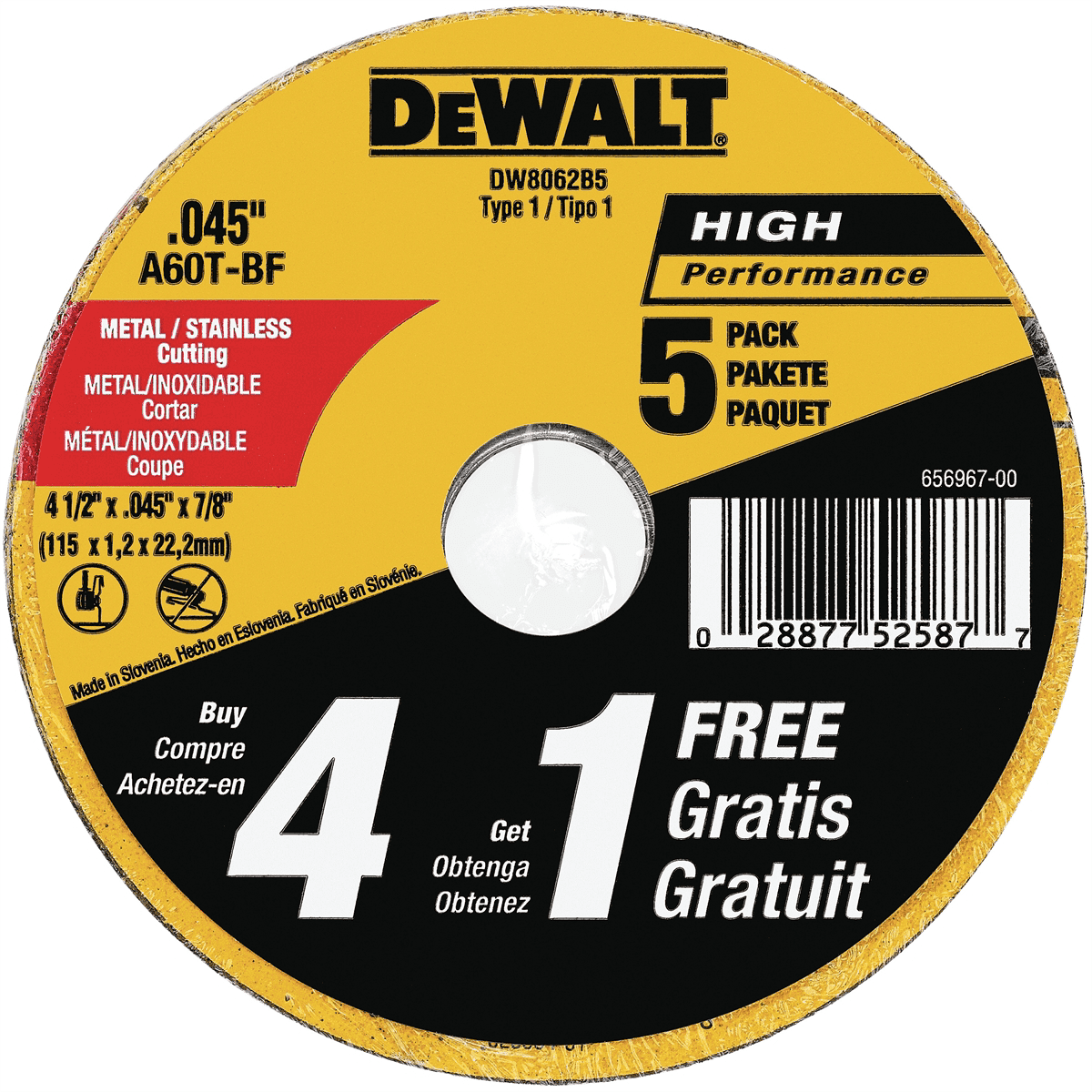
DEWALT DW8062B5 4.5-Inch Heavy Duty Cut-Off Wheel (5-Pack)
Great all-around aluminum oxide wheel for mild steel; reinforced and affordable for beginners.
Best for: General DIY metal cutting: angle iron, rebar, sheet metal.
Price Range: $10-$15
Sait 70755 4.5" x .045" x 7/8" Stainless Steel Cut-Off Wheel (25-Pack)
Thin zirconia alumina wheel designed for stainless steel; fast cutting with minimal heat.
Best for: Cutting stainless steel tubing, sheet, or bolts; also works on mild steel.
Price Range: $20-$30
MK Diamond 4.5-Inch Diamond Cut-Off Wheel for Masonry
Diamond-embedded wheel for cutting concrete, brick, tile, and stone without dust (wet or dry).
Best for: Masonry cutting: concrete pavers, brick, ceramic tile.
Price Range: $15-$25
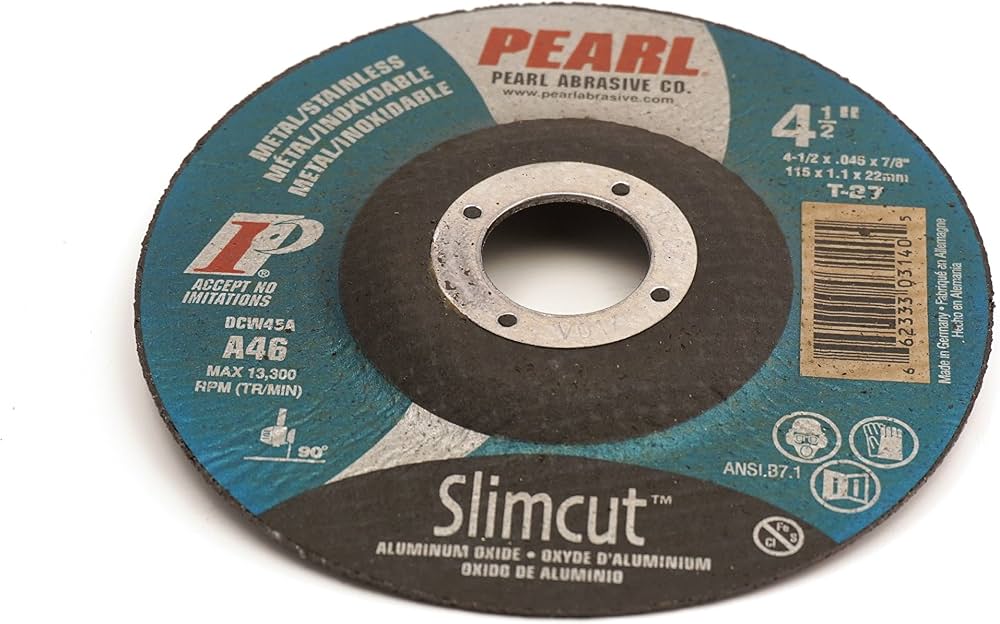
Pearl Abrasive A45574.5 4.5" x .045" x 7/8" Cut-Off Wheel Variety Pack (5-Pack)
Mixed pack with one wheel for steel, stainless, aluminum, masonry, and tile—perfect for testing.
Best for: For users who cut various materials occasionally; eliminates having to buy multiple packs.
Price Range: $12-$18