
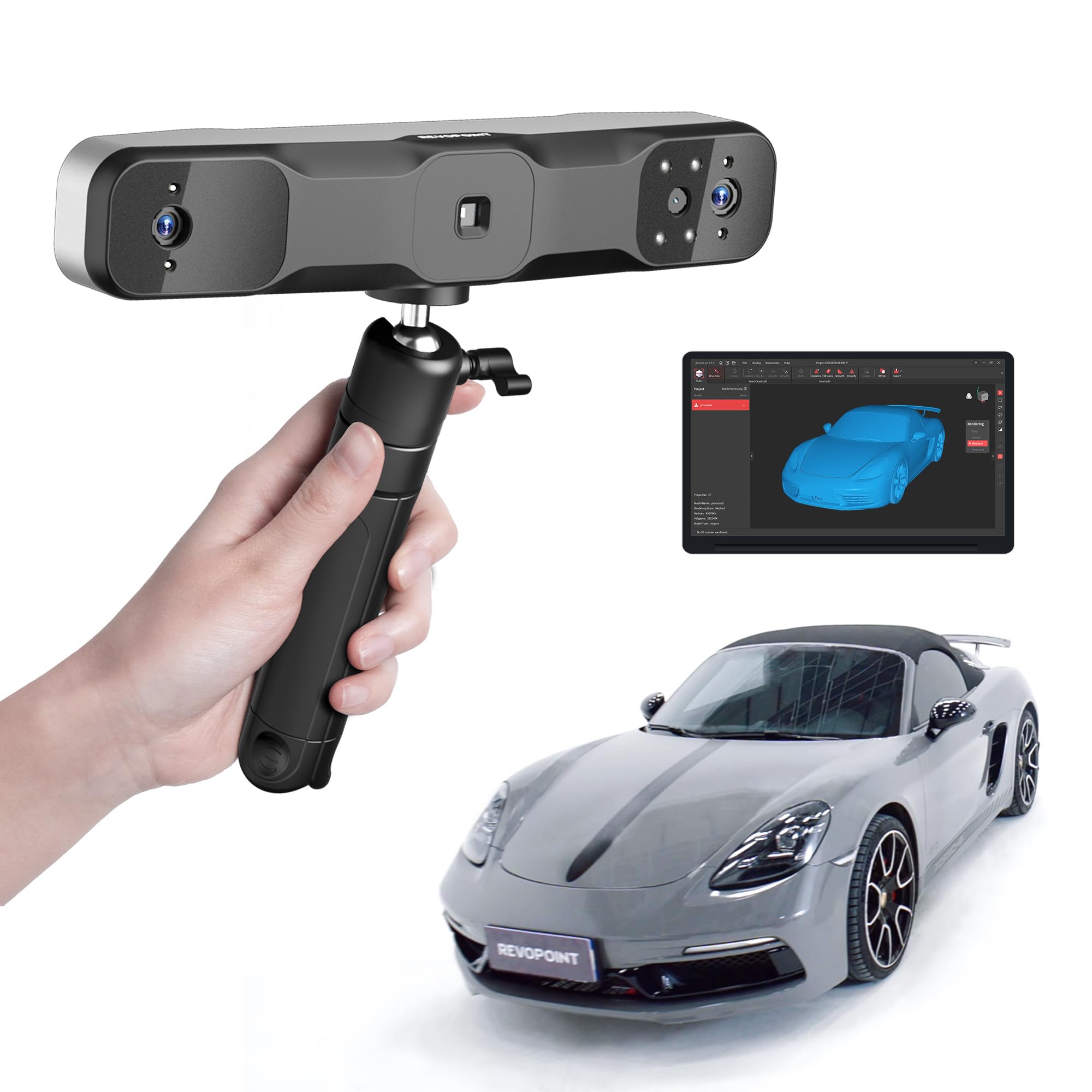
Revopoint RANGE 2
Dynamic large objects like vehicles or sculptures in workshops.
$899-$999
Revopoint RANGE 2 Large FOV (860x1380mm) and 0.1mm accuracy ideal for furniture/cars; markerless tracking simplifies large scans.
Get the App
Better experience on mobile
Master the expert process to select high-performance 3D scanners for cars, furniture, and sculptures, ensuring precision, speed, and ROI.
Scanning large objects like vehicles, industrial parts, or architectural elements can be a nightmare with the wrong tool. Advanced users often face issues like insufficient field of view (FOV), poor accuracy over distance, or endless stitching errors, leading to distorted models and wasted time. The good news? With a structured approach, you can pick a scanner that delivers photorealistic, metrology-grade results.
In this guide, you'll learn a step-by-step method to evaluate scanners based on key metrics like accuracy, range, and software. Tailored for advanced users familiar with CAD and scanning workflows, this process takes 45-60 minutes of research and will arm you with a shortlist of top contenders.
Expect to dive into technical specs, compare technologies, and make data-driven decisions—no guesswork involved.
Estimated Time: 45-60 minutes Difficulty: advanced
Start by documenting your project's specifics. List object sizes (e.g., up to 5m length), required accuracy (e.g., 0.05mm for reverse engineering), environment (indoor/outdoor, shiny surfaces?), and output needs (mesh for 3D printing or point cloud for inspection).
Why it matters: Large objects demand scanners with wide FOV and long-range capabilities; mismatched specs lead to multi-setup scans and alignment errors. Expect a 1-page requirement doc as success.
Image Description: Checklist table with columns for object size, accuracy, environment, and use case.
💡 Tips:
⚠️ Warnings:
Compare scanning methods: Structured light (fast, close-range), laser triangulation (versatile, medium-range), LiDAR (long-range, outdoor), and photogrammetry (budget, ultra-large).
For large objects (>1m), favor LiDAR or hybrid laser (e.g., blue laser for dark materials). Structured light struggles beyond 1m without turntables. Success: Match tech to needs—e.g., LiDAR for 10m+ statues.
Pro insight: Hybrids like laser+LED excel in mixed lighting.
💡 Tips:
⚠️ Warnings:
Scrutinize specs: Point accuracy (<0.1mm), resolution (0.1-0.5mm), FOV (300mm+), and max scan volume (2m+ single capture). Check ISO certifications for volumetric accuracy.
Test with formulas: Error propagation = distance * angular accuracy. For a 3m car, aim for <0.2mm total error. Success: Shortlist scanners meeting your thresholds.
Markdown table:
| Spec | Target | Example |
|---|---|---|
| Accuracy | 0.05mm | 0.02mm |
💡 Tips:
For large objects, prioritize handheld/wireless over tripod stationary. Check scan speed (1M+ points/sec), battery life (4h+), and tracking (markerless AI preferred).
Workflow matters: Auto-alignment reduces stitching time from hours to minutes. Success: Scanners with <30min/setup for full car scan.
💡 Tips:
⚠️ Warnings:
Ensure software supports STL/OBJ/PLY export, texture mapping, and CAD integration (e.g., Geomagic, PolyWorks). Check reverse engineering tools and cloud processing.
Advanced users need API access or SDK for automation. Success: Native support for your pipeline (e.g., SolidWorks).
💡 Tips:
Look for IP-rated ruggedness, warranty (2y+), and local support. Calculate ROI: Cost per scan vs. time saved.
Budget tiers: Prosumer $2k-10k, Pro $20k+. Success: 3-5 finalists with TCO analysis.
💡 Tips:
Read pro reviews (e.g., 3DScannersystems.com), case studies on similar objects, and forums (Reddit r/3DScanning). Request demos.
Success: Purchase confidence via verified large-object scans.
⚠️ Warnings:
Problem: Scans drift on large objects
Solution: Switch to marker-based tracking or LiDAR; increase overlap to 60%.
Problem: Shiny surfaces cause holes
Solution: Apply scanning spray; choose blue laser over white light.
Problem: Slow stitching
Solution: Use GPU-accelerated software; pre-align with total station.
Problem: Budget overrun
Solution: Rent/test first; calculate scans/year for ROI.
Large FOV (860x1380mm) and 0.1mm accuracy ideal for furniture/cars; markerless tracking simplifies large scans.
Best for: Dynamic large objects like vehicles or sculptures in workshops.
Price Range: $899-$999
Hybrid LiDAR+laser (0.02mm acc, 2m range) excels on large, complex parts with anti-shake tech.
Best for: Industrial reverse engineering of machinery or auto bodies.
Price Range: $1,200-$1,500
Blue laser+LED hybrid (0.05mm acc, 1.35m³ volume) handles large dark/shiny objects without markers.
Best for: Quality inspection of large castings or heritage scanning.
Price Range: $9,999
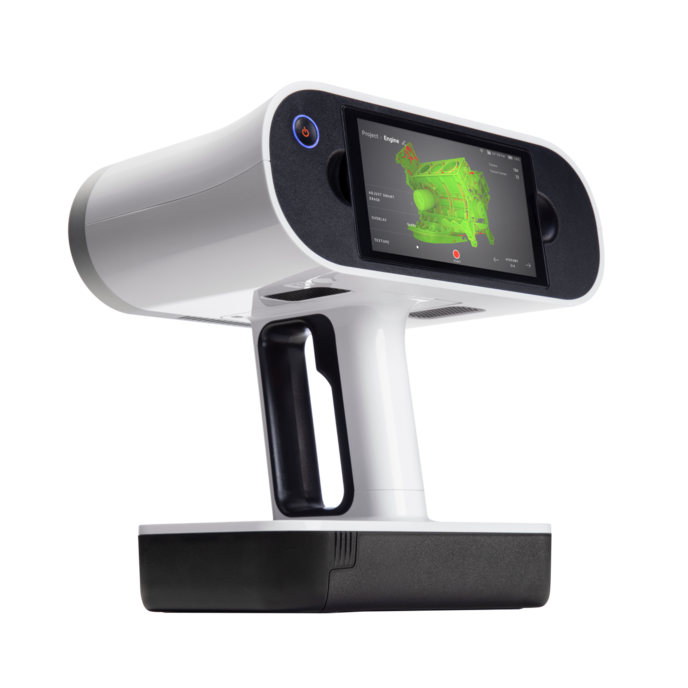
Wireless, AI-powered (0.05mm acc, up to 80m range potential with stations) for seamless large-scale capture.
Best for: Field scanning of boats, buildings, or pipelines.
Price Range: $30,000+
Dynamic large objects like vehicles or sculptures in workshops.
Revopoint RANGE 2 Large FOV (860x1380mm) and 0.1mm accuracy ideal for furniture/cars; markerless tracking simplifies large scans.

Industrial reverse engineering of machinery or auto bodies.
Creality CR-Scan Raptor Hybrid LiDAR+laser (0.02mm acc, 2m range) excels on large, complex parts with anti-shake tech.

Quality inspection of large castings or heritage scanning.
Shining 3D EinScan HX Blue laser+LED hybrid (0.05mm acc, 1.35m³ volume) handles large dark/shiny objects without markers.
Field scanning of boats, buildings, or pipelines.
Artec Leo Wireless, AI-powered (0.05mm acc, up to 80m range potential with stations) for seamless large-scale capture.