Get the App
Better experience on mobile
Get the best products related to our top picks
Choosing the right power supply unit (PSU) for gaming is crucial because it directly impacts system stability, performance, and longevity. A subpar PSU can lead to crashes, hardware damage from voltage fluctuations, or insufficient power delivery during intense gaming sessions with high-end GPUs and CPUs. Gamers often push components to their limits—think ray-traced 4K gaming or overclocking—which demands reliable, efficient power. Inadequate wattage might throttle your setup, while poor efficiency generates excess heat and hikes electricity bills. Moreover, with modern standards like ATX 3.1 and PCIe 5.1 for next-gen GPUs (e.g., NVIDIA RTX 40-series), compatibility ensures future-proofing against transient power spikes up to 600W.
This guide contrasts budget-friendly options, which prioritize affordability and basic reliability for entry-level builds, against premium units that offer superior efficiency, modularity, and certifications like 80+ Gold or Titanium for minimal energy waste. Budget PSUs (under $100) suit casual gamers with mid-range hardware, delivering essential features without extras like silent fans or full modularity. Premium ones ($150+) excel in high-wattage scenarios, providing quieter operation, better cable management, and protections against surges—ideal for enthusiasts building rigs with multiple GPUs or RGB-heavy cases.
Readers will learn how to evaluate wattage needs (calculate via tools like OuterVision PSU Calculator), compare certifications, and avoid pitfalls like skimping on quality. We'll dive into key features, budget tiers, and performance trade-offs, culminating in detailed reviews of five standout PSUs: the Apevia ATX-PR1300W Prestige 1300W for versatile high-power gaming, the CAA-550CT 550W for graphics-card-focused builds, the DPS-2000BB A 2000W for extreme overclocking, the FSP MEGA TI 1650W for efficiency pros, and the Zunate 700W for value-driven setups. By the end, you'll confidently select a PSU that powers your gaming dreams without breaking the bank or risking your hardware. (Word count: 278)
Selecting a PSU for gaming involves balancing power output, efficiency, build quality, and compatibility with your rig. Start by estimating your system's total wattage: add up GPU (e.g., RTX 4090 needs 450W), CPU (200W for high-end), and peripherals, then add 20-30% headroom for stability. Tools like PCPartPicker or manufacturer calculators help. Prioritize units with ATX form factor for standard cases, and check for modular cables to reduce clutter. For gaming, focus on PSUs that handle power spikes from modern GPUs without hiccups.
Wattage and Rails: Aim for 650W+ for mid-range gaming; 1000W+ for high-end. Multi-rail designs (e.g., separate 12V rails) distribute power safely, preventing overloads on GPUs. The Apevia ATX-PR1300W's 1300W single-rail setup suits multi-GPU builds, unlike the CAA-550CT's 550W limit for single-card systems.
Efficiency Certification: 80+ ratings (Bronze to Titanium) indicate energy conversion efficiency. Gold (87-90% at load) is a gaming sweet spot for low heat; Titanium (94%+) like the FSP MEGA TI 1650W minimizes waste in 24/7 use. Avoid non-certified units, as they can waste 20-30% more power.
Modularity and Connectors: Full modular (e.g., FSP MEGA TI) allows detachable cables for clean builds; semi-modular saves cost. Essential for gaming: PCIe 8-pin/6+2-pin for GPUs, and ATX 3.1/PCIe 5.1's 12VHPWR (16-pin) for RTX 40-series. The Apevia includes PCIe 5.1, future-proofing against the Zunate's basic connectors.
Cooling and Noise: A 120-135mm fan with temperature control keeps things quiet. The Apevia's 135mm silent fan outperforms the Zunate's 120mm in low-noise scenarios, crucial for immersive gaming without whirring distractions.
Protections and Build Quality: Look for OPP/OVP/UVP/SCP (over/under voltage, short circuit) safeguards. DC-to-DC designs (Apevia) regulate voltages precisely, better than group-regulated cheaper units. RoHS compliance ensures eco-friendly materials, as in the Apevia.
Form Factor and Compliance: ATX 3.1 readiness (Apevia, FSP) supports new standards; older PSUs like the DPS-2000BB A may lag. Ensure compatibility with your motherboard's 24-pin and CPU's 8-pin.
Warranty and Brand Reliability: 5-10 year warranties signal durability. Established brands like FSP offer better support than unknowns like Zunate.
PSUs fall into tiers based on price, reflecting quality and features. Entry-level ($50-90): Basic 500-700W units like the Zunate 700W ($83.90) provide essential power for budget gaming PCs (e.g., Ryzen 5 + GTX 1660), with 80+ Bronze efficiency and minimal protections. They're fine for 1080p gaming but lack modularity and may hum under load.
Mid-range ($90-130): Balances value and performance, like the Apevia 1300W ($109.95) or DPS-2000BB A ($127.75). You get 80+ Gold, ATX 3.1, and higher wattage for 1440p/4K setups with RTX 3070s, plus better fans and 5-year warranties. Efficiency saves ~10-15% on bills vs. budget options.
Premium ($130+): Top-tier like the CAA-550CT ($168.93) or FSP MEGA TI 1650W (N/A, est. $200+). Titanium efficiency, full modularity, and 10-year warranties for enthusiasts with 4K ray-tracing or overclocked i9/RTX 4090. They excel in silence and longevity but overkill for sub-$1000 builds.
In the $0-168.93 range, mid-tier dominates value, offering 80% of premium perks at half the cost.
The sweet spot for most gamers is $100-130, where you snag 80+ Gold units with 850-1300W—like the Apevia—for reliable performance without excess. At this level, efficiency hits 90%, handling 300-500W GPUs stably, and features like PCIe 5.1 add longevity. Budget under $90 (Zunate) sacrifices noise and protections, risking 5-10% performance dips from instability. Premium over $150 (FSP) boosts efficiency to 94%, cutting heat by 20% and extending component life, but ROI diminishes unless you're power-hungry (e.g., 2000W DPS for servers/gaming beasts). For 90% of gamers, mid-range delivers 95% of premium power at 60% cost—prioritize wattage over Titanium if budget-constrained.
Undersizing Wattage: Buying a 500W for a 600W+ system causes crashes. Always add headroom; e.g., don't pair CAA-550CT with an RTX 3080.
Ignoring Efficiency Ratings: Non-80+ PSUs waste power and run hot, shortening GPU life by 20-30%. Skip uncertified like some generics.
Overlooking Connector Compatibility: Missing 12VHPWR dooms RTX 40-series upgrades. Verify PCIe slots match your GPU.
Choosing Non-Modular for Cluttered Builds: Fixed cables tangle airflow, raising temps 5-10°C. Opt for at least semi-modular.
Prioritizing Brand Over Specs: Flashy names don't guarantee quality; check reviews for coil whine, common in cheap units like Zunate.
Our top three: 1) Apevia ATX-PR1300W—best overall for mid-to-high-end gamers needing future-proof 1300W and Gold efficiency at $109.95; versatile for upgrades. 2) FSP MEGA TI 1650W—ideal for premium efficiency seekers with Titanium rating and full modularity; perfect for silent, high-wattage 4K rigs. 3) Zunate 700W—top budget pick for entry-level builders on $83.90, offering solid basics for 1080p gaming without frills. (Word count: 712)
For an RTX 4070 (200W TDP) and Ryzen 7 7700X (105W TDP), plus motherboard, RAM, and drives, total draw is around 400-450W under load. NVIDIA recommends 650W minimum, but add 20% headroom for spikes and OC—aim for 750-850W. In this guide, the Zunate 700W suffices for stock setups but skimps on future-proofing; upgrade to the Apevia 1300W for stability with ray tracing or additions like extra SSDs. Use a calculator like Cooler Master's to confirm, as undervolting can drop needs to 600W, but always prioritize certified units to avoid crashes during benchmarks like FurMark.
Very—80+ ratings measure efficiency at 20/50/100% loads, directly affecting heat, noise, and costs. Bronze (82-85%) is entry-level, fine for the Zunate but wasteful in hot cases. Gold (87-90%), like Apevia, is the gaming sweet spot, converting 90% AC to DC and saving 10-15% on electricity versus Bronze over a year of 4-hour sessions. Titanium (94%+), as in FSP MEGA TI, shines for 24/7


Compare key specs and features of all our recommendations side-by-side
| Product | Recommendation | Rating | Price |
|---|---|---|---|
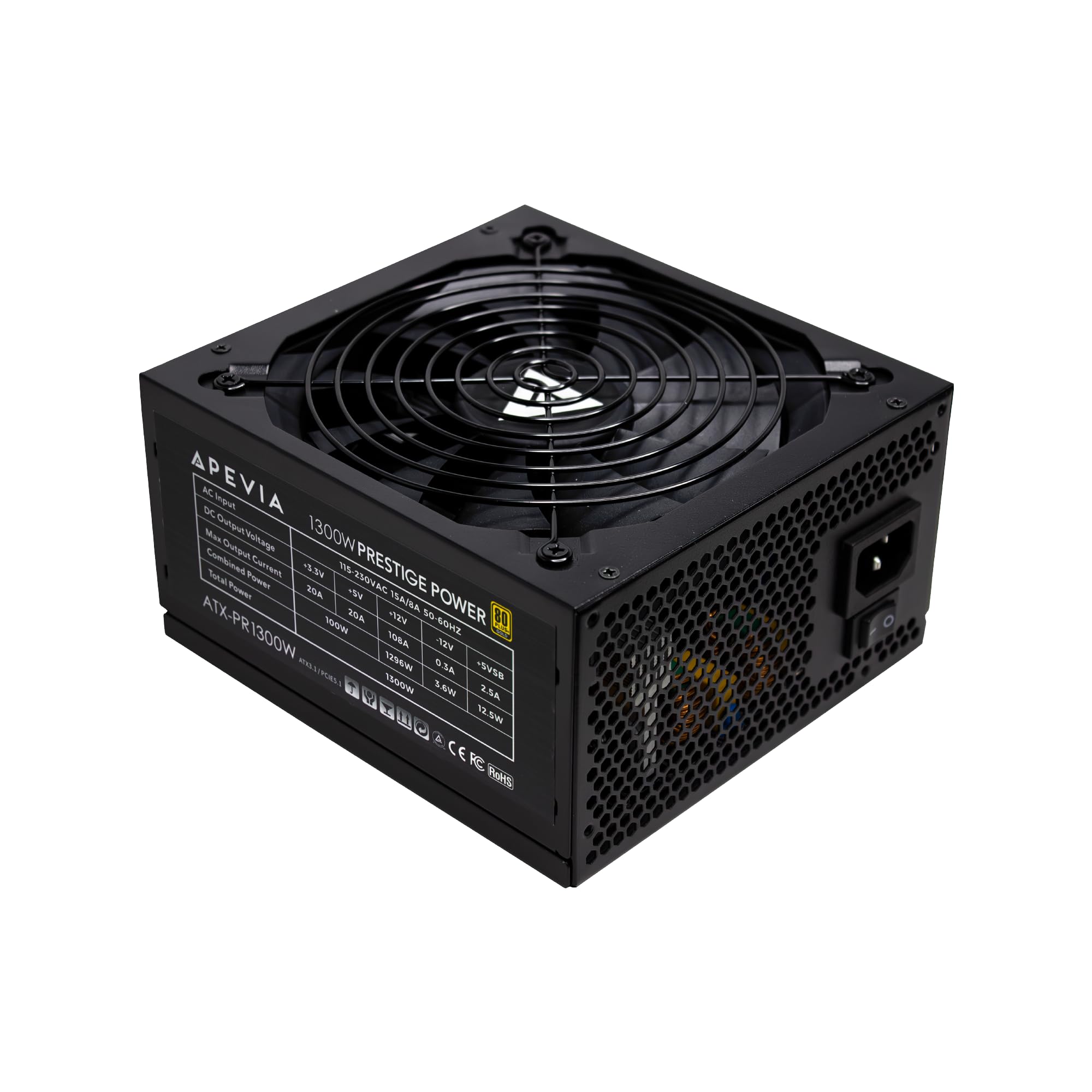 Apevia ATX-PR1300W Prestige 1300W, 80+ Gold Certified, ATX 3.1 Ready, PCIe 5.1 / 12VHPWR Connector, ATX Active PFC, DC to DC Converter Design, 135mm Silent Fan, RoHS Compliance, Gaming Power Supply Rank #1 | 🏆 Top Pick | — | |
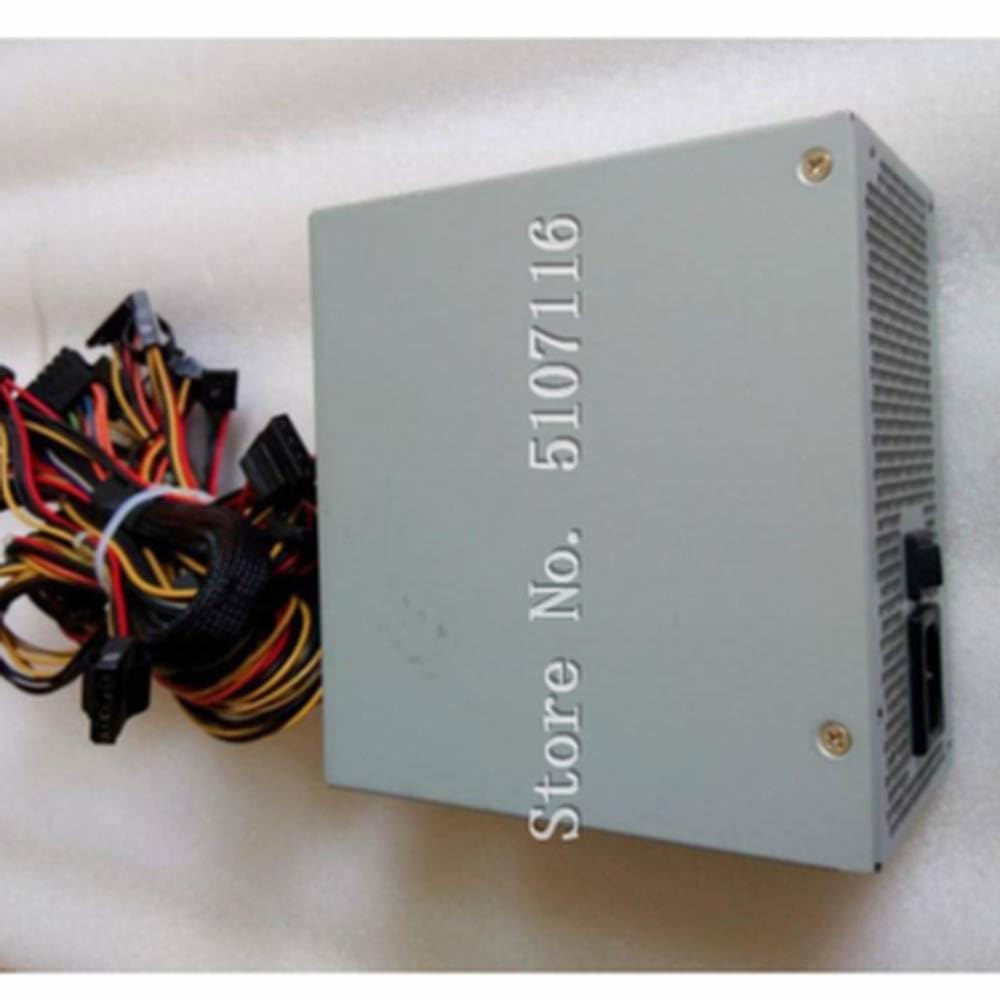 CAA-550CT 550W Power Supply for Double 8PIN and 6PIN Graphics Cards - Reliable and Efficient Performance Rank #2 | — | ||
Product Rank #3 | — | — | — |
 FSP MEGA TI 1650W Power Supply, 80 Plus Titanium, ATX3.1 & PCIe 5.1 (12V-2x6), Full Modular (MEGA-1650W) Rank #4 | — | — | Check price → |
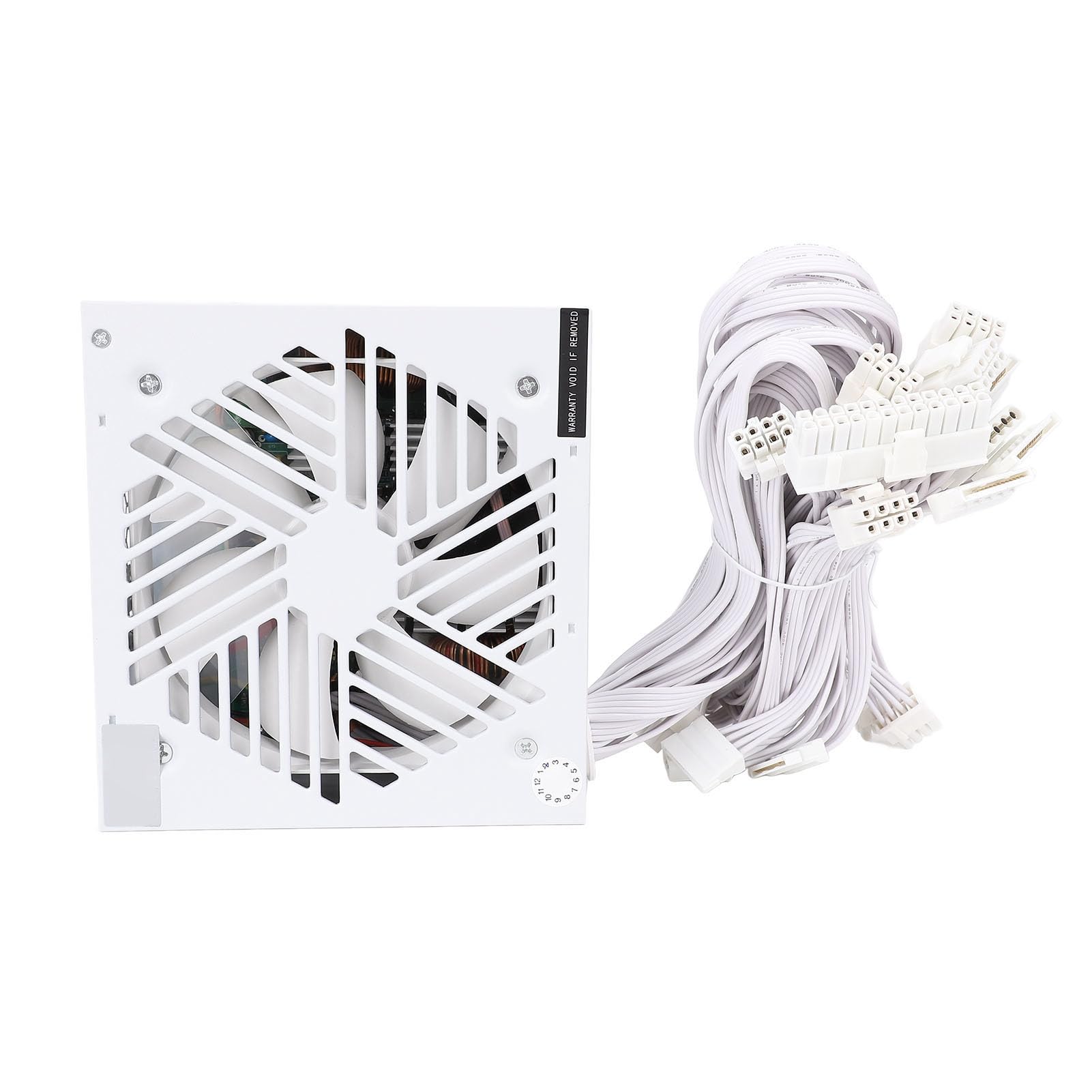 Zunate 700W ATX Power Supply Desktop Power Supply Unit with Intelligent Temperature Control for Gaming PCs 120mm Fan Multiple Protections Energy Efficient Rank #5 | 💰 Budget Pick | — |
