Get the App
Better experience on mobile
Seven purifiers ranked on verified filtration, real room coverage, ongoing filter cost, and how quiet they are when you're trying to sleep.
Nearly every purifier box leads with the same number: 99.97%. That figure describes how efficiently true HEPA media captures particles at 0.3 microns — the hardest size to catch — but it says nothing about the room you're sitting in. It's a measure of what happens to air that reaches the filter, not how much air gets there. Two purifiers can use identical HEPA paper and deliver completely different results, because the fan, the seals, and the airflow path do most of the real work.
For allergy sufferers, the number worth caring about is CADR (clean air delivery rate), expressed in cubic feet per minute. Divide a purifier's smoke CADR by your room's square footage, and you get a rough sense of how many air changes per hour it can deliver. Allergists and indoor-air researchers generally point to four to five air changes per hour in the room where you sleep as a meaningful target — which is why a cheap unit in a large open living room often disappoints while the same unit in a closed bedroom works well.
The other half of the equation is cost of ownership. Filters are consumables: a budget purifier may run $20–$40 a year in replacements, while premium units with large carbon beds can run $150–$300 or more per filter change. That gap is rarely advertised. Noise matters too — a purifier that's only effective on its highest setting is a purifier most people turn off at night, which defeats the purpose.
This list covers seven machines from roughly $100 to about $1,100, chosen for different jobs: a small bedroom, a pet-heavy living room, a smoke-affected house, or a chemically sensitive household. Every pick has an honest limitation, because in this category there is no single purifier that is simultaneously cheap, silent, powerful, and inexpensive to maintain.
The Mighty has earned its reputation the boring way: a genuine four-stage filtration stack (washable pre-filter, activated carbon, true HEPA, optional ionizer), a rated CADR in the mid-200s CFM, and an Eco mode that shuts the fan down once its sensor reads clean air. It's a well-sealed, quiet-at-low-speeds machine that consistently sells for well under $250, and its replacement filters are among the least expensive in the true-HEPA class. The trade-off is that it's a strictly manual appliance — no app, no scheduling, no smart-home integration — and it's sized for a bedroom or den rather than a large open floor plan.
Main limitation: No Wi-Fi, app control, or scheduling, so you'll be adjusting it by hand and remembering to swap filters yourself.
Skip if: Skip it if you want app-based control and air-quality history, or if the room you're treating is larger than about 350 square feet.
The Core 300S is the rare sub-$130 purifier that uses real HEPA media and still includes app control, voice assistant support, scheduling, and an auto mode driven by an onboard particle sensor. For a closed bedroom or a small home office, it delivers genuinely useful filtration at a price that doesn't require justification. What you don't get is headroom: it's a small-room machine, and its sensor reacts more slowly and coarsely than the sensors in mid-range and premium units.
Main limitation: Small effective coverage area and a basic particle sensor that can lag behind real air-quality changes.
Skip if: Skip it if you're treating a living room, a whole floor, or a household with heavy smoke or multiple pets.
Blueair's HEPASilent design pairs electrostatic charging with mechanical filtration, which lets the 211+ move a large volume of air with relatively little noise and low energy draw. It's rated for rooms up to roughly 540 square feet, making it one of the few mid-priced purifiers that can actually keep up with an open-plan living and kitchen area. The washable fabric pre-filter is machine-washable and comes in several colors, though the proprietary main filter replacement is priced higher than most competitors' and its carbon layer is thin, so it's not the right tool for serious odor or VOC problems.
Main limitation: Replacement filters cost noticeably more than comparable units, and the carbon layer is too thin for heavy cooking odors or chemical off-gassing.
Skip if: Skip it if you're chasing the lowest possible filter cost per year or need meaningful activated-carbon capacity for odors and VOCs.
The Vital 200S was designed around the pet problem specifically: a large washable pre-filter that traps visible fur before it reaches the HEPA layer, plus a U-shaped air intake that pulls from the sides as well as the front. It covers rooms up to roughly 380 square feet with app control, scheduling, and an auto mode, and its replacement HEPA filters cost less than most competitors at this coverage level. The catch is that its carbon filter is modest, so while it handles dander and hair well, it won't eliminate a strong litter-box or wet-dog odor on its own.
Main limitation: Limited activated-carbon capacity means persistent pet odors can linger even when particle counts drop.
Skip if: Skip it if odor control is your primary complaint rather than dander, hair, and airborne particles.
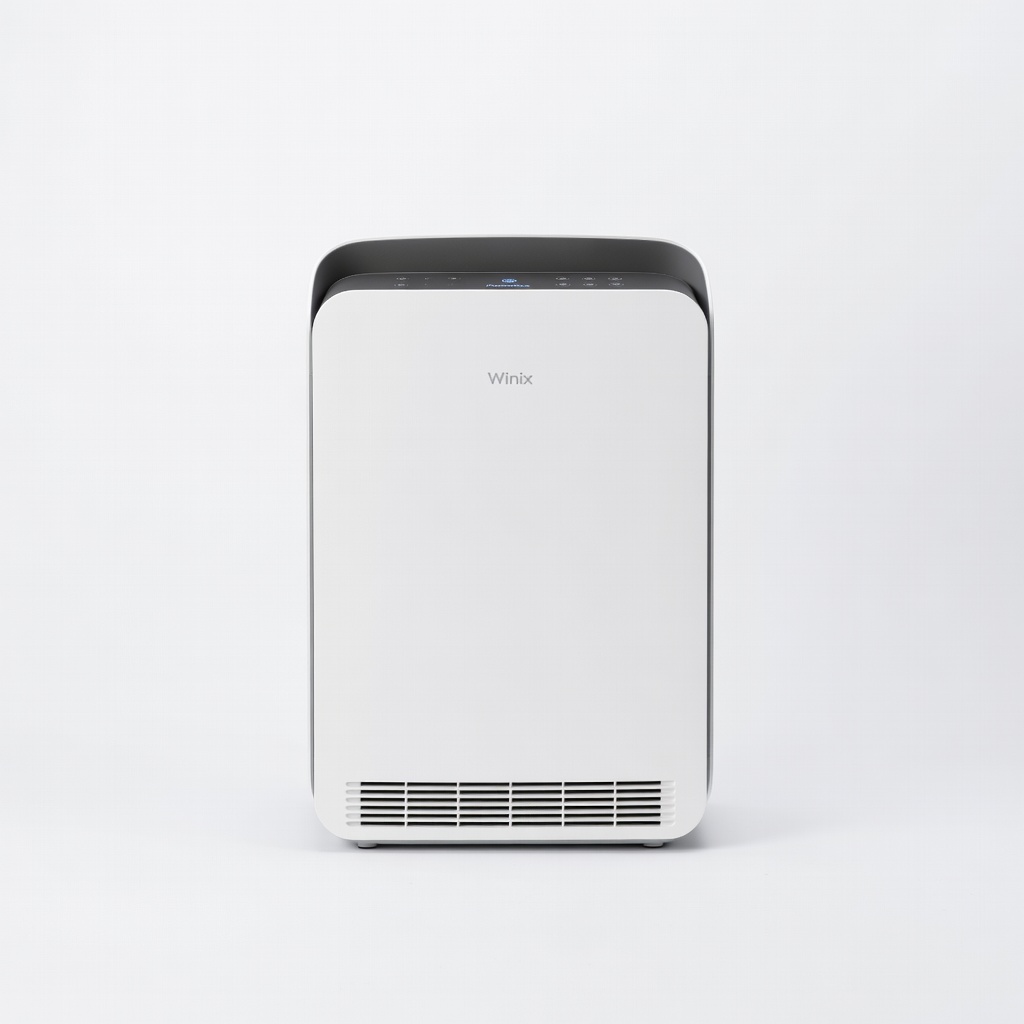
The 5500-2 stands out in the mid-price tier for its washable AOC carbon filter, which gives it more odor-adsorbing capacity than the thin carbon sheets found in most sub-$200 purifiers, plus a true HEPA layer and a 360-degree intake. It covers rooms up to about 360 square feet, includes auto mode and a remote, and its washable carbon element stretches the interval between filter purchases. The objections are real, though: the PlasmaWave ionizer is a polarizing feature that some buyers prefer to run disabled, and the unit itself is a bulky, utilitarian box with no app connectivity.
Main limitation: The PlasmaWave ionizer produces trace ozone within regulatory limits, and some users would rather not run ionization technology at all.
Skip if: Skip it if you want to avoid ionizer technology entirely, or if you want app-based control and air-quality logging.
The MinusA2 is one of the few purifiers explicitly engineered for quiet operation, and it's the pick we'd point to for a nursery or a light sleeper's bedroom. It uses a six-stage filter cartridge you choose at purchase — options include germ defense, pet allergy, odor remover, and toxin absorber — and it can be wall-mounted to reclaim floor space, backed by a ten-year warranty. The obvious downside is economics: the unit costs several times a budget purifier, and the proprietary cartridges are priced accordingly, so the cost per unit of clean air is high.
Main limitation: High purchase price and proprietary filter cartridges make it one of the more expensive options per square foot of coverage.
Skip if: Skip it if you're optimizing for coverage per dollar rather than near-silent operation and design flexibility.
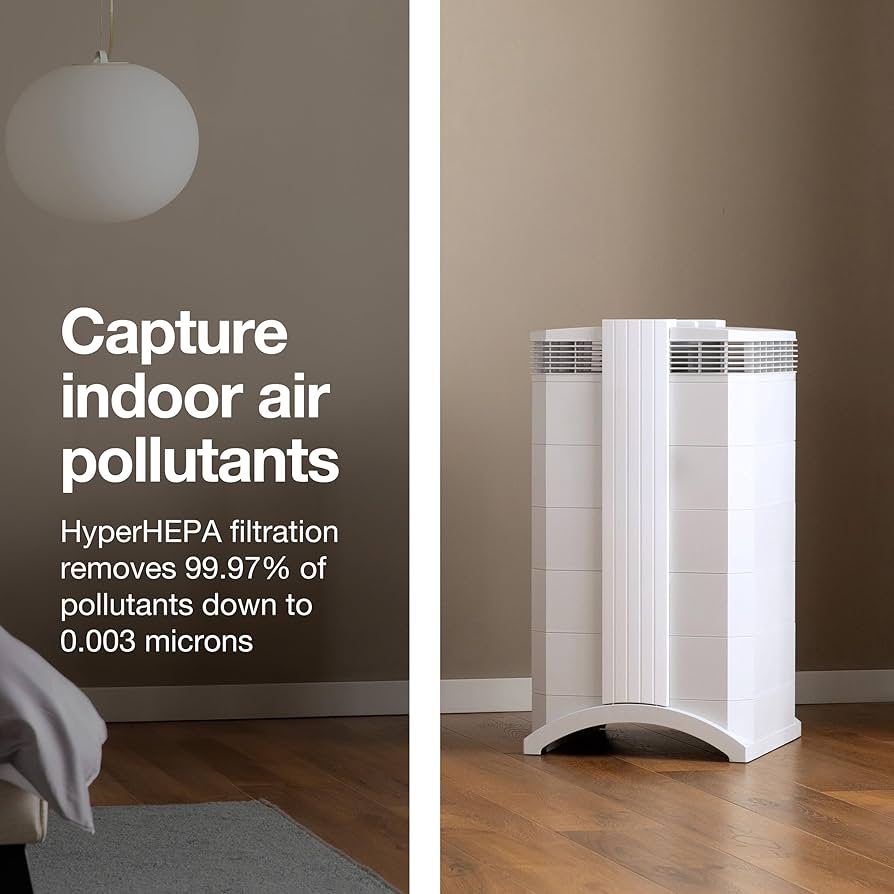
The HealthPro Plus is the reference point for people who need filtration beyond standard HEPA: its HyperHEPA media is rated to capture particles down to 0.003 microns, well below the 0.3-micron benchmark, and a separate V5-Cell gas and odor filter adds substantial carbon and potassium permanganate capacity. Each unit is individually tested and certified before it leaves the factory, and it's rated for spaces up to roughly 1,125 square feet. The cost is the story — four figures upfront, expensive filter replacements on a staggered schedule, no auto mode, and a heavy, clinical-looking cabinet that won't disappear into your decor.
Main limitation: Premium price, expensive replacement filters, and no smart features, auto mode, or air-quality sensing of any kind.
Skip if: Skip it if you have a limited budget or a single small room, where a mid-priced unit will deliver comparable practical results.
Compare key specs and features of all our recommendations side-by-side
| Product | Recommendation | Rating | Price |
|---|---|---|---|
Coway AP-1512HH Mighty Air Purifier Rank #1 | 🏆 Top Pick | 9.2/10 | $180–$250 Check current price → |
Levoit Core 300S Air Purifier Rank #2 | 💰 Budget Pick | 8.2/10 | $90–$140 Check current price → |
Blueair Blue Pure 211+ Auto Air Purifier Rank #3 | ⭐ Editor's Choice | 8.7/10 | $280–$380 Check current price → |
Levoit Vital 200S Air Purifier Rank #4 | — | 8.3/10 | $160–$220 Check current price → |
Winix 5500-2 Air Purifier with PlasmaWave Rank #5 | — | 8.1/10 | $150–$230 Check current price → |
Rabbit Air MinusA2 SPA-780A Air Purifier Rank #6 | — | 8.5/10 | $500–$680 Check current price → |
IQAir HealthPro Plus Air Purifier Rank #7 | — | 8.8/10 | $900–$1,200 Check current price → |
Common questions buyers have about this category.
For airborne allergens — pollen, dust mite debris, pet dander, mold spores — the evidence is reasonably consistent that a correctly sized HEPA purifier reduces airborne particle concentrations in a closed room. The caveat is that symptom relief depends on the source: purifiers help most with particles that stay suspended in air, and help much less with allergens that settle into carpets, bedding, and upholstery, which require vacuuming, washing, and source control. Many allergists recommend a purifier in the bedroom specifically because that's where you spend seven or eight uninterrupted hours breathing.
A useful rule of thumb is to match a purifier's smoke CADR to your room's square footage at a ratio of roughly two-thirds or higher — so a 300-square-foot bedroom benefits from a smoke CADR of about 200 CFM or more. That ratio supports roughly four to five air changes per hour under real-world conditions, which is the range generally cited for meaningful allergen reduction. If you have a vaulted ceiling, an open floor plan, or several doorways, increase the target, because those factors effectively enlarge the volume of air you're trying to clean.
True HEPA media is tested to capture at least 99.97% of particles at 0.3 microns, the particle size that most readily slips through filter media. 'HEPA-type,' 'HEPA-like,' or '99% effective' language generally signals a lower-grade or thinner filter that has not been tested to that standard, and it's common on inexpensive purifiers. You can usually identify true HEPA units by their published CADR numbers, since CADR testing requires verification of the complete system rather than just the filter material.
Put it in the room where you spend the most time — almost always the bedroom — and give it at least a foot or two of clearance on all sides so it isn't choked by a wall, curtain, or sofa. Closing the door behind you dramatically improves performance, because the unit is no longer competing with the entire house's air volume. Avoid placing it directly against a heating vent or in a corner, and if you have several rooms to treat, consider two smaller units over one large one that can only be in one place at a time.
Ionizers produce small amounts of ozone as a byproduct, and many devices that market themselves as ionizer air purifiers are legally limited to ozone output deemed acceptable by regulators such as California's Air Resources Board. However, health agencies generally advise against deliberately using ozone generators in occupied spaces, and some people with asthma or chemical sensitivities report irritation from ionizer-equipped units even at low output. If you want to be cautious, choose a mechanical HEPA purifier with no ionizer, or pick a model whose ionizer can be turned off with a physical switch.
Most true HEPA filters are rated for six to twelve months of continuous use, while pre-filters and washable carbon elements typically need cleaning every two to four weeks. Annual filter spending in this category commonly ranges from about $30–$50 for budget units to $150–$300 or more for premium machines with large carbon beds, though staggered replacement schedules and longer-lasting media can spread those costs out. Nuisance signals like increased noise, reduced airflow, and lingering odors are more reliable indicators than the calendar.
HEPA media captures particles, not gases — so smoke, cooking fumes, paint solvent, and formaldehyde pass straight through it. If odors or volatile organic compounds are part of your problem, you need activated carbon, and the amount matters far more than its presence: the thin pre-filter sheets in budget units are primarily there to extend HEPA life, not to meaningfully clean the air of gases. Units with several pounds of carbon, such as the IQAir HealthPro Plus or Austin Air HealthMate, are in a different category entirely for chemical and odor removal.
Products we evaluated but did not recommend — and why.
