7 Best Best Stand-Up Paddleboard for beginners in 2026: Tested &…
Everything you need to know to choose your first paddleboard with confidence and avoid common mistakes.
Stand-up paddleboarding (SUP) is one of the best ways to enjoy the water, but choosing your first board can feel overwhelming. With dozens of brands, confusing specs, and a wide price range, it's easy to get stuck. This guide is here to simplify everything. We'll help you understand what matters for a beginner, recommend top products available on Amazon, and show you how to avoid costly mistakes. By the end, you'll feel ready to pick the perfect board and start paddling with confidence.
📋 In This Guide
• Why Beginners Struggle with Stand-Up Paddleboard
• What to Look For (Key Features)
• Top 4 Beginner-Friendly Stand-Up Paddleboard
• Essential Accessories for Beginners
• Common Beginner Mistakes to Avoid
• Your Progression Path
• FAQ & Learning Resources
😰 Why Beginners Struggle with Stand-Up Paddleboard
New paddlers often feel lost due to technical jargon like 'volume,' 'construction,' and 'fin systems.' Many worry about buying the wrong board—too small, too large, or too fragile. The sheer number of options (inflatable vs. rigid, all-around vs. touring) adds confusion. Beginners also overthink features like multiple fins or fancy graphics, missing the basics: stability, ease of pumping, and included accessories. Without guidance, it's easy to end up with a board that's hard to balance, difficult to transport, or missing essential gear.
🔍 What to Look For: Key Beginner-Friendly Features
As a beginner, prioritize stability, ease of use, and value. Look for an inflatable SUP (iSUP) because they're forgiving, easy to store, and often cheaper. Must-have features: a wide, stable shape (at least 30 inches wide), soft deck pad for comfort, a reliable pump, and a backpack for carrying. You don't need a race-oriented nose or complex fin setups. A simple 3-fin system (with a center fin pre-installed) is fine. Also check the weight limit—most boards hold 200-300 lbs. Avoid ultra-light boards that feel wobbly. Focus on kits that include paddle, pump, leash, and bag—these save you money and hassle.
✅ Essential Features for Beginners
•Inflation system: Easy to inflate to 15 PSI with a dual-action pump
•Wide deck: At least 30 inches wide for better balance
•Soft EVA foam pad: Provides grip and comfort while kneeling
•Simple fin setup: Single or triple fins with tool-free installation
•Full accessory kit: Includes paddle, leash, pump, and carrying bag
•Moderate length: 10-11 feet for stability and maneuverability
•High weight capacity: 250+ lbs to accommodate beginners and gear
•Durable military-grade PVC: Resists punctures and UV damage
🏆 Top 4 Best Stand-Up Paddleboard for Beginners
#1
💰 Budget
SereneLife Inflatable Stand Up Paddle Board (10'6" x 32" x 6")
Learning Curve: Easy
$169.99
Difficulty: 1/5
Why Great for Beginners:
This board offers a stable wide deck and includes everything a beginner needs: paddle, pump, leash, and backpack. It's affordable without sacrificing essential features. The inflation is easy with the dual action pump, and the board holds up well for calm waters.
✓ Beginner Pros
+Very stable due to 32-inch width
+Complete kit out of the box
+Lightweight at 19 lbs
+Soft deck pad for comfort
+Affordable price for trying the sport
✗ Beginner Cons
-Pump valve can be finicky
-Paddle feels a bit heavy for long sessions
-Bag straps are not very durable
👍 Best for: Budget-conscious beginners who want a reliable, stable board to learn on flat, calm water.
👎 Not for: Those who plan to paddle in windy conditions or want a lightweight carbon paddle.
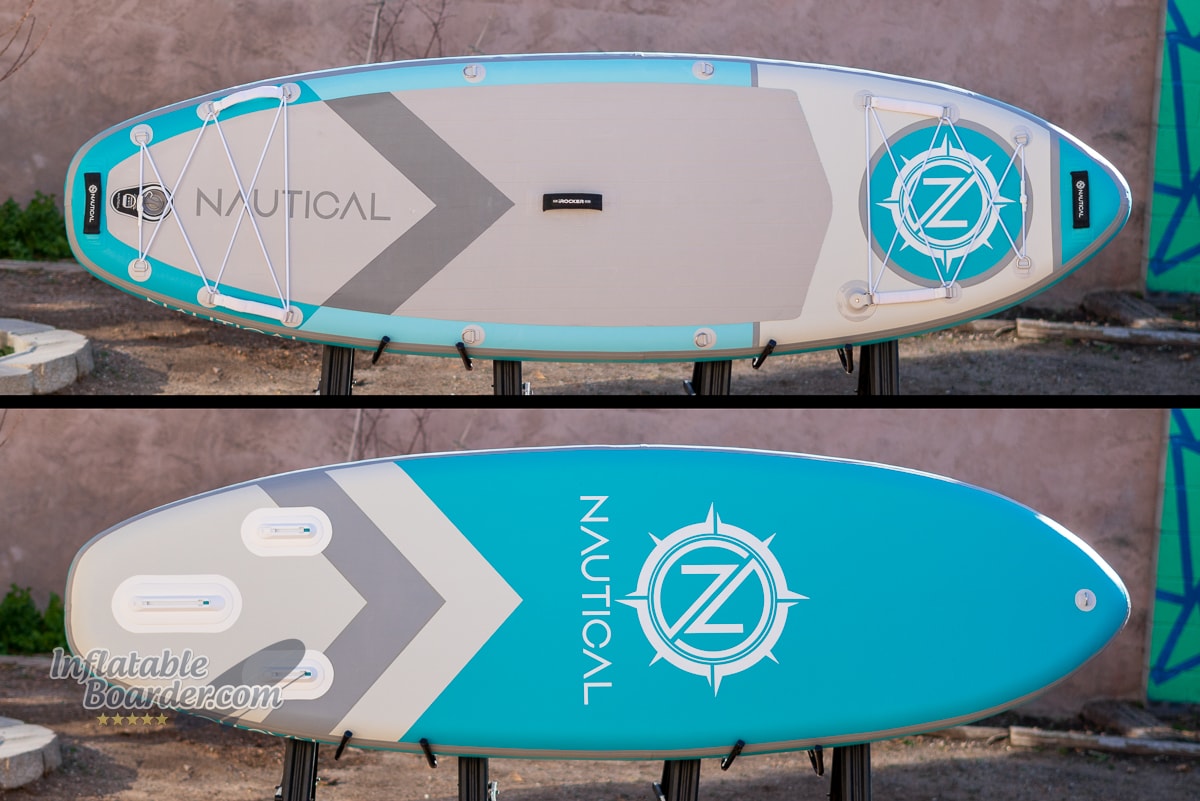
iRocker Nautical 10'8" Inflatable Stand Up Paddle Board
Learning Curve: Easy
$359.99
Difficulty: 1/5
Why Great for Beginners:
The iRocker Nautical is one of the most popular beginner boards thanks to its exceptional stability, full accessory package, and high build quality. It comes with a fiberglass paddle (much lighter than aluminum), a triple-action pump, and a wheeled backpack that makes carrying a breeze.
✓ Beginner Pros
+Super stable 33-inch width
+High weight capacity (300 lbs)
+Includes fiberglass paddle (lightweight)
+Triple-action pump inflates quickly
+Wheeled backpack for easy transport
✗ Beginner Cons
-Premium price may be overkill for casual users
-Board is slightly heavier (23 lbs)
-Fins are not removable without tools
👍 Best for: Beginners who want the best all-around experience without breaking the bank, and plan to paddle regularly.
👎 Not for: Strict budget shoppers or those who need a compact board for storage.
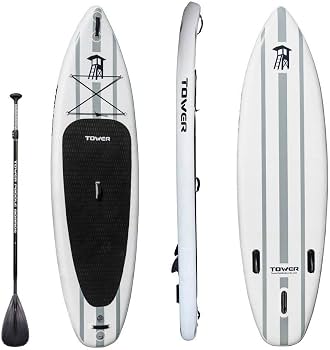
The Tower Adventurer is a premium board that beginners can grow into. It features a sleek design, excellent tracking, and a stiff construction that feels almost like a hard board. The included carbon-fiber paddle is ultra-light, and the backpack is well-padded.
✓ Beginner Pros
+Very rigid construction (firm underfoot)
+Lightweight carbon paddle included
+Excellent tracking for longer paddles
+High-quality bag with shoulder straps
+Comes with a 5-year warranty
✗ Beginner Cons
-High price for a first board
-Narrower than dedicated beginner boards (32 inches)
-May be overkill if you only paddle occasionally
👍 Best for: Beginners with a bigger budget who want a board that will last for years and perform well as skills improve.
👎 Not for: Casual paddlers or those on a tight budget.
Roc Inflatable Stand Up Paddle Board (10'6" x 32" x 6")
Learning Curve: Easy
$279.99
Difficulty: 1/5
Why Great for Beginners:
Roc boards offer a near-perfect balance of price and performance. They are slightly wider than many competitors, making them very stable. The kit includes a decent dual-action pump and a lightweight aluminum paddle. Users rave about the board's stiffness once properly inflated.
✓ Beginner Pros
+Very affordable mid-range option
+Stable and forgiving for new paddlers
+Includes a bungee storage area for gear
+Good customer support from brand
+Lightweight at 17.5 lbs
✗ Beginner Cons
-Pump handle can be uncomfortable
-Paddle is not adjustable for all heights
-Bag lacks padding
👍 Best for: Budget-minded beginners who want a step up from the cheapest boards with better performance.
👎 Not for: Tall paddlers who need a longer paddle shaft (the included one may be short).
📖 Complete Beginner's Guide to Stand-Up Paddleboard
Stand-up paddleboards come in two main types: rigid (hard) and inflatable. For beginners, inflatable SUPs are hands-down the best choice. They are softer if you fall, easier to transport in a car, and simpler to store in an apartment. Rigid boards are lighter and faster but require roof racks and careful handling—more hassle for a newcomer. Within inflatables, look for 'all-around' boards (10-11 feet, 30-33 inches wide) that offer the best stability for flatwater paddling. Avoid narrow 'touring' or 'racing' shapes—they are tippy and hard to control. Beginners should also choose a board with a moderate weight (22-26 lbs) and a comfortable backpack. Many brands bundle a paddle, pump, and leash—these are essential. Be wary of 'extra thick' boards (6 inches versus standard 4-6 inches) as they can be harder to pump but offer more rigidity. The sweet spot for beginners is a 10'6" x 32" x 6" board with 200+ liters volume. And remember: price often correlates with build quality, but even budget boards (under $200) can be great for learning.
🤔 How to Choose Your First Stand-Up Paddleboard
Start by asking yourself: where will you paddle? Calm lakes and bays are best for beginners. Avoid rivers or waves for now. Next, set a realistic budget: $150-250 for a solid starter kit, $300-500 for a board that will last for years. Check the included accessories—good pumps and paddles matter. Read reviews focusing on 'ease of inflation' and 'stability.' If you're heavier (over 200 lbs), opt for a board with higher weight capacity (300+ lbs). Beginners often overlook the paddle: a 3-piece aluminum adjustable paddle is fine, but a fiberglass or carbon shaft is lighter and more comfortable. Finally, consider storage—inflatable boards fit in a closet. Red flags to avoid: no branded pump, missing repair kit, or boards under 6" thickness (they may feel floppy). If possible, watch a video review to see the board being inflated and paddled.
💰 Budget Guide for Beginners
500+
Enthusiast level: Excellent durability, advanced features like multiple fin options, and high-end accessories. Ideal if you know you'll paddle frequently.
150 - $300
Sweet spot: Best value for most beginners. Includes reliable pumps, decent paddles, and stable boards. Many brands offer full kits at this price.
300 - $500
Premium beginner: Higher quality materials, lighter boards, better paddles, and better carrying bags. Boards are stiffer and track straighter.
Under $ - $150
Entry level: Good for casual use and trying the sport. May have lower build quality and heavier accessories. Expect to upgrade if you get hooked.
⚠️ Common Beginner Mistakes to Avoid
Many beginners jump into buying a rigid board because it looks 'cool' or fast. But rigid boards require roof racks, are heavy, and can easily scratch your car. An inflatable is safer and more practical. Another big mistake is choosing a board based solely on price. An ultra-cheap board (under $100) often has poor construction, a small pump, and a weak paddle—making the experience frustrating. Conversely, spending too much on a top-tier board before knowing if you love the sport is wasteful. Beginners also forget to practice inflation. Watching a video on how to properly inflate a board (to the correct PSI) makes a huge difference. Lastly, many assume all paddles are the same. An aluminum paddle is fine, but a fiberglass or carbon one will make your day much more enjoyable. Instead of guessing, read reviews specifically from beginners and consider renting a board first if possible.
×Buying a rigid board first – too hard to transport and store.
×Choosing a board that is too narrow (less than 30 inches) – very tippy.
×Buying a board with too low weight capacity – poor stability.
×Skipping a leash – dangerous and causes frustration when board drifts.
×Buying a kit with a cheap pump – inflation becomes a workout.
×Overlooking the paddle quality – heavy paddle tires you out quickly.
×Not checking the board's thickness (6 inches is standard; 4-5 inches feel floppy).
×Ignoring local conditions – a long touring board is bad for small lakes.
📈 Your Progression Path: Beginner to Intermediate
Start by paddling on calm, flat water—a lake or protected bay. Focus on balancing and learning to stand from a kneeling position. Work on smooth paddling strokes and steering. Once you can paddle straight for 30 minutes without falling, try small chop or gentle currents. Consider swapping the included fin for a larger one for better tracking. After 10-15 sessions, you might want a lighter paddle and a better pump. When you feel limited by your board's speed or stability in mild waves, it's time to consider an upgrade to a longer touring or hybrid board. Most beginners stay with their first board for 1-2 seasons. Signs you've outgrown it: you want to go faster, paddle offshore, or try yoga on the board. For progression, focus on technique: learn a proper forward stroke, cross-bow turn, and bracing. Join a local SUP group or take a lesson. Remember, paddleboarding is a lifelong sport—enjoy the journey!
🎯 Bottom Line: Our Recommendations
For most beginners, the iRocker Nautical 10'8" (around $360) strikes the perfect balance of stability, quality, and value. If your budget is tighter, the SereneLife board ($170) will still get you out on the water without worry. Those who want the best and plan to paddle often should invest in the Tower Adventurer ($600). Regardless of choice, remember to get a leash, a repair kit, and perhaps knee pads. Don't overspend on accessories until you know you love the sport. Your first board is a tool for learning—focus on having fun and staying safe. Once you find your balance, the world of SUP opens up. So pick a board, inflate it, and hit the water. You'll be glad you did!
❓ Frequently Asked Questions
The best beginner SUP is an inflatable all-around board between 10' and 11' long, at least 32 inches wide, with a full accessory kit. Our top pick is the iRocker Nautical 10'8" for its stability and quality. For budget, the SereneLife board is excellent.
Plan to spend between $150 and $400 for a reliable inflatable SUP kit. Under $150 may compromise quality. Over $500 is fine if you have the budget, but not necessary to start.
Beginners need a wide deck (30+ inches), a soft traction pad, a reliable pump (dual-action or triple-action), a coiled leash, and an adjustable paddle. Inflatable construction is recommended.
The easiest boards are those with a wide width (33 inches) and a soft deck pad. The iRocker Nautical and Roc boards are very beginner-friendly due to their stability and easy inflation.
Essential: a coiled leash, a repair kit, a pump (included with most boards), and an adjustable paddle. Nice-to-have: paddle gloves and a knee pad for comfort.
Start by considering your budget and where you'll paddle. Choose an inflatable all-around board 10-11 feet long. Read reviews for stability and ease of inflation. Ensure the kit includes a leash and pump.
SUP is easy to learn but takes practice to master. Most beginners can stand up and paddle within a few tries on calm water. Inflatable boards make falls safer and learning less intimidating.
Common mistakes: buying a rigid board first, choosing too narrow a board, skipping a leash, buying a cheap pump, and not inflating the board to the correct PSI (12-15 PSI).
You can learn the basics in one session. Becoming comfortable and able to paddle for an hour without falling may take 3-5 sessions. Regular practice accelerates progress.
Yes, but calm ocean conditions (small waves, no current) are best for beginners. Start on lakes or protected bays. Inflatables are suitable for ocean use but avoid strong currents.